
OAT Physics Practice Test 2026 Untimed with Explanation
$69.00
- Buy to unlock unlimited access to all Quiz questions.
- After purchase you can print a PDF of the whole quiz at any point. The PDF will contain the questions and the correct answers.
About this Exam
The Optometry Admission Test (OAT) is a standardized examination designed to measure the general academic ability and comprehension of scientific information required for admission to optometry schools. The Physics section is one of four subtests within the OAT (the others being the Survey of the Natural Sciences, Reading Comprehension, and Quantitative Reasoning). It is designed to evaluate an applicant’s understanding of fundamental physics principles, which are crucial for the coursework in an optometry program. Taking a comprehensive, untimed practice test with explanations is an invaluable step for students aiming to familiarize themselves with the question formats, identify knowledge gaps, and build the confidence needed for test day.
Ready to test your knowledge?
Buy Now to Access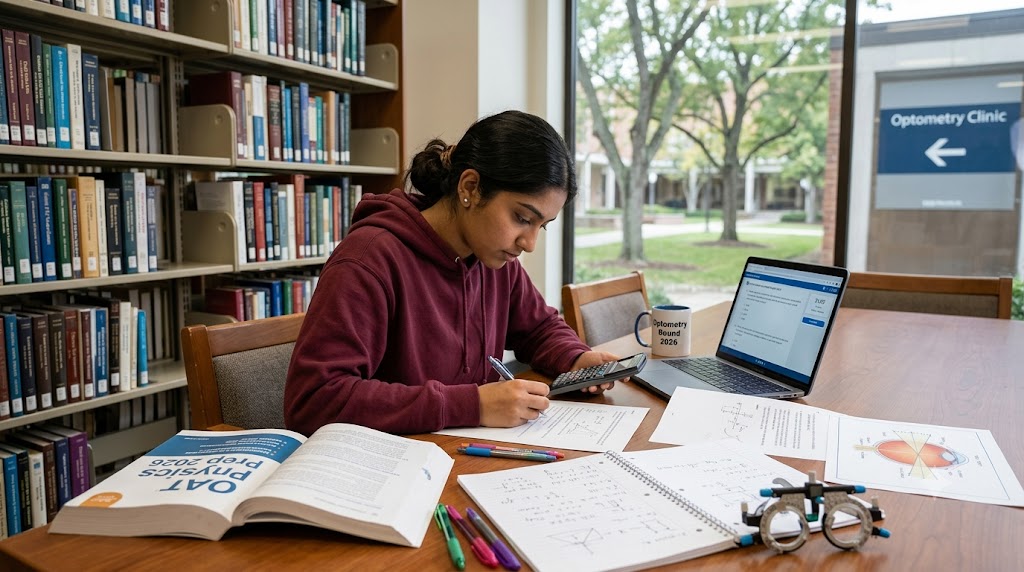
Additional Information
What the Course Entails and Exam Details
The OAT Physics section assesses mastery of topics typically covered in a year-long undergraduate, non-calculus-based physics sequence. While the questions are often conceptual and require solving problems using formulas, the primary focus is on understanding underlying principles and applying scientific reasoning.
The core areas covered in the OAT Physics syllabus include:
Units and Vectors: Measurement systems, significant figures, vector addition/subtraction, and component resolution.
Kinematics: Displacement, velocity, acceleration, and motion in one and two dimensions (projectile motion).
Dynamics: Newton’s Laws of Motion, force, friction, and uniform circular motion.
Work, Energy, and Power: Work-energy theorem, kinetic and potential energy, conservation of energy, and power.
Linear Momentum: Impulse, momentum, conservation of linear momentum, and collisions (elastic and inelastic).
Rotational Motion: Torque, angular kinematics, rotational equilibrium, and rotational inertia.
Properties of Matter: Density, specific gravity, pressure in fluids, Archimedes’ principle, and Pascal’s principle.
Thermodynamics: Temperature scales, thermal expansion, heat transfer (conduction, convection, radiation), calorimetry, Laws of Thermodynamics, and ideal gases.
Electrostatics and Electricity: Coulomb’s Law, electric field, electric potential, capacitance, Ohm’s Law, resistance, and DC circuits (series and parallel).
Optics: Reflection, refraction (Snell’s Law), mirrors, lenses, and thin lens equation. This section is particularly relevant to optometry.
Waves and Acoustics: Wave properties (amplitude, frequency, wavelength, speed), superposition, interference, and the Doppler effect.
Modern Physics: Atomic structure, energy levels, photoelectric effect, and radioactivity.
What to Expect in the Final Exam
The actual OAT is a computer-based standardized test administered by Prometric testing centers. During the official, timed examination, the Physics section consists of 40 multiple-choice questions.
You are allotted exactly 50 minutes to complete this section. This works out to just over one minute per question, making time management a critical skill on test day.
Unlike some other standardized tests, the OAT does not provide a formula sheet; therefore, memorization and fluent application of key physics formulas are required. No calculator is permitted for the Physics section, though a basic four-function calculator is provided on the computer screen during the Quantitative Reasoning section only.
The total OAT score ranges from 200 to 400. There is no penalty for guessing, so you should answer every question.
How to Study and Exam Centers
Effective preparation for the OAT Physics section requires a balance of reviewing content and practicing problem-solving.
Actionable Study Strategies:
Review the Fundamentals: Start with a reliable non-calculus physics textbook or comprehensive OAT prep books. Focus on understanding the conceptual basis for physical laws.
Master Key Formulas: Create flashcards for all essential physics equations. You must be able to recall them quickly.
Practice Consistently: Solve as many practice problems as possible. Start untimed to focus on accuracy, but transition to timed practice to build speed.
Analyze Your Mistakes: When taking practice tests, meticulously review the detailed explanations for every question you missed or guessed on. Understand why the correct answer is correct and why yours was incorrect.
Focus on Optics and Light: Since these topics are foundational to optometry, make sure you are exceptionally comfortable with the optics questions (lenses, mirrors, refraction, eye anatomy/vision correction).
Take Full-Length Practice Exams: Simulate the real testing experience by taking full-length, timed OAT practice tests to build endurance and refine your overall test-taking strategy.
How to Take the OAT and Exam Centers:
The OAT is administered year-round at Prometric test centers throughout the United States, its territories, and Canada. To take the OAT, you must first register with the American Dental Association (ADA), which develops and administers the exam on behalf of the Association of Schools and Colleges of Optometry (ASCO). After obtaining a DENTPIN and registering for the exam, you can schedule your test appointment at a convenient Prometric location through their website.
Job Opportunities from the Course
Successfully preparing for and passing the OAT is the essential first step toward admission to an optometry program. Upon completion of a four-year Doctor of Optometry (O.D.) degree and obtaining state licensure, multiple career paths become available. This preparation unlocks the specific role of:
Optometrist (Doctor of Optometry)
Within the field of optometry, professionals can pursue various specializations and practice settings, including:
Primary Eye Care Provider
Pediatric Optometrist
Geriatric Optometrist
Contact Lens Specialist
Low Vision Rehabilitation Specialist
Vision Therapy/Binocular Vision Specialist
Ocular Disease Specialist (specializing in conditions like glaucoma or diabetic retinopathy)
Optometrist in a Corporate or Group Practice
Optometrist in a Hospital or Multispecialty Clinic
Academic or Research Optometrist
Preparing for the OAT Physics section is rigorous, but a systematic approach will help you achieve the competitive score needed for optometry school admission. Good luck!
Frequently Asked Questions
Reviews
5.0
Based on 0 reviews
Leave a Review
No reviews yet. Be the first to review!