
NREMT EMS Operations Practice Test 2026
$69.00
- Buy to unlock unlimited access to all Quiz questions.
- After purchase you can print a PDF of the whole quiz at any point. The PDF will contain the questions and the correct answers.
About this Exam
The National Registry of Emergency Medical Technicians (NREMT) cognitive exams (for EMT, AEMT, and Paramedic levels) are a vital step toward becoming a certified and licensed EMS professional.
The NREMT EMS Operations domain is a critical component across all levels of the cognitive examination, focusing on the fundamental principles of managing an emergency scene and vehicle operations safely and effectively.
This practice guide is specifically designed for students preparing for the official NREMT cognitive exam in 2026, offering a comprehensive and realistic practice experience aimed directly at mastering the Operations section.
The knowledge covered in EMS Operations ensures that providers can not only deliver patient care but also navigate the entire response process safely, from the initial dispatch to the final documentation and vehicle restock.
Strong competence in this area is not just about passing the test; it is about protecting yourself, your crew, your patients, and the public.
Whether you are aiming for your initial EMT certification or advancing to a higher level, this practice guide provides the targeted study you need for the crucial Operations portion of your NREMT cognitive exam.
Ready to test your knowledge?
Buy Now to Access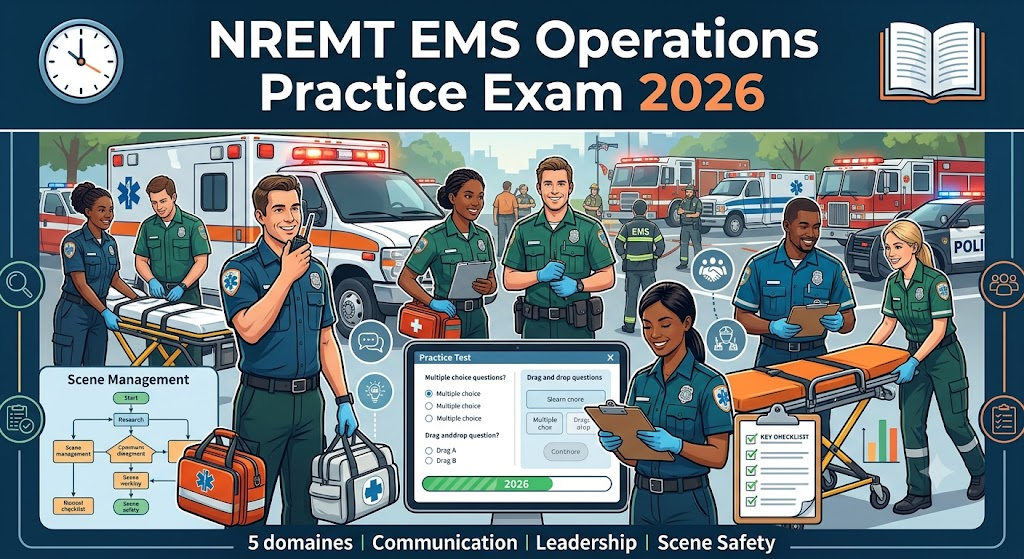
Additional Information
What the Course Entails and Exam Details
The EMS Operations content for the NREMT exam and this practice guide encompasses a broad spectrum of logistical, safety, and managerial topics crucial for any EMS professional.
By working through this material, you are developing skills and knowledge that are applied daily in the field.
Key areas covered include:
Scene Size-Up and Safety: Identifying hazards, managing bystanders, calling for appropriate resources, and ensuring continuous scene safety.
Vehicle Operations and Ambulance Standards: Proper ambulance driving techniques, safety standards, and vehicle checks.
Incident Command and Multi-Casualty Incidents (MCI): Understanding the incident command structure, triage principles, and effective resource management in large-scale events.
Communication: Effective radio communication, documentation (patient care reports), and crew resource management.
Medical Research and Evidence-Based Practice: The importance of research and applying proven data to modern EMS operations.
Documentation and Patient Care Reports: The legal, clinical, and logistical significance of clear and accurate PCRs.
Legal and Ethical Issues in EMS Operations: Confirmed competence on relevant federal, state, and local laws/regulations.
Crew Resource Management (CRM): Maximizing team performance and minimizing errors through strong teamwork.
The official NREMT cognitive exam overall uses a dynamic format, and the EMS Operations questions follow suit.
Your practice experience with this guide should mimic the diversity and rigor you will face, helping you develop critical thinking and decision-making skills.
What to Expect in the Final Exam
It is essential to understand the structure of the final, official NREMT cognitive exam you are preparing for.
While this practice guide is an excellent tool for mastering the specific content, the format of the official exam is a Computer Adaptive Test (CAT).
CBT/CAT Format and Questions:
Adaptive Nature: The NREMT cognitive exam is a CAT, meaning the difficulty and number of questions you see will adjust in real-time based on your previous answers. The exam will continue until the computer is 95% confident in your ability relative to the entry-level competency standard or until you reach the maximum number of questions or time limit.
Diverse Question Types: Expect more than just standard multiple-choice questions. The exam incorporates Technology Enhanced Items (TEIs), including:
Multiple-choice (traditional format)
Drag-and-Drop: Categorize items, symptoms, or actions.
Build-List: Prioritize steps or treatments in order.
Checklist/Grid: Indicate all applicable options.
(Paramedic level only) Clinical Judgment simulations.
The EMS Operations section typically makes up about 10% to 14% of the EMT level cognitive exam.
For Paramedic candidates, Operations questions are presented alongside multiple other advanced domains.
Time Limit and Passing Standard:
The time limit for the official cognitive exam depends on your level of certification:
EMT: Approximately 2 hours.
Paramedic: Approximately 3.5 hours.
(Note: These are estimates for the entire exam, which includes all sections.)
Passing Score: The NREMT does not provide a simple percentage passing score. Results are scored against a national entry-level competency standard. Your final performance is reported on a scale from 100-1500, where 950 usually indicates the passing point.
Rules: Prohibited items, strict identification requirements, and adherence to the NDA are standard procedures at all Pearson VUE testing centers.
How to Study and Exam Centers
Effective preparation is key. Leverage the following actionable strategies to ensure success in the NREMT EMS Operations domain and your overall cognitive exam:
Actionable Study Strategies:
Utilize Core Textbooks: Use your official EMT or Paramedic textbook (e.g., AAOS Emergency Care and Transportation). Dedicate significant study time to the specific chapters on EMS Operations. Read, highlight, and take detailed notes.
Regular Practice Questions: Make practice questions your most powerful tool. Consistently work through a high volume of NREMT-style questions, including those in this guide. Do not just look for the correct answer; analyze why correct answers are correct and, just as importantly, why the other options are wrong. Look for full CAT-simulated practice tests for the complete exam experience.
Active Learning Techniques:
Create detailed flashcards for key terms, procedures, and rules (triage levels, vehicle standards, etc.).
Engage with a study group. Discussing scenarios and teaching concepts to others reinforces your own understanding.
Utilize local/state protocols and guidelines. While the exam tests general principles, knowing standard practices is vital.
Hands-on/Clinical Reinforcement: Connect cognitive knowledge with practical skills. Reflect on scene safety and operational aspects during clinical rotations and hands-on training. How did we ensure safety on that call? Was triage handled effectively?
Simulate Exam Conditions: For practice tests, time yourself, minimize distractions, and practice with diverse question types.
Exam Centers and How to Register:
The final NREMT cognitive exam must be taken through an authorized Pearson VUE testing center or via their online proctoring option. The process involves:
Complete Coursework: Finish your state-approved EMT or Paramedic program.
Register with NREMT: Create or log in to your account on the official NREMT website and complete the application.
Pay Fee & Get ATT: Pay the application fee and receive your Authorization to Test (ATT) letter, which confirms your eligibility.
Schedule with Pearson VUE: Use the information in your ATT to schedule your specific date and time with a authorized Pearson VUE testing center in your location. The ATT will have a link and clear instructions. Pearson VUE has numerous physical testing sites, and you can also select the online proctored option if you meet the requirements.
Job Opportunities from the Course
A strong performance on the NREMT exam and mastering EMS Operations knowledge is essential for unlocking a diverse range of rewarding careers.
The certification itself serves as the national standard and is recognized across the United States.
Your competence in Operations prepares you for the critical responsibilities that come with every role in the emergency medical services field.
Potential job titles and career paths for successful NREMT certificants include:
Emergency Medical Technician (EMT): Entry-level EMS professional, providing basic life support and safe patient transport.
Advanced EMT (AEMT): Certified to perform select advanced skills in addition to basic care.
Paramedic: Highest level of pre-hospital provider, certified to provide advanced life support, administer medications, and manage complex cases.
Flight Paramedic / Flight Medic: Provides critical care in an aviation environment, responding to complex scenes and high-risk transports.
Critical Care Transport Paramedic (CCT-P): Specializes in the inter-facility transport of unstable or critically ill patients.
EMS Supervisor or Manager: Leads and manages a team of EMS providers, ensuring operational efficiency and high-quality care.
Emergency Room Technician: Applies EMS knowledge and skills within a hospital emergency department setting.
Emergency Dispatcher (relevant knowledge): EMS knowledge can enhance efficiency in dispatch roles, particularly in communicating effectively with responders.
Industrial / Contract Medic: Provides medical care and manages dynamic safety issues in specific job sites or remote locations (e.g., construction sites, dynamic scene events, off-shore platforms).
Tactical Paramedic / Rescue Medic: Integration with law enforcement or specialized rescue units, providing care and tactical operational support.
Health and Safety Officer: (Within larger EMS systems) Evaluates procedures, reduces risks, and ensures compliance.
This is a growing field with robust demand across public agencies, private ambulance services, fire departments, hospital systems, and private industry.
Success in this area isn't just about a job title; it's about being an expert in safe, efficient, and life-saving operations every single day.
Frequently Asked Questions
Reviews
5.0
Based on 0 reviews
Leave a Review
No reviews yet. Be the first to review!