
NREMT Cardiology & Resuscitation Practice Test 2026
$69.00
- Buy to unlock unlimited access to all Quiz questions.
- After purchase you can print a PDF of the whole quiz at any point. The PDF will contain the questions and the correct answers.
About this Exam
The NREMT Cardiology & Resuscitation Practice Test is a crucial, high-stakes assessment designed for Emergency Medical Technicians (EMTs), Advanced EMTs (AEMTs), and Paramedics aiming to achieve National Registry certification or maintain their licensure. This specific domain is a cornerstone of emergency medical care, as cardiovascular emergencies remain a leading cause of morbidity and mortality. This exam is meticulously crafted to ensure that candidates possess the critical knowledge, clinical reasoning, and decision-making skills required to manage acute cardiac conditions and lead resuscitation efforts effectively in the field. Passing this section is not just a regulatory hurdle; it is a validation of your ability to save lives when every second counts.
Ready to test your knowledge?
Buy Now to Access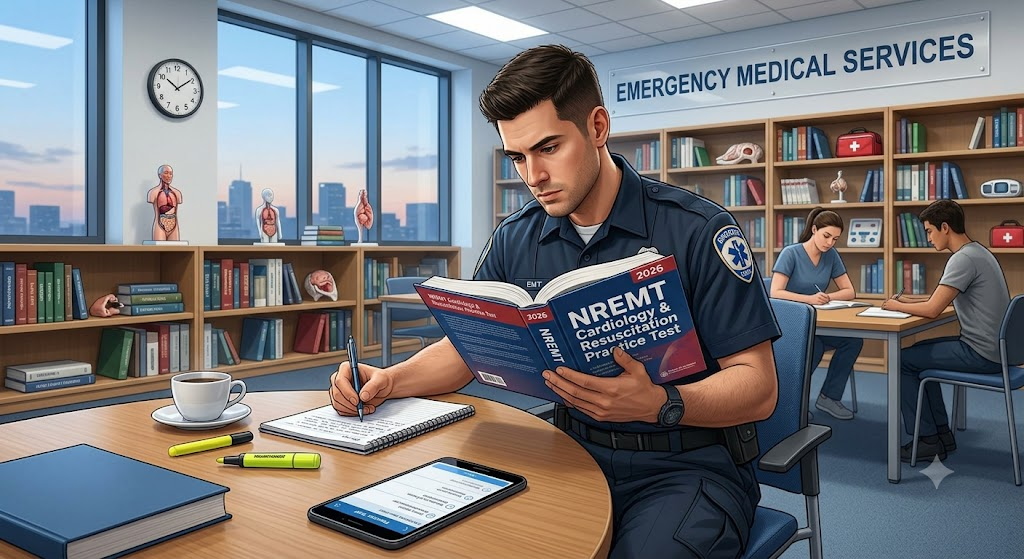
Additional Information
What the Course Entails and Exam Details
This section of the NREMT curriculum is comprehensive and demands a deep understanding of both theoretical concepts and practical applications. The core topics covered in the Cardiology & Resuscitation domain include:
Anatomy and Physiology of the Cardiovascular System: A detailed understanding of heart structure, electrical conduction, blood flow, and hemodynamics.
Pathophysiology of Cardiac Emergencies: Recognizing and understanding the underlying mechanisms of conditions such as Acute Coronary Syndrome (ACS), Myocardial Infarction (MI), Angina, Heart Failure, and Hypertensive Emergencies.
Cardiac Arrest Management: Comprehensive mastery of Basic Life Support (BLS) and Advanced Cardiovascular Life Support (ACLS) protocols, including high-quality CPR, defibrillation, and post-resuscitation care.
Arrhythmia Recognition and Management: The ability to accurately interpret basic and advanced ECG rhythms (static and dynamic) and implement appropriate pharmacological and electrical interventions (e.g., synchronized cardioversion, transcutaneous pacing).
Pharmacology: Detailed knowledge of indications, contraindications, dosages, and administration routes for key cardiac medications like Oxygen, Aspirin, Nitroglycerin, Epinephrine, Amiodarone, and Adenosine.
Special Populations: Considerations for cardiac management in pediatric, geriatric, and bariatric patients.
What to Expect in the Final Exam
The NREMT utilizes a Computerized Adaptive Testing (CAT) model for the cognitive exam. This means the test adapts its difficulty to your ability level. You should not expect a fixed number of questions in this domain, but rather a variable number between 18–22% of the total exam questions, focusing specifically on Cardiology & Resuscitation.
Format: The exam consists of multiple-choice questions, but they are often scenario-based and require critical thinking, rather than simple recall. Many questions are considered "high-level" applications of knowledge.
Time Limits: You are given a strict time limit for the entire NREMT cognitive exam (e.g., up to 2 hours for EMT, up to 2.5 hours for AEMT, and up to 3.5 hours for Paramedic). There is no specific time breakdown per domain, so time management is crucial.
Passing Score Requirements: There is no specific "score" like 70% that guarantees a pass. The CAT format determines passing based on whether you can consistently answer questions just above the minimal entry-level competency standard with a specified 95% level of confidence.
Specific Rules: You are not allowed to go back to previous questions; you must answer the question presented to you to move forward. The exam can end abruptly as soon as the CAT algorithm determines with high statistical certainty that you are either above or below the passing standard.
How to Study and Exam Centers
Preparation for the NREMT Cardiology & Resuscitation domain must be multifaceted, combining rigorous study with practical application.
Actionable Study Strategies:
Utilize the Practice Test: Use the 2026 Practice Test as your primary assessment tool. Take it multiple times to identify your weak areas in rhythm recognition, protocol knowledge, or pharmacology. Focus your study efforts on these specific gaps.
Master BLS/ACLS Guidelines: Memorize the current American Heart Association (AHA) Guidelines for CPR and ECC. Know the algorithms cold.
ECG Practice: Use dynamic ECG simulators online to practice real-time rhythm identification and intervention. Static rhythm strips are a good start, but dynamic practice is essential.
Scenario-Based Study: Create or utilize scenario-based study guides. When you see a patient presentation (e.g., crushing chest pain), immediately think through your differential diagnosis, assessment steps, and immediate treatment plan.
Active Recall and Spaced Repetition: Use flashcards (digital or physical) for pharmacology and protocol dosages to ensure long-term retention.
Exam Centers:
The NREMT cognitive exam is not taken at your school or online from home. It is administered strictly at authorized Pearson VUE testing centers. These centers are highly secure and provide a standardized testing environment. When you receive your Authorization to Test (ATT) letter from the NREMT, you must create a Pearson VUE account and schedule your exam at a convenient physical location. Some states may have a limited number of authorized schools that also act as Pearson VUE select sites. Ensure you arrive early and bring two forms of valid identification, as required by the center's security protocols.
Job Opportunities from the Course
Mastery of Cardiology & Resuscitation is central to any role in Emergency Medical Services (EMS). Achieving National Registry certification unlocks a wide range of career opportunities across the country:
Emergency Medical Technician (EMT-Basic)
Advanced EMT (AEMT)
Paramedic (NRP)
Flight Paramedic / Critical Care Paramedic
Firefighter/EMT or Firefighter/Paramedic
Tactical Medic (Law Enforcement Support)
Industrial/Remote Medic (e.g., Oil Rigs, Mining)
Emergency Room Technician
Community Paramedic / Mobile Integrated Healthcare Provider
Frequently Asked Questions
Reviews
5.0
Based on 0 reviews
Leave a Review
No reviews yet. Be the first to review!