
New York CDL Double/Triple Trailers Practice Test
$69.00
- Buy to unlock unlimited access to all Quiz questions.
- After purchase you can print a PDF of the whole quiz at any point. The PDF will contain the questions and the correct answers.
About this Exam
The New York CDL Double/Triple Trailers knowledge test is an essential endorsement exam for Commercial Driver's License (CDL) holders who wish to operate combinations of two or three trailers. This endorsement (T) is required for drivers looking to maximize their hauling capacity and expand their opportunities in the heavy transportation sector.
The exam is designed for experienced commercial drivers who already hold a Class A CDL or are in the process of obtaining one and want to specialize in pulling multiple-trailer combinations. This certification ensures that drivers possess the specific knowledge and safety awareness necessary to handle the unique stability and maneuvering challenges of longer vehicle combinations on New York roads.
Ready to test your knowledge?
Buy Now to Access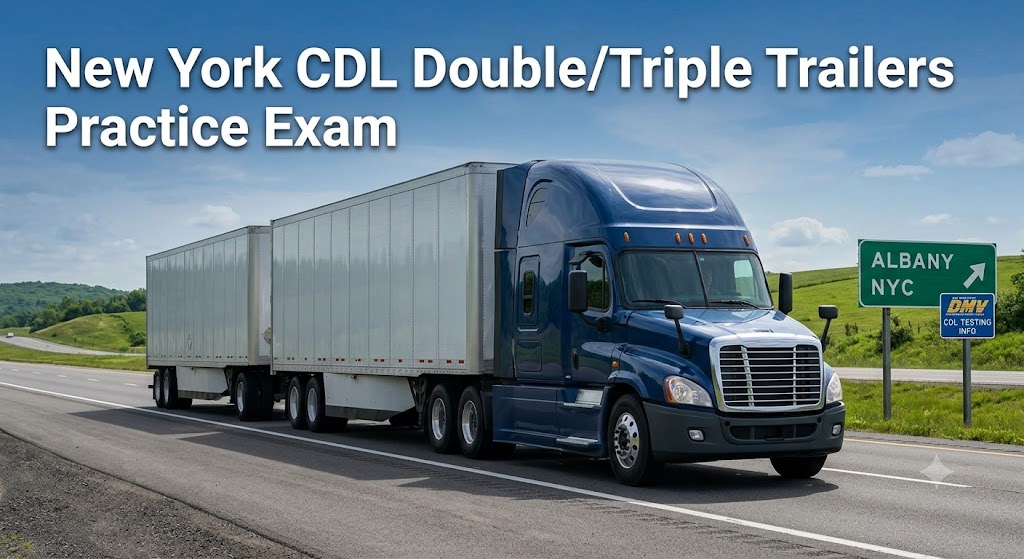
Additional Information
What the Course Entails and Exam Details
To prepare for this endorsement, you must master several specialized operational concepts and safety procedures. The examination covers critical technical skills that distinguish multiple-trailer operations from single-trailer combinations.
Key areas of focus include:
Coupling and Uncoupling Procedures: A detailed understanding of the step-by-step process for connecting the tractor to the first trailer, and subsequently, connecting the second (and third) trailer using a converter dolly. Mastering the correct order of operations and safety checks is crucial.
Inspection Techniques: How to conduct thorough pre-trip and en-route inspections specific to doubles and triples, checking the converter dolly, air lines, pintle hooks, and ensuring all locking mechanisms are secure.
Handling Characteristics: Understanding the specific stability challenges, such as the "crack-the-whip" effect, where rear trailers are prone to swaying or rolling over during sudden turns or lane changes. Drivers must learn how to manage speed and make smooth steering inputs.
Air Brake Systems for Combinations: Knowledge of how the air brake system operates throughout multiple trailers, ensuring proper air pressure management and testing the emergency brakes on all trailers.
What to Expect in the Final Exam
The final New York CDL Double/Triple Trailers exam is a computerized knowledge test administered at local DMV offices. Unlike the initial CDL skills test, this endorsement typically requires only a written theory exam, although you must already possess the foundational skills required for a Class A license.
Exam Format: The test consists of multiple-choice questions based on the material in the Doubles and Triples section of the New York State CDL Manual.
Number of Questions: The exam usually contains around 20 to 30 questions, depending on the current DMV standard.
Passing Score: Drivers must achieve a score of at least 80% to pass and receive the endorsement.
Time Limit: While there isn't typically a strict, ticking clock for the knowledge tests, you are expected to complete the exam within a reasonable timeframe (usually under an hour).
How to Study and Exam Centers
Preparation is vital for passing this specialized knowledge test. Follow these actionable strategies to ensure success:
Study the Official Manual: Your primary resource should be the New York State CDL Manual (Form MV-500C). Dedicate significant time to studying Section 7, which covers Doubles and Triples, in detail.
Use Practice Tests: Online practice tests are highly effective for identifying knowledge gaps. Take multiple practice exams that specifically simulate the NY DMV Doubles/Triples endorsement test questions.
Take the Exam: When you are ready, you must take the knowledge test in person at an authorized New York State DMV office. It is recommended to check the DMV website (dmv.ny.gov) to find a location that offers CDL knowledge testing and to make an appointment.
Job Opportunities from the Course
Obtaining the T endorsement significantly enhances a Class A driver's employability, opening doors to specialized roles in high-volume freight transport.
This certification unlocks the following career paths:
Long-Haul Truck Driver (Doubles/Triples)
Line-Haul Driver
Freight Transport Specialist
Regional Freight Driver
LTL (Less-Than-Truckload) Combination Driver
These roles often offer higher pay potential and more consistent routes compared to standard single-trailer operations due to the increased productivity of hauling multiple trailers.
Frequently Asked Questions
Reviews
5.0
Based on 0 reviews
Leave a Review
No reviews yet. Be the first to review!