
New Jersey CDL Practice Test
$69.00
- Buy to unlock unlimited access to all Quiz questions.
- After purchase you can print a PDF of the whole quiz at any point. The PDF will contain the questions and the correct answers.
About this Exam
The New Jersey Commercial Driver's License (CDL) is the gateway to a wide range of rewarding careers in the transport industry. This license is required to operate heavy or specialized vehicles in the state, including big-rig trucks, passenger buses, combinations, and vehicles carrying hazardous materials.
A New Jersey CDL Practice Test is a critical study tool designed specifically to help aspiring commercial drivers prepare for the initial step in the licensing process: passing the mandatory knowledge (written) exams administered by the New Jersey Motor Vehicle Commission (MVC). By simulating the actual test environment and question formats, this practice exam empowers students to build confidence, identify knowledge gaps, and master the complex regulations and safety practices required for safe commercial operation.
Ready to test your knowledge?
Buy Now to Access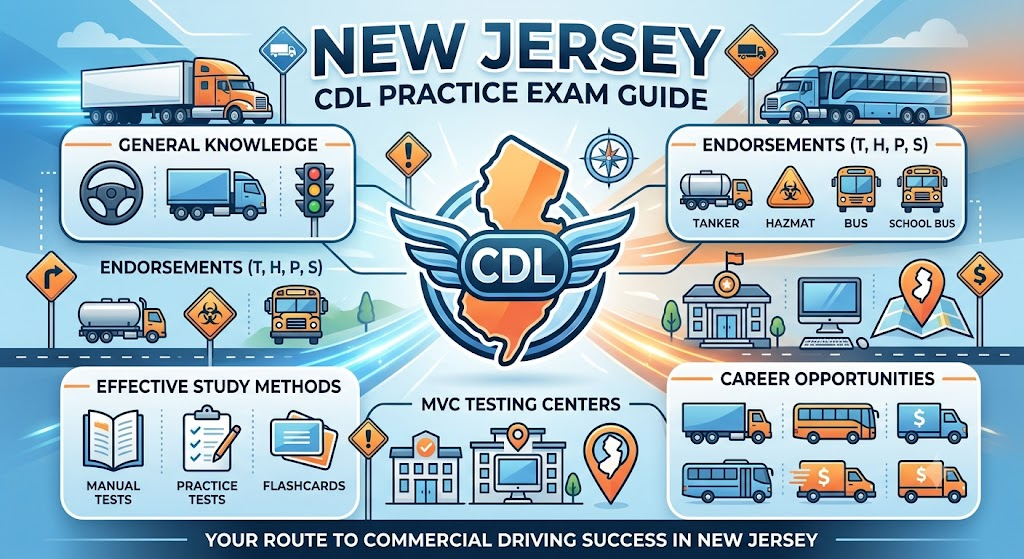
Additional Information
What the Course Entails and Exam Details
Preparing for the NJ CDL knowledge exams involves a deep understanding of the Official New Jersey CDL Manual. A comprehensive practice test mirrors the curriculum, covering a diverse array of essential topics that form the foundation of professional commercial driving.
The core domains of a quality study guide and practice test include:
General Knowledge: This foundational test is required for all CDL classes. Topics cover vehicle control, shifting gears, defensive driving, safe merging, backing, night driving, hot and cold weather operation, railway crossings, anti-lock braking systems (ABS), vehicle inspections (pre-trip, en-route, post-trip), cargo securement, emergency procedures, and basic hazardous materials regulations.
Air Brakes: Necessary if you operate a vehicle with air brakes. It covers the parts of an air brake system, proper usage, and inspection of air brakes.
Combination Vehicles: Required for a Class A CDL. This section details safety concepts for pulling a trailer, including coupling and uncoupling, and the unique dynamics of combinations.
Endorsement-Specific Topics: Practice tests also offer modules for specific endorsements, such as Tanks (N), Hazardous Materials (H), Doubles/Triples (T), Passenger (P), and School Bus (S), each with unique rules, regulations, and safety requirements.
What to Expect in the Final Exam
When you are ready for the actual knowledge tests at an NJ MVC agency, you will face a structured, computerized exam. While the experience may vary slightly by location, here is what you can typically expect for the multiple-choice written tests:
Format: Computer-based, using multiple-choice and true/false questions.
Question Distribution: The core General Knowledge test consists of approximately 50 questions. For each additional endorsement you seek, such as Air Brakes, Combinations, or HazMat, you will take a separate test, usually containing between 20 and 30 questions.
Passing Score: You must answer at least 80% of the questions correctly on each test you take. For General Knowledge, this means correctly answering at least 40 out of 50 questions.
Time Limits: While there is typically not a strict, universal time limit, the tests are designed to be completed within a reasonable timeframe, often and varying from 60 to 90 minutes.
Testing Rules: These are closed-book exams. No external resources, cell phones, or study materials are permitted. If you fail, a mandatory waiting period (currently 7 days) applies before you can re-take the test.
How to Study and Exam Centers
Successfully passing the NJ CDL written tests demands dedication and a layered study approach. The key to success is combining conceptual understanding with rigorous practice.
Primary Source: The Official NJ CDL Manual. Start by thoroughly reading and summarizing the content, which is available for download on the official NJ MVC website or at any physical agency.
Layer 2: Consistent Practice Tests. Use New Jersey-specific practice tests as your main training tool. Focus not just on memorizing answers, but on understanding why a particular answer is correct. Repetition is essential for memory retention.
Layer 3: Target Weak Areas. After each practice test, review your results and concentrate your study efforts on the specific topics where you struggled.
Layer 4: Utilize Study Tools. Break down the material using flashcards for key terms, definitions, and inspection sequences.
Exam Centers: To take the official NJ CDL knowledge test, you must visit a physical New Jersey Motor Vehicle Commission (MVC) Agency that offers commercial driver licensing services. Appointments are required for CDL testing. You can schedule your test receipt and appointment on the official NJMVC website. Make sure to bring your "6 Points of ID" and a current medical certificate as part of the initial CLP (Commercial Learner's Permit) application process.
Job Opportunities from the Course
Earning a New Jersey Commercial Driver's License unlocks a wide range of diverse and well-paying career paths across many sectors of the economy. The exact type of jobs you qualify for will depend on your specific class of license (Class A, B, or C) and the endorsements you hold.
The job opportunities unlocked by a CDL include:
Over-the-Road (OTR) Truck Driver (Class A)
Regional or Local Delivery Driver (Class A or B)
Construction Vehicle Operator (e.g., dump trucks, concrete mixers) (Class A or B)
School Bus Driver (Class B with P and S endorsements)
Transit or Charter Bus Driver (Class B with P endorsement)
Hazardous Materials Transport Driver (e.g., fuel tanker, chemical transport) (Class A or B with X/H endorsements)
Owner-Operator (Class A)
Heavy Equipment Hauler (Class A)
Sanitation Truck Driver (Class B)
Airport Ground Support Vehicle Driver (Class A or B)
Frequently Asked Questions
Reviews
5.0
Based on 0 reviews
Leave a Review
No reviews yet. Be the first to review!