
New Hampshire CDL General Knowledge Practice Test 3
$69.00
- Buy to unlock unlimited access to all Quiz questions.
- After purchase you can print a PDF of the whole quiz at any point. The PDF will contain the questions and the correct answers.
About this Exam
The New Hampshire CDL General Knowledge exam is the mandatory foundational written test for any aspiring commercial driver in the Granite State.
This test evaluates your comprehensive understanding of essential safety regulations, driving techniques, and equipment management required to operate large vehicles safely.
Passing this exam is the critical first step needed to obtain your Commercial Learner's Permit (CLP), allowing you to begin behind-the-wheel training.
Whether you intend to drive tractor-trailers, local delivery trucks, or passenger buses, mastering the general knowledge component is required before adding specific endorsements.
It is designed for new drivers or those upgrading from a standard Class D license who seek a career in professional commercial transportation.
Ready to test your knowledge?
Buy Now to Access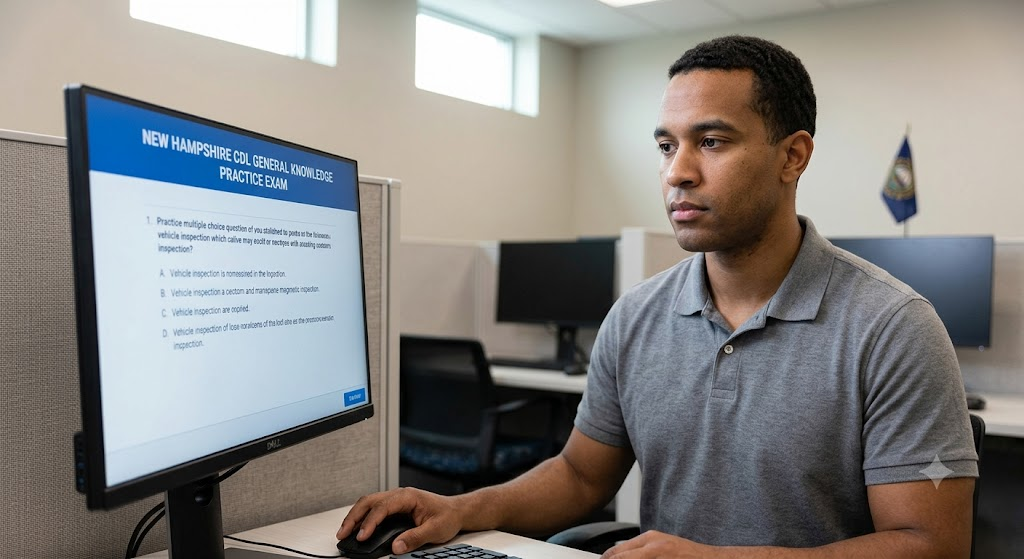
Additional Information
What the Course Entails and Exam Details
Preparing for the New Hampshire CDL General Knowledge domain involves a thorough self-study of the official New Hampshire Commercial Driver's License Manual.
This is not a traditional "course," but rather a dedication to learning the comprehensive rules and safety guidelines detailed by the DMV.
Key topics you must master include comprehensive vehicle inspection procedures (pre-trip, en route, and post-trip) to ensure all equipment is in safe working order.
You will also study basic vehicle control maneuvers, including shifting gears, braking, and proper backing techniques.
A significant portion of the material covers critical safety areas, such as maintaining safe speeds, space management around your vehicle, and communicating effectively with other road users.
Furthermore, you must understand special driving conditions, including night driving, navigating winter weather in New Hampshire, mountain driving, and driving in hot weather.
The curriculum also assesses your knowledge on vital topics such as skid control and recovery, accident procedures, fire safety, and the hazards of driving under the influence of drugs or alcohol.
What to Expect in the Final Exam
The official New Hampshire CDL General Knowledge exam is a computer-based test consisting of multiple-choice questions.
The exam consists of exactly 50 questions, all derived directly from the information provided in the NH CDL Manual.
To pass this section and qualify for your CLP, you must achieve a score of at least 80 percent, which means you need to answer 40 out of the 50 questions correctly.
While the specific time limit can vary slightly between locations, applicants should generally plan for approximately 60 to 90 minutes to complete this extensive test.
This is a closed-book examination; you are not permitted to use any notes, manuals, or external study aids during the testing session.
How to Study and Exam Centers
The single most effective study method is to read the official New Hampshire CDL Manual multiple times, focusing intently on the General Knowledge section.
Since all questions are pulled directly from this source, understanding the concepts presented in the manual is paramount.
Once you have studied the material, utilize interactive online tools like the New Hampshire CDL General Knowledge Practice Test 3 to simulate the testing environment and assess your retention.
Review the questions you miss during practice tests and cross-reference them back to the manual to clarify your understanding of those specific concepts.
When you are ready to take the official exam, you must visit a physical New Hampshire DMV office that handles commercial licensing.
Key NH DMV testing centers are located in Concord, Manchester, and Nashua, though you should verify location specific availability.
It is highly recommended, and often required, to schedule an appointment in advance for the CDL knowledge test through the NH DMV official website.
Job Opportunities from the Course
Successfully passing the General Knowledge exam and obtaining your Commercial Learner's Permit is the gateway to a wide array of career paths in the transportation industry.
This certification is required for nearly every professional driving role, unlocking high-demand job opportunities.
Passing this exam is essential for pursuing the following career paths:
Long-Haul OTR (Over-the-Road) Tractor-Trailer Driver
Regional Freight Truck Driver
Local Delivery Driver (Class B Vehicles)
Construction Vehicle Operator (Dump Trucks, Cement Mixers)
Passenger Bus Driver (Transit or Motorcoach)
School Bus Driver
Garbage and Recycling Truck Operator
Hazmat (Hazardous Materials) Transporter (Requires additional endorsement)
Tanker Truck Driver (Requires additional endorsement)
Frequently Asked Questions
Reviews
5.0
Based on 0 reviews
Leave a Review
No reviews yet. Be the first to review!