
Nbme Practice Test & Exam Prep
$69.00
- Buy to unlock unlimited access to all Quiz questions.
- After purchase you can print a PDF of the whole quiz at any point. The PDF will contain the questions and the correct answers.
About this Exam
The NBME (National Board of Medical Examiners) practice tests are essential self-assessment tools designed primarily for medical students preparing for the United States Medical Licensing Examination (USMLE) sequence, particularly Step 1 and Step 2 CK. These practice exams utilize retired USMLE questions to provide students with a realistic simulation of the actual test-taking experience. They are designed to help students gauge their readiness, identify specific areas of academic weakness, and familiarize themselves with the pacing and formatting of the license exams. In addition to USMLE preparation, NBME also offers Subject Exams (often called 'shelf exams') used by medical schools to assess knowledge at the end of core clinical clerkships.
Ready to test your knowledge?
Buy Now to Access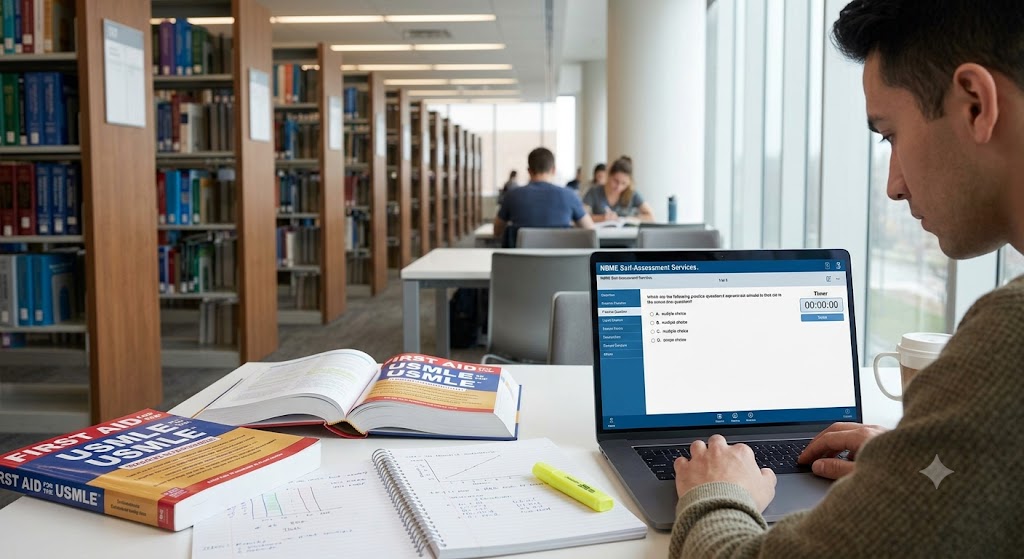
Additional Information
What the Course Entails and Exam Details
NBME practice assessments are not structured 'courses' with taught content; rather, they are evaluation tools that cover the extensive material expected of a medical student.
USMLE preparation (CBSE/CCSE): These exams cover the fundamental preclinical sciences, including Anatomy, Behavioral Sciences, Biochemistry, Microbiology, Pathology, Pharmacology, and Physiology, as well as interdisciplinary topics like Genetics and Immunology. Step 2 CK prep focuses on clinical sciences like Internal Medicine, Obstetrics and Gynecology, Pediatrics, Psychiatry, and Surgery.
Subject Exams (Shelf Exams): These focus specifically on one clinical discipline (e.g., the Medicine Shelf Exam covers internal medicine topics encountered during that rotation).
The practice exam details usually mirror the USMLE format: they are computer-delivered assessments consisting of multiple-choice questions (MCQs). The standard comprehensive practice exams typically contain 4 blocks of 50 questions each, totaling 200 questions.
What to Expect in the Final Exam
When taking an NBME self-assessment, you should expect a test environment that closely simulates the actual USMLE.
Format: All questions are multiple-choice, often presenting as clinical vignettes that require you to apply basic or clinical science knowledge to a patient scenario.
Time Limit: Practice exams are timed. For the comprehensive self-assessments (like the CCSE), students typically have 75 minutes per block of 50 questions, mirroring the time constraints of the real USMLE.
Scoring: Upon completion, you will receive a performance report. This report provides a total survey score, which can be correlated to a USMLE three-digit score, as well as a breakdown of your performance by content area, highlighting your strengths and weaknesses. It is important to note that practice exams are for self-assessment and do not have a set 'passing score' required by the NBME itself, though your medical school may set internal benchmarks.
How to Study and Exam Centers
Effective study strategies for NBME exams involve a combination of content review and systematic practice.
Study Strategies:
Use High-Yield Resources: Combine your review with standard medical education resources such as 'First Aid for the USMLE Step 1' or 'Step 2 CK', and comprehensive question banks like UWorld.
Simulate Test Conditions: When taking NBME practice forms, do so in a quiet environment, adhering strictly to the time limits for each block to build testing stamina.
Review Thoroughly: The most crucial step is reviewing your performance report. Spend significant time analyzing why you got questions wrong (or right). Focus your subsequent studying on the areas where your performance was weaker.
Exam Centers:
NBME self-assessments are purchased directly through the NBME Services Portal (NSP) on the official NBME website. They are web-based assessments intended to be taken by the student on their own computer. You do not need to visit a physical testing center to take a self-assessment. (Actual USMLE licensing exams are administered at Prometric testing centers).
Job Opportunities from the Course
While the NBME practice exams are assessment tools and not certifications themselves, achieving high scores on these tests is highly predictive of success on the USMLE license exams. Passing the USMLE is the critical gateway for medical graduates to enter residency training and ultimately practice medicine in the United States. Success in this pathway opens the door to numerous prestigious and essential career opportunities, including:
Resident Physician (in all medical specialties: Internal Medicine, Pediatrics, Surgery, etc.)
Licensed Physician (MD or DO)
Medical Fellow (specializing further after residency)
Clinical Educator/Academic Medicine Faculty
Medical Researcher (Clinical or Translational)
Frequently Asked Questions
Reviews
5.0
Based on 0 reviews
Leave a Review
No reviews yet. Be the first to review!