
NASM 3 OLD
$69.00
- Buy to unlock unlimited access to all Quiz questions.
- After purchase you can print a PDF of the whole quiz at any point. The PDF will contain the questions and the correct answers.
About this Exam
The [NASM 3 OLD] certification, an older designation within the National Academy of Sports Medicine (NASM) framework, was designed to validate advanced expertise in specific areas of fitness and personal training. While official naming and current structures might differ, this qualification represented a significant level of specialization for dedicated fitness professionals. It aimed to equip experienced trainers with higher-level skills, potentially in areas such as advanced corrective exercise, performance enhancement, or specialized client populations, building upon the foundational knowledge of core NASM certifications. This program was suitable for trainers seeking to differentiate themselves, take on more complex clients, and deepen their understanding of human movement and advanced program design.
Ready to test your knowledge?
Buy Now to Access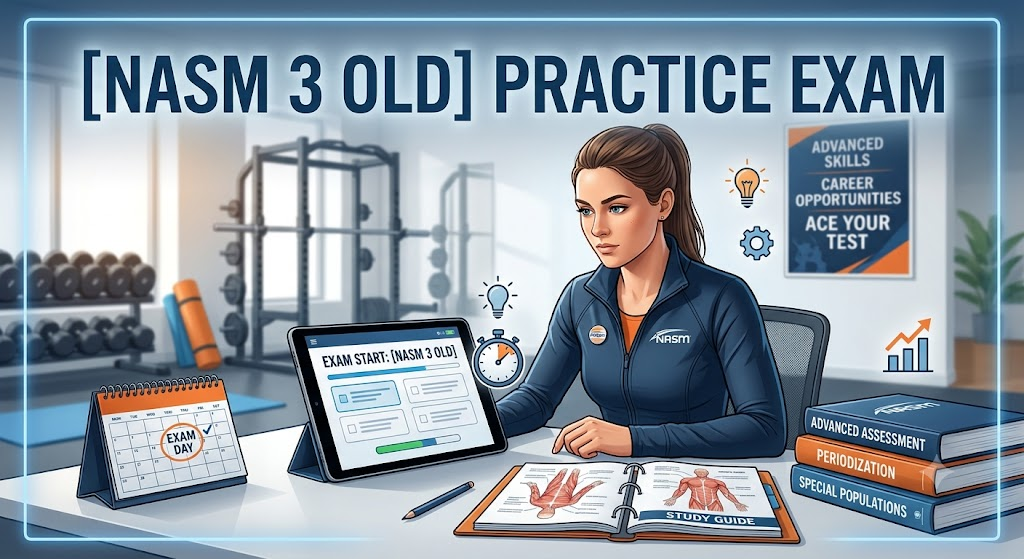
Additional Information
What the Course Entails and Exam Details
This advanced course, reflective of its depth, covered a range of comprehensive topics typical for advanced specializations. Students could expect to explore:
Advanced Client Assessment: In-depth analysis of posture, movement patterns, and physiological markers to identify detailed imbalances and specific needs.
Advanced Corrective Exercise Strategies: Detailed techniques and progressions for addressing complex musculoskeletal issues and movement compensations.
Performance Enhancement Principles: Advanced strategies for improving speed, agility, quickness, power, and overall athletic performance.
Periodization and Program Design: Complex periodization models and advanced program development tailored to specific client goals and populations.
Special Populations: Deep dives into the specific considerations, training adaptations, and contraindications for working with unique client groups (e.g., seniors, youth, post-rehab).
Nutritional Concepts for Specializations: Advanced nutritional guidance relevant to the specific focus area (e.g., performance, recovery). The specific syllabus and emphasis would depend on the exact older specialization it represented, but these areas were common for higher-level NASM qualifications.
What to Expect in the Final Exam
While exact details could vary, candidates preparing for this type of exam typically faced a rigorous assessment:
Format: Historically, these exams were primarily multiple-choice, taken online. Some specializations might have included case study analysis or application questions within that format.
Number of Questions: Exams often ranged from 100 to 120 multiple-choice questions.
Time Limit: Typically, candidates were allowed between 90 and 120 minutes to complete the test.
Passing Score: A passing score was usually around a scaled score of 70, consistent with many NASM assessments.
Conditions: For older specializations, these exams were frequently administered through an online portal and could sometimes be open-book, though this varied. Proctoring, either in-person or live-remote, became more common for higher-stakes exams but might not have been standard for all older specializations.
How to Study and Exam Centers
Effective preparation for this advanced exam requires a structured approach:
Deep Foundational Knowledge: Ensure you have a rock-solid understanding of foundational personal training concepts (ideally from a NASM-CPT or equivalent) as advanced specializations build directly upon this base.
Thorough Material Review: Dedicate significant time to studying the primary resources for this specific older certification. This includes any re-released study guides, digital course materials, or relevant textbooks.
Take Practice Exams: Utilizing resources like the [NASM 3 OLD] Practice Exam suggested in the title is crucial. Multiple practice tests help familiarize you with the question style, time constraints, and identify weak areas for focused study.
Create Study Aids: Make flashcards for key terms, diagrams for muscle function and assessment protocols, and summary sheets for specific populations or strategies.
Online Forums & Groups: While specific forums for an older exam might be less active, broader NASM study groups or professional fitness forums can still provide support and clarification on advanced concepts.
For older specializations, official, dedicated exam centers were less common than for modern certifications. Exam Centers were typically accessed via:
Online Portals: The predominant method was taking the exam remotely through a designated NASM online testing platform. Candidates would access the exam from a computer with internet access.
Specific Partner Locations: In some instances, historical versions of specializations might have had associations with certain educational institutions or authorized testing centers, but online administration was the common, flexible approach. Always check for current guidance if attempting to prepare for or access materials related to an older program, but assume preparation resources and practice tests will be primarily online.
Job Opportunities from the Course
Successfully validating your expertise with an advanced qualification like this opened doors to various rewarding career paths:
Corrective Exercise Specialist (Illustrative)
Performance Enhancement Specialist (Illustrative)
Advanced Personal Trainer
Strength and Conditioning Coach (Advanced coaching roles often require further specific qualifications)
Fitness Director/Manager
Corporate Wellness Coordinator
Specialized Fitness Instructor (e.g., for senior fitness programs, youth sports)
Online Fitness Coach (leveraging specialization credibility)
By focusing on diligent study and leveraging relevant practice materials, you can confidently prepare for and succeed in advanced fitness assessments.
Frequently Asked Questions
Reviews
5.0
Based on 0 reviews
Leave a Review
No reviews yet. Be the first to review!