
Metropolitan Transportation Authority (MTA) Conductor Practice Test
$69.00
- Buy to unlock unlimited access to all Quiz questions.
- After purchase you can print a PDF of the whole quiz at any point. The PDF will contain the questions and the correct answers.
About this Exam
The Metropolitan Transportation Authority (MTA) Conductor Exam is a highly competitive civil service assessment designed for individuals seeking a rewarding career in New York City’s bustling public transportation system.
This certification test evaluates candidates on the fundamental skills required to safely and efficiently manage subway train operations.
It is tailored for safety-conscious professionals, customer service enthusiasts, and anyone looking to secure a stable, unionized career with excellent benefits within the largest public transit network in North America.
Taking the MTA Conductor Practice Test is the first critical step toward mastering the cognitive and situational challenges presented in the actual examination.
Ready to test your knowledge?
Buy Now to Access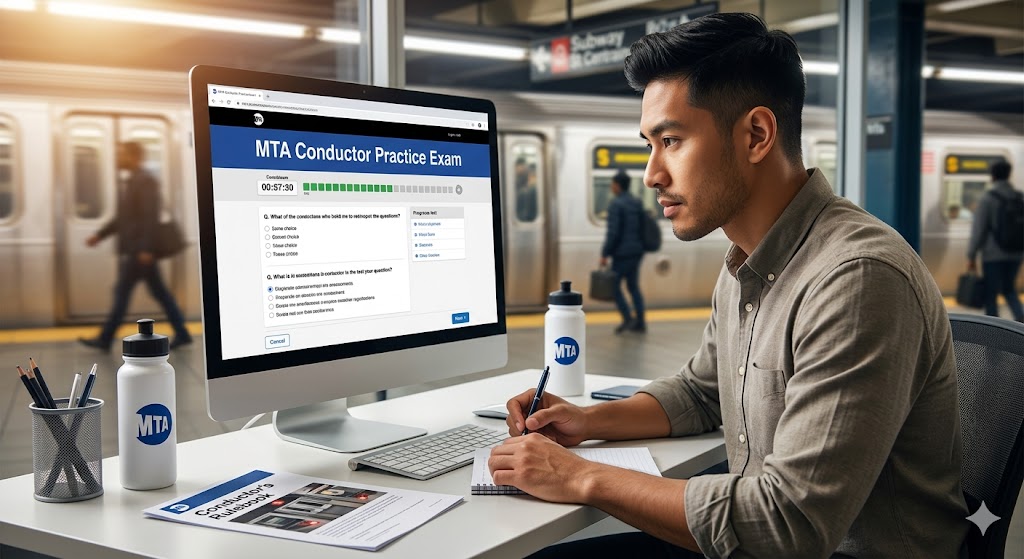
Additional Information
What the Course Entails and Exam Details
While there is no mandatory prerequisite "course"
to take the exam, preparing for the MTA Conductor assessment entails mastering
a specific set of operational and cognitive skills.
A comprehensive study plan covers essential topics such as
reading comprehension, information ordering, and problem sensitivity.
Candidates will learn to interpret complex transit
schedules, understand strict workplace safety protocols, and follow detailed
written rules and procedures.
Additionally, the syllabus includes situational judgment
tests focusing on customer service, conflict resolution, and emergency
response, ensuring candidates are fully equipped to handle the daily demands of
a transit conductor.
What to Expect in
the Final Exam
The official MTA Conductor Exam is typically administered as
a computerized multiple-choice test designed to measure your aptitude for the
role, rather than your prior transit experience.
You can expect to encounter questions that test your
deductive and inductive reasoning, spatial orientation, and ability to memorize
and recall vital information quickly.
The exam usually has a time limit of approximately three to
four hours, giving you ample time to read through the scenario-based questions
carefully.
While the baseline passing score is generally 70%, it is
crucial to aim much higher; because this is a competitive civil service exam,
candidates are placed on a hiring list in rank order based on their final
scores.
How to Study and Exam Centers
To achieve a top-tier score, your study strategy should
heavily rely on taking timed practice exams to familiarize yourself with the
question formats and pacing.
Focus on reading comprehension drills and cognitive ability
exercises, as these make up the bulk of the test.
Reviewing MTA-specific rulebooks or historical civil service
exam study guides can also give you a significant edge over the competition.
When it is time to take the official exam, it is typically
administered by the NYC Department of Citywide Administrative Services (DCAS).
You will need to register through the online OASys (Online
Application System) portal during an open filing period, and the exam itself
will be held at one of the dedicated DCAS Computer-based Testing &
Applications Centers (CTACs) located across the various boroughs of New York
City.
Job Opportunities
from the Course
Successfully passing the MTA Conductor Exam and completing
the subsequent hiring and training process unlocks a clear, stable career path
within the Metropolitan Transportation Authority.
The primary entry-level role is an MTA Train Conductor,
where you will be responsible for operating train doors, making public
announcements, and ensuring passenger safety.
With accumulated experience and a strong performance record,
this foundational role opens the door to several lucrative promotional
opportunities.
You can advance to become a Train Operator, taking physical
control of the subway cars.
Further career progression can lead to management and
logistical roles such as a Train Dispatcher, overseeing train movements and
schedules, or a Yardmaster, coordinating the complex operations within the MTA
train yards.
Frequently Asked Questions
Reviews
5.0
Based on 0 reviews
Leave a Review
No reviews yet. Be the first to review!