
Medical Assistant Laboratory Work Practice Test 2026
$69.00
- Buy to unlock unlimited access to all Quiz questions.
- After purchase you can print a PDF of the whole quiz at any point. The PDF will contain the questions and the correct answers.
About this Exam
The Medical Assistant Laboratory Work Practice Test 2026 is an essential preparatory tool designed for aspiring medical assistants focusing on the clinical laboratory component of their certification journey. This comprehensive practice exam simulates the actual testing environment to help candidates assess their knowledge and readiness for laboratory-related questions on their final certification exams. It is specifically tailored for students and healthcare professionals pursuing key credentials such as the Certified Medical Assistant (CMA), Registered Medical Assistant (RMA), or Certified Clinical Medical Assistant (CCMA). By targeting laboratory procedures, safety protocols, and specimen processing, this practice test ensures you have the specialized skills needed to excel in a modern clinical setting and pass your upcoming exams with confidence.
Ready to test your knowledge?
Buy Now to Access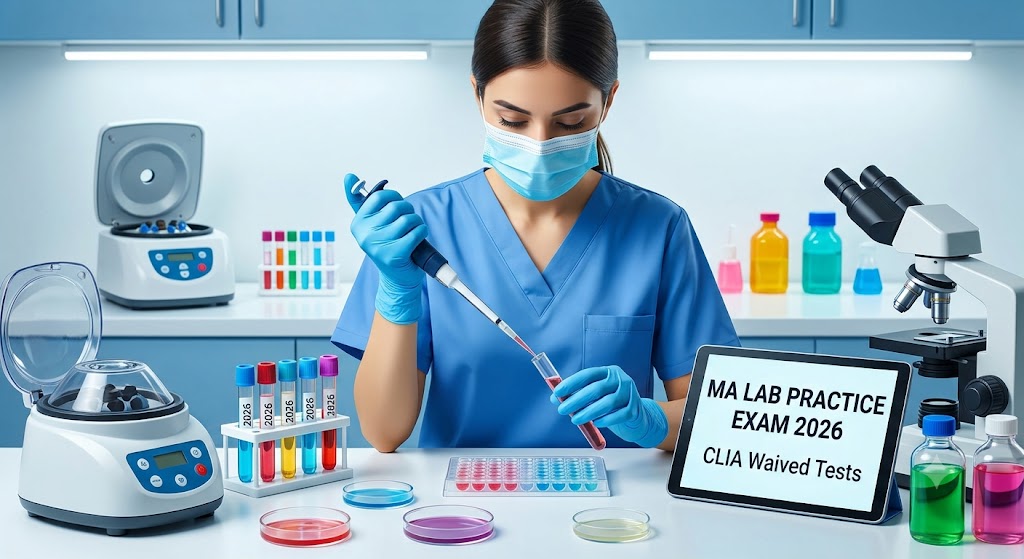
Additional Information
What the Course Entails and Exam Details
This practice test course mirrors the content outlines set
by major credentialing bodies for medical assistant certification, ensuring you
focus on the most relevant laboratory skills. The material covers core topics
essential for safe and accurate laboratory work in an ambulatory care
environment. Students preparing with this practice guide will master crucial
laboratory knowledge. Major areas covered include:
- Laboratory
Safety and Regulation: In-depth knowledge of OSHA (Occupational Safety
and Health Administration) regulations, CLIA (Clinical Laboratory
Improvement Amendments) waived tests, safety data sheets (SDS), personal
protective equipment (PPE), and proper biohazard waste disposal.
- Specimen
Collection and Processing: Techniques for correct patient
identification, labeling, collecting blood (venipuncture and capillary
puncture), and non-blood specimens (urine, throat swabs). Understanding
proper handling, transport, and storage to ensure specimen integrity is
critical.
- Routine
Laboratory Procedures: Performing and interpreting common CLIA-waived
tests, including urinalysis, rapid strep tests, pregnancy tests, and basic
hematology/coagulation monitoring (e.g., hemoglobin, Prothrombin Time).
- Urinalysis:
Proper methods for chemical and physical urinalysis, including the use of
reagent strips and understanding urine concentration and color
significance.
- Hematology
and Phlebotomy: Mastery of the order of draw, identifying
complications during blood collection, and performing basic blood counts
or hemoglobin tests.
- Microbiology
and Immunology: Techniques for throat cultures, wound cultures,
preparing smears, and understanding basic concepts related to infection
control and immunological testing principles.
- Quality
Control and Assurance: Understanding the importance of standardizing
tests, performing controls, calibrating equipment, and meticulous
documentation in the laboratory setting to maintain accurate results.
- Medical
Terminology and Documentation: Utilizing proper terminology related to
lab tests, equipment, diseases, and accurately recording test results and
patient data in medical records.
What to Expect in the Final Exam
This 2026 practice test environment simulates the actual
certification exam, which primarily utilizes a multiple-choice format designed
to assess critical thinking, application of knowledge, and decision-making
skills. For your actual final Medical Assistant Certification Exam (CMA, RMA,
CCMA, etc.):
- Format:
The primary examination consists entirely of multiple-choice questions
(MCQs), with each question typically having four possible options and only
one correct answer. Some exams may also incorporate limited practical
components or interactive computer-based scenarios (e.g., matching or
ordering steps).
- Number
of Questions: The number of questions specifically dedicated to
laboratory procedures varies significantly by credentialing body (AAMA,
AMT, NHA), ranging from 30 to over 100 dedicated lab-focused questions
within the broader exam.
- Passing
Score: There is no single universal passing score. Major organizations
set scaled passing scores (e.g., AAMA requires a scaled score of 425),
which are equivalent to achieving a certain percentage of correct answers,
usually ranging between 70% and 75%.
- Time
Limit: The final certification exams are timed events, often allowing
between 2 to 3 hours total, with lab questions being completed within that
overall time allocation. Practical time management is essential.
- Specific
Rules: Final examinations are strictly proctored, whether in person or
remotely. Cell phones, smart devices, watches, and any unauthorized
personal items are forbidden. Candidates are typically allowed short,
scheduled breaks, but timing does not stop. Valid government-issued photo
ID is always required for admission to the testing center or online
portal.
How to Study and
Exam Centers
Successfully passing the lab section of your medical
assistant certification requires a combination of targeted study strategies and
consistent practice. Actionable preparation methods include:
- Take
Multiple Practice Tests: Consistently utilize high-quality practice
exams like this 2026 guide to simulate the real testing experience, gauge
your progress, and become familiar with different question styles.
Identify weak areas and focus your revision efforts on those specific
laboratory topics.
- Master
the Core Content: Review your comprehensive medical assistant textbook
sections on laboratory procedures, anatomy/physiology related to lab
tests, safety, and CLIA regulations. Deeply understand the 'why' behind
each technique.
- Utilize
Flashcards: Create physical or digital flashcards for key laboratory
terminology, normal lab values (especially CLIA-waived test ranges), the
order of draw for phlebotomy, and important acronyms.
- Hands-on
Practice: In addition to theoretical study, seek opportunities for
hands-on practice whenever possible in a classroom or clinical setting,
focusing on proper pipetting, specimen collection, and performing waived
tests to build confidence and muscle memory.
- Join
Study Groups: Interacting with peers can provide different
perspectives, help clarify complex concepts, and offer valuable peer
support through the preparation process.
Exam Centers: Final certification exams (CMA, RMA,
CCMA) are administered in secure, proctored environments and must be scheduled
directly through the relevant credentialing organization. Testing centers and
methods include:
- Prometric
Testing Centers: A widely used network of physical testing locations
across North America for the CMA (AAMA) exam.
- Pearson
VUE Testing Centers: Physical centers used by organizations like AMT
for the RMA certification. Pearson VUE offers both physical center testing
and remote proctoring options in some cases.
- PSI
Testing Centers: Another network of secure physical centers often
utilized by NHA for the CCMA exam.
- Authorized
Schools/Colleges: Many medical assistant programs are authorized to
serve as testing sites for their graduating students, offering the exam
on-campus.
- Live
Remote Proctoring: Some organizations, such as NHA for the CCMA, offer
live, remote-proctored exams taken online through a specific web portal,
which requires a strict technological and environmental setup on the
candidate's end.
Job Opportunities
from the Course
Mastering laboratory skills and achieving certification
opens numerous doors for medical assistants, highlighting your versatility and
competence in both clinical and laboratory settings. This specialization and
your subsequent medical assistant certification unlock career paths in varied
healthcare environments:
- Certified
Medical Assistant (CMA) - Lab Specialization
- Clinical
Medical Assistant - Laboratory Coordinator
- Phlebotomist/Medical
Assistant (in high-volume outpatient clinics)
- Medical
Laboratory Assistant (MLA) (entry-level lab roles)
- Point-of-Care
Testing (POCT) Specialist
- Specimen
Processor/Laboratory Clerk
- Quality
Control Medical Assistant (in larger health systems)
- Medical
Assistant in specialized clinics (e.g., Urgent Care, Pediatrics,
Endocrinology, or Oncology, where extensive lab work is standard)
- Lead
Medical Assistant (often requires advanced clinical and lab proficiency)
- Opportunities
in hospitals, private physician practices, outpatient facilities, and
research laboratories.
Frequently Asked Questions
Reviews
5.0
Based on 0 reviews
Leave a Review
No reviews yet. Be the first to review!