
Medical Assistant Anatomy and Physiology Practice Test 2026
$69.00
- Buy to unlock unlimited access to all Quiz questions.
- After purchase you can print a PDF of the whole quiz at any point. The PDF will contain the questions and the correct answers.
About this Exam
The Medical Assistant Anatomy and Physiology Practice Test for 2026 is an essential preparatory tool designed for aspiring medical assistants.
This practice test specifically targets the biological foundations required for successful medical assisting practice.
It is designed for students enrolled in medical assisting programs, those nearing graduation, and professionals seeking a refresher on vital anatomical and physiological concepts before attempting their formal certification exams.
A strong grasp of how the human body is structured and functions is crucial for direct patient care, medical coding, and understanding clinical procedures, making this study guide and practice test a pivotal step in a medical assistant’s career path.
Ready to test your knowledge?
Buy Now to Access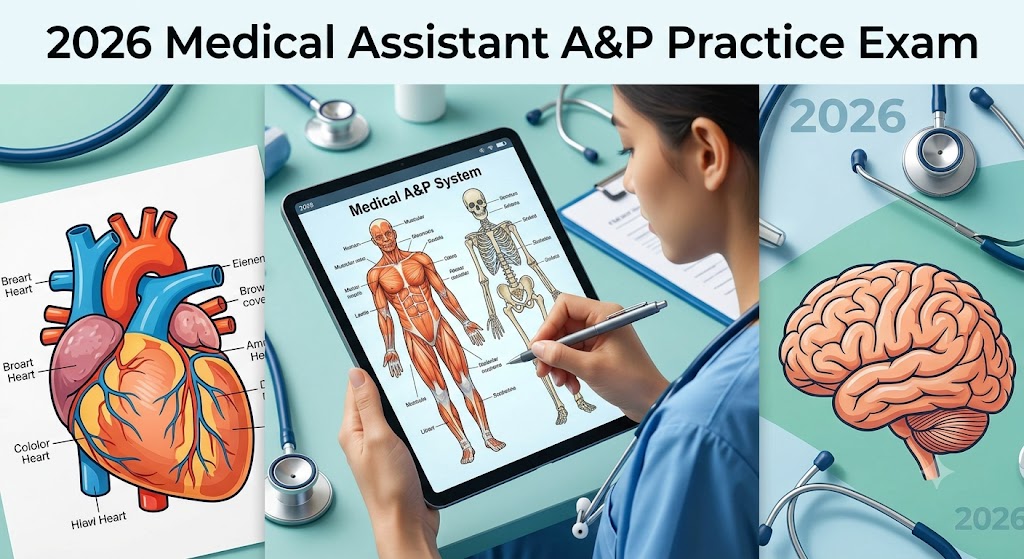
Additional Information
What the Course Entails and Exam Details
This preparation guide and practice test cover the
fundamental systems and biological principles of the human body that are most
relevant to the daily duties of a medical assistant.
The core syllabus and topics covered in this practice exam
include:
- Organization
of the Body: Understanding the levels of structural organization from
chemical to organism, body regions, and anatomical planes and directions.
- The
Integumentary System: Structure and function of the skin, hair, and
nails.
- The
Skeletal System: Major bones, skeletal divisions, joint types, and
basic skeletal function.
- The
Muscular System: Principal muscle groups, muscle tissue types, and
mechanisms of muscle contraction.
- The
Nervous System: Central and peripheral systems, neurons, and the
senses.
- The
Endocrine System: Major glands and the regulatory role of hormones.
- The
Cardiovascular System: Blood components, heart structure and function,
and blood vessel distribution.
- The
Lymphatic and Immune Systems: Understanding lymph flow, immunity
types, and major immune organs.
- The
Respiratory System: Upper and lower respiratory tract, gas exchange
mechanics, and regulation of breathing.
- The
Digestive System: Anatomy of the digestive tract and organs, and the
physiology of digestion and absorption.
- The
Urinary System: Kidney structure, nephron function, and the regulation
of urine and body fluids.
- The
Reproductive System: Female and male anatomy, physiology, and basic
reproductive cycles.
The actual practice test focuses heavily on medical
terminology and real-world clinical applications related to these systems,
ensuring that candidates can apply their knowledge to patient care scenarios, such
as explaining a procedure or recognizing an anatomical landmark.
What to Expect in the Final Exam
While the final formal certification (such as the CMA or RMA
exams) includes administrative and clinical components, this specific practice
test focuses exclusively on the Anatomy and Physiology domain.
The 2026 Medical Assistant A&P Practice Test is designed
to simulate the academic rigor and formatting style of these formal exams.
- Format:
The exam consists of approximately 100 multiple-choice questions, which is
the standard format for the anatomy section of medical assisting
certifications.
- Passing
Score: While specific benchmarks vary by practice platform, a score of
75% or higher on this practice test generally indicates strong readiness
for the anatomy portion of the official certification exam.
- Time
Limit: To simulate real testing conditions, candidates are encouraged
to complete the practice test within a 90-minute time frame, promoting
efficient time management skills.
- Specific
Rules: This practice test is taken as a self-assessment tool;
candidates should aim to complete it in one sitting without using external
reference materials to accurately gauge their knowledge and identify
weaknesses.
How to Study and
Exam Centers
Effective study for the A&P portion of the medical
assisting career pathway requires a blend of visual memorization and functional
understanding.
Here are actionable study strategies for this exam:
- Visualize
the Body: Anatomy is inherently visual. Use anatomical diagrams,
flashcards (both digital and physical), and color-coding for different
systems to memorize structures.
- Understand
the "Why": Physiology is about how systems work. Don't just
memorize what the liver is; understand what it does for digestion
and detoxification.
- Use
Active Recall: Test yourself frequently rather than passively
re-reading notes. Use flashcards and practice quizzes.
- Incorporate
Practice Tests: Take this 2026 Medical Assistant A&P Practice Test
multiple times. Research has consistently shown that taking practice tests
is one of the single most effective ways to study, as it improves
retention and familiarizes you with the question formats you will face on
exam day.
Taking the Exam: As this is a practice test and not a
formal certifying exam, you do not need to schedule a time at a Pearson VUE
center.
It is typically accessed through authorized online learning
portals provided by your medical assisting school or specific educational
publishers.
You can take it in any quiet, distraction-free environment,
such as a home library, with reliable internet access.
Job Opportunities
from the Course
A strong understanding of Anatomy and Physiology is the
foundation of clinical competence for a medical assistant.
While a practice test is a step toward licensure rather than
the license itself, mastering this content directly enables success in passing
the full certification exam (such as CMA, RMA, or NCMA), which is required for
virtually all medical assisting job opportunities.
Passing this exam and achieving your medical assisting
certification unlocks a wide range of job opportunities in diverse healthcare
settings, including:
- Clinical
Medical Assistant: Working directly with patients in physician's
offices and clinics, preparing them for examinations and taking vital
signs.
- Specialty
Medical Assistant: For example, working as a Cardiology Assistant,
where deep knowledge of the heart’s anatomy and physiology is crucial.
- Phlebotomy
Technician: Drawing blood, a skill requiring excellent knowledge of
the circulatory system.
Frequently Asked Questions
Reviews
5.0
Based on 0 reviews
Leave a Review
No reviews yet. Be the first to review!