
MCAT Psychology and Sociology Practice Test 2026
$69.00
- Buy to unlock unlimited access to all Quiz questions.
- After purchase you can print a PDF of the whole quiz at any point. The PDF will contain the questions and the correct answers.
About this Exam
The MCAT Psychological, Social, and Biological Foundations of Behavior section assesses your understanding of the ways psychological, social, and biological factors influence human behavior. It focuses on the concepts required to understand the social, cultural, and behavioral determinants of health, which are vital for a successful medical career. This section is designed for students aiming for admission to medical schools (MD and DO) in the United States and Canada. As the fourth and final section of the full 7.5-hour MCAT, it demands mental stamina and strategic preparation to perform optimally when fatigue is highest.
Ready to test your knowledge?
Buy Now to Access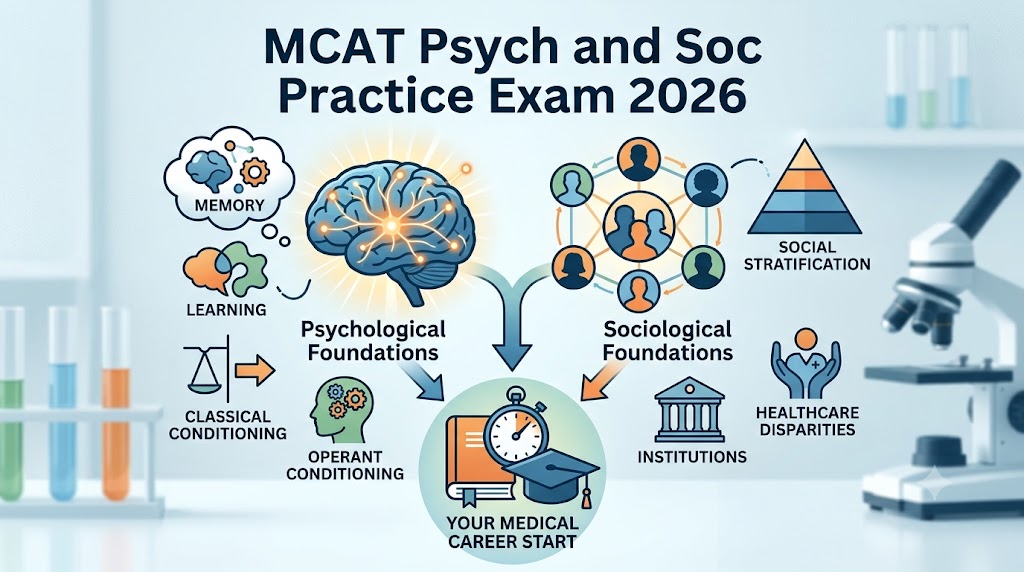
Additional Information
What the Course
Entails and Exam Details
This section is unique in its integration of three major
disciplines. The Association of American Medical Colleges (AAMC) distributes
the content as follows: 65% introductory psychology, 30% introductory
sociology, and 5% introductory biology (specifically focused on the brain and
nervous system).
The AAMC organizes the content around five foundational
concepts, which test-takers must master:
- Foundational
Concept 6: Sensing the environment, making sense of the world, and
responding to the world (e.g., sensation, perception, memory, attention).
- Foundational
Concept 7: Individual influences on behavior, social processes that
influence behavior, and attitude and behavior change (e.g., operant and
classical conditioning, prejudice, persuasion).
- Foundational
Concept 8: Self-identity, social thinking, and social interaction
(e.g., self-concept, attribution theory, social inequality).
- Foundational
Concept 9: Understanding social stratification and institutions (e.g.,
healthcare disparities, medicalization).
- Foundational
Concept 10: Understanding the demographic characteristics of
populations (e.g., social migration, epidemiology).
Additionally, 20% of the section is dedicated to Scientific
Inquiry and Reasoning Skills (SIRS), which require you to demonstrate
proficiency in:
Knowledge of Scientific
Principles: Recalling and defining concepts.
Scientific Reasoning and
Problem-Solving: Applying knowledge to new situations.
Reasoning about the Design and
Execution of Research: Understanding methodologies and limitations of
studies.
Data-based Statistical
Reasoning: Interpreting charts, graphs, and statistical data.
What to Expect in the Final Exam
The MCAT Psych/Soc section is a multiple-choice examination.
It is standardized, computer-based, and administered within a secure testing
facility.
- Number
of Questions: 59 questions in total.
- Format:
The section consists of 10 passage-based sets, containing 4 to 6 questions
each (44 questions total), and 15 standalone discrete (non-passage-based)
questions.
- Time
Limit: 95 minutes.
- Scoring:
Like all MCAT sections, Psych/Soc is scored on a scaled range from 118
(lowest) to 132 (highest). The midpoint score for the population of
test-takers is set at 125.
- Passing
Score: There is no universal "passing" score for the MCAT or
this section. Medical schools use your scaled score, along with other
application components, to compare your readiness against other
applicants. Competitive scores vary by institution.
- Special
Rules: The MCAT is taken in a secure environment. You are not allowed
to bring personal items into the testing room. An optional 10-minute break
precedes this final section.
How to Study and Exam Centers
Strategic preparation is key to conquering this final leg of
the MCAT.
Actionable Study Strategies:
- Master
the Vocabulary: This section is heavily dependent on precise
definitions. Use flashcards for key terms, but go beyond simple
memorization.
- Compare
Look-Alike Terms: Pay special attention to concepts that seem similar
but have distinct differences (e.g., actor-observer bias versus
fundamental attribution error, top-down versus bottom-up processing). Focus
on being able to distinguish them in passage contexts.
- Prioritize
Experimental Design: Spend significant time reviewing research
methodologies. Practice identifying independent and dependent variables,
confounding variables, different types of study designs (longitudinal,
cross-sectional, experimental), and potential biases.
- Read
Data Thoroughly: Practice interpreting graphs, error bars, and
statistical significance. A common mistake is rushing to answer before
fully understanding the presented results.
- Practice
with Mental Fatigue: To simulate the real exam day, take several
full-length practice tests and ensure you complete the Psych/Soc section
last, after sitting through the first three sections. This builds
necessary stamina.
- Use
Official AAMC Resources: Prioritize official AAMC practice materials,
as they best reflect the format, difficulty, and tone of the actual exam.
Where and How to Take the Exam:
The MCAT is administered exclusively by the Association of
American Medical Colleges (AAMC). You must register for the exam through your
official AAMC account online. The actual testing takes place at professional,
secure computer-based testing centers managed by Pearson VUE, which are located
throughout the United States, Canada, and selected international locations.
When you register, you will choose a specific testing date and location from
the available slots in their network. You should book well in advance to secure
your preferred site and date.
Job Opportunities
from the Course
A strong score on the MCAT, including the Psychology and
Sociology section, is a vital prerequisite for admission to medical school.
Successfully navigating medical school and subsequent residency training
unlocks a wide array of prestigious and rewarding career paths.
Completing this journey enables you to pursue various
specialized medical careers, including but not limited to:
- Physician
(e.g., Primary Care, Family Medicine, Internal Medicine, Pediatrics)
- Surgeon
(e.g., General Surgery, Neurosurgery, Orthopedic Surgery, Cardiothoracic
Surgery)
- Psychiatrist
- Neurologist
- Anesthesiologist
- Emergency
Medicine Physician
- Medical
Researcher/Scientist
- Medical
Educator/Professor
- Healthcare
Administrator/Executive
Frequently Asked Questions
Reviews
5.0
Based on 0 reviews
Leave a Review
No reviews yet. Be the first to review!