
MBLEx Benefits and Physiological OLD
$69.00
- Buy to unlock unlimited access to all Quiz questions.
- After purchase you can print a PDF of the whole quiz at any point. The PDF will contain the questions and the correct answers.
About this Exam
The Massage & Bodywork Licensing Examination (MBLEx) is the national entry-level licensure examination for the massage therapy profession in the United States. Developed by the Federation of State Massage Therapy Boards (FSMTB), passing the MBLEx is a mandatory requirement for licensure in most states.
This comprehensive guide focuses specifically on the critical content area: Benefits and Physiological Effects of Techniques that Manipulate Soft Tissue. This section evaluates your fundamental understanding of how massage therapy impacts the human body, both physically and psychologically. It is designed for students who have completed a massage therapy program and are preparing to begin their professional careers. This knowledge is essential for creating safe, effective, and evidence-based treatment plans that meet the unique needs of every client, including special populations such as the elderly.
Ready to test your knowledge?
Buy Now to Access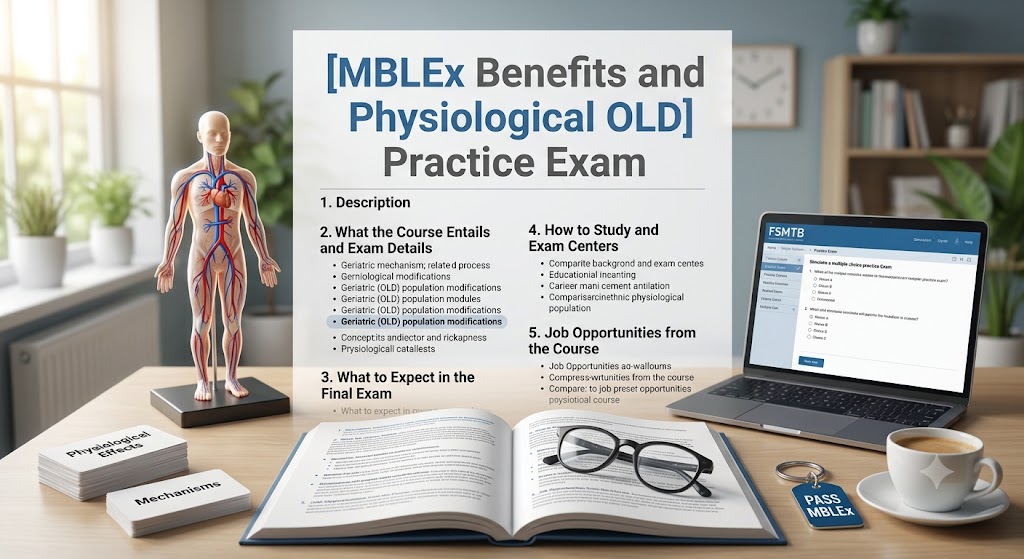
Additional Information
What the Course Entails and Exam Details
This content area covers the scientific rationale behind
massage therapy. It typically accounts for 15% of the overall MBLEx,
making it a high-yield section to master.
Your preparation will entail a deep dive into the following
core topics:
- Physiological
Effects: You must be able to identify, define, and describe the
specific physical, measurable changes in body structure and function
caused by different soft tissue manipulation techniques. This includes
understanding the three main types of effects:
- Mechanical
Effects: Resulting from direct physical application (e.g., breaking
down adhesions with deep friction).
- Reflexive
Effects: Involuntary responses triggered by nervous system
stimulation (e.g., lowering heart rate via parasympathetic activation).
- Systemic
Effects: Changes impacting the entire body (e.g., altered hormone
levels due to the relaxation response).
- Effects
on Body Systems: You need to understand how soft tissue manipulation
affects each major body system, including:
- Cardiovascular:
Improved peripheral circulation, decreased blood pressure, and increased
venous and lymphatic flow.
- Nervous:
Activation of the parasympathetic nervous system (rest-and-digest), pain
modulation (via the gate control theory and endogenous opioid release),
and reduced neuromuscular excitability.
- Musculoskeletal:
Increased soft tissue pliability and range of motion, decreased trigger
point activity, and reduced adhesions.
- Integumentary,
Respiratory, Lymphatic, Immune, and Endocrine Systems.
- Psychological
and Emotional Effects: Identifying the benefits of touch, including
reduced stress, anxiety, and depression, and an enhanced sense of
well-being.
- Effects
on Special Populations: Critically, you will study the unique
considerations, benefits, and necessary modifications for different client
groups, including prenatal, pediatric, and geriatric (older/OLD)
clients, as well as those with specific pathologies or contraindications. This
includes understanding the physiological changes associated with the aging
process and how to adapt your techniques safely.
- Soft
Tissue Techniques: An overview of common modalities (such as Swedish
massage, deep tissue, trigger point therapy, myofascial release, and
manual lymphatic drainage) and their physiological rationale.
What to Expect in
the Final Exam
While "Benefits and Physiological Effects" is a
section of the MBLEx, you will not sit for a standalone "Benefits and
Physiological OLD" exam. Instead, questions from this domain will be
integrated throughout the full MBLEx.
- Format:
The MBLEx is a computer-based examination (CBT). It consists of 100
multiple-choice questions.
- Question
Type: The questions are multiple-choice with four options. Many
questions are scenario-based, asking you to apply your knowledge of
benefits and effects to a specific client case. You must select the single
best answer.
- Time
Limit: You are given 2 hours to complete the exam. This includes time
for a tutorial and end-of-exam survey. It is critical to manage your time
effectively, aiming to answer each question in about 60 to 70 seconds.
- Passing
Score: The MBLEx uses a scaled scoring system ranging from 300 to 900.
The scaled passing score for the MBLEx is 600. Your score is
determined by the total number of questions answered correctly, weighted
by difficulty.
- Specific
Rules: The MBLEx is a closed-book exam. You are not permitted to use
any external resources or notes. The exam is administered in a secure,
proctored environment. The specific designation "OLD" in your
guide's title may indicate a focus on "Old" populations
(Geriatrics), which is a key component of the special populations material
covered in the exam. Ensure your study materials are current with the
FSMTB's official MBLEx Content Outline.
How to Study and Exam Centers
Effective preparation for the "Benefits and
Physiological Effects" content area requires moving beyond simple rote
memorization to true conceptual understanding and critical application.
- Actionable
Study Strategies:
- Master
the Vocabulary: Create flashcards for every key term and concept. You
must perfectly define 'adhesion,' 'parasympathetic,' 'mechanical effect,'
and 'systemic change.'
- Use
the Official Outline: Base your study on the most current FSMTB
MBLEx Content Outline. This document is your map to success.
- Scenario-Based
Practice: Do not just quiz yourself on definitions. Actively seek out
MBLEx-style practice questions that use client scenarios (e.g., "A
client presents with chronic edema. Which technique will provide the most
effective physiological benefit, and through what mechanism?").
- Create
Concept Maps: Connect techniques (like petrissage) to their
mechanical and reflexive effects and the specific body systems they
influence.
- Utilize
Official Resources: Use the FSMTB's official study guide and practice
exams. These offer the closest look at the actual exam's format and
difficulty.
- Special
Populations Deep Dive: Create a dedicated study section for special
populations, particularly geriatric clients, noting the expected
physiological changes and how to adjust your treatment for benefits while
ensuring safety.
- Exam
Centers and How to Register:
- Registration:
The FSMTB does not register candidates directly. You must apply for
licensure through your state's regulatory board, and they will confirm
your eligibility. Once approved, you will receive an "Authorization
to Test" (ATT) with instructions to schedule your exam.
- Taking
the Exam: The MBLEx is administered exclusively at Pearson VUE
testing centers. These secure, authorized physical centers are
located throughout the United States and internationally. You must
schedule your appointment at a center of your choice within your ATT
validity period.
Job Opportunities
from the Course
Passing the MBLEx is the master key to your career as a
Licensed Massage Therapist (LMT). This foundational knowledge opens a wide
array of job opportunities and career paths.
Licensed Massage Therapists can find rewarding employment in
a diverse range of professional settings, allowing them to specialize and grow.
Specific job opportunities include:
- Spa
and Wellness Practitioner: Working in destination, resort, and day
spas providing relaxation-focused and therapeutic treatments.
- Medical
Massage Therapist: Collaborating with doctors, chiropractors, physical
therapists, and other healthcare providers in hospitals, medical clinics,
and rehabilitation centers.
- Clinical
or Sports Massage Therapist: Working with professional, collegiate, or
amateur athletes and active individuals to enhance performance, prevent
injury, and aid recovery.
- Franchise
Therapist: Employed by major chains and clinics that offer accessible
massage services to a broad clientele.
- Sole
Proprietor/Private Practice: Opening your own clinic, allowing for
complete autonomy in branding, scheduling, and client care.
- Specialized
Geriatric Massage Therapist: Focusing your practice on the unique
needs of older adults in senior living communities, memory care
facilities, and private homes.
- Corporate/Chair
Massage Therapist: Providing convenient, on-site services in corporate
environments to reduce workplace stress.
- Massage
Educator: Training the next generation of therapists by teaching in
massage therapy schools or presenting continuing education courses.
By demonstrating a comprehensive understanding of the
Benefits and Physiological Effects, you prove to licensing boards and future
employers that you possess the critical knowledge needed to excel in any of
these roles.
Frequently Asked Questions
Reviews
5.0
Based on 0 reviews
Leave a Review
No reviews yet. Be the first to review!