
Massachusetts CDL Pre-Trip Practice Test
$69.00
- Buy to unlock unlimited access to all Quiz questions.
- After purchase you can print a PDF of the whole quiz at any point. The PDF will contain the questions and the correct answers.
About this Exam
The Massachusetts Commercial Driver's License (CDL) Pre-Trip Inspection is a foundational component of the full CDL Skills Test. This mandatory exam ensures that all aspiring commercial drivers in the Commonwealth can verify that their vehicle is safe to operate on public roadways before leaving the yard. It is a critical safety barrier designed to identify defects that could lead to accidents.
This exam is designed for individuals seeking their initial Class A, Class B, or Class C CDL, as well as those upgrading their current license or removing restrictions. Mastering this inspection is not just about passing the test; it is an essential daily practice for a professional, responsible commercial driver.
Ready to test your knowledge?
Buy Now to Access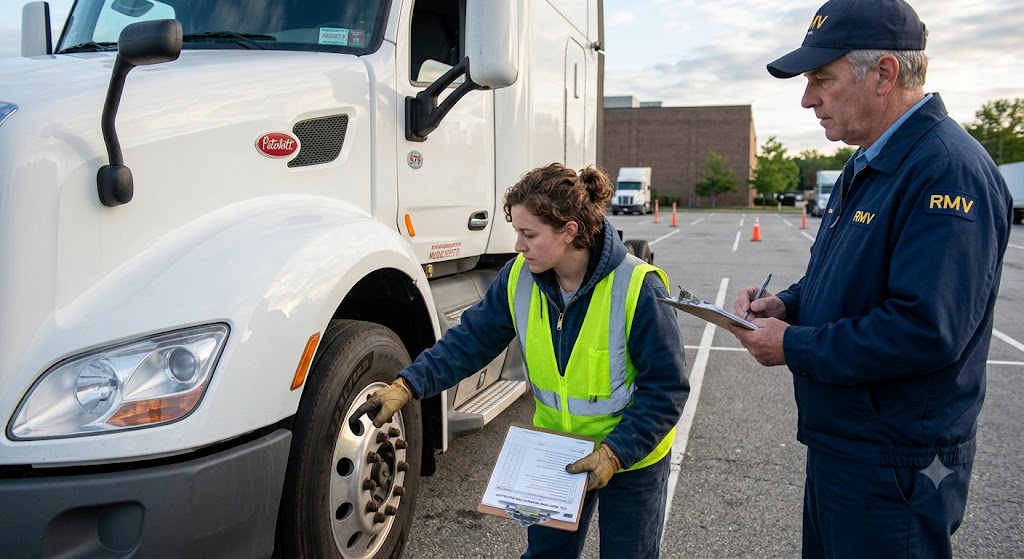
Additional Information
What the Course Entails and Exam Details
To prepare for the Pre-Trip Inspection, you must learn a systematic and comprehensive method for checking critical vehicle components. This isn't just about identifying parts; you must memorize the proper inspection procedure for every mandated item and understand what constitutes a safety defect.
Key areas covered include:
Engine Compartment Check: Inspecting fluid levels, belts, hoses, the air compressor, and looking for leaks.
Cab Check and Engine Start: Verifying all gauges, lights, horns, wipers, and, crucially, performing the emergency equipment check and the full air brake system check.
External Walk-Around: Checking tires, wheels, rims, suspension systems, braking systems, and all lights and reflectors around the entire vehicle.
Coupling System (for Class A): Inspecting the connection between the tractor and trailer (fifth wheel, kingpin, etc.).
Trailer Inspection (for Class A): Checking the side, rear, and landing gear of the trailer.
What to Expect in the Final Exam
The Pre-Trip Inspection is a hands-on, practical test conducted face-to-face with an official Massachusetts RMV examiner. It is not a written test. You will be required to physically walk around and interact with the vehicle you are testing in.
Format: You must point to or touch each item you are inspecting and clearly explain to the examiner what you are checking and why (e.g., "I am checking this tire for proper inflation, tread depth, and no cuts or bulges.").
Passing Score: The exam is pass/fail based on a point system. You must correctly identify and describe the condition of a mandatory minimum number of items. Missing safety-critical components—especially failing the air brake test—can result in an immediate failure.
Time Limits: There is no strict official time limit, but you must complete the inspection efficiently. Unnecessary delays or general unfamiliarity with the vehicle can result in a failure.
Specific Rules: The air brake test is scored separately and must be performed without error. You must bring a vehicle representative of the class you are applying for.
How to Study and Exam Centers
Preparation for this practical exam requires repeated, physical practice. It is highly recommended that you train with an experienced instructor or CDL school.
How to Study:
Use the Massachusetts CDL Manual: Study the official Pre-Trip Inspection section thoroughly—this is the source material.
Create or Use Checklists: Practice with the same checklist of components the examiner will use.
Memorize the Sequence: Learn the sequence of the walk-around so it becomes automatic.
Practice with a Vehicle: Spend significant time physically inspecting the type of vehicle you will use for the test. Point to the parts and say the required checks out loud.
Watch Demonstration Videos: Online videos illustrating a perfect Massachusetts Pre-Trip Inspection can be invaluable.
Exam Centers:
The CDL Skills Test, which includes the Pre-Trip Inspection, is administered exclusively at official Massachusetts RMV-designated skills test sites. You cannot take this exam online or via a portal like Pearson VUE. After obtaining your Commercial Learner’s Permit (CLP), you must schedule your appointment through the RMV’s automated system or website once you are ready for the practical test.
Job Opportunities from the Course
Passing the Pre-Trip Inspection and obtaining your CDL is the key that unlocks the door to a wide array of stable, well-paying career paths.
Some common job opportunities include:
Heavy and Tractor-Trailer Truck Driver (Long-Haul or Regional)
Bus Driver (School Bus, Charter, Transit)
Delivery Driver (CDL-required vehicles)
Cement Mixer or Dump Truck Driver
Refuse and Recyclable Material Collector
Tow Truck Operator
Hazardous Materials (Hazmat) Driver
Specialized Equipment Operator/Transporter
Frequently Asked Questions
Reviews
5.0
Based on 0 reviews
Leave a Review
No reviews yet. Be the first to review!