
Maryland CDL Practice Test
$69.00
- Buy to unlock unlimited access to all Quiz questions.
- After purchase you can print a PDF of the whole quiz at any point. The PDF will contain the questions and the correct answers.
About this Exam
The Maryland Commercial Driver's License (CDL) Practice Test is an essential preparatory tool for anyone seeking to operate a commercial motor vehicle (CMV) within the state of Maryland.
This test is designed for prospective commercial drivers who aim to secure their Class A, Class B, or Class C commercial driver’s license.
By passing the required knowledge and skills tests, individuals can embark on a rewarding career path that forms the backbone of regional and national logistics and transportation infrastructure.
Ready to test your knowledge?
Buy Now to Access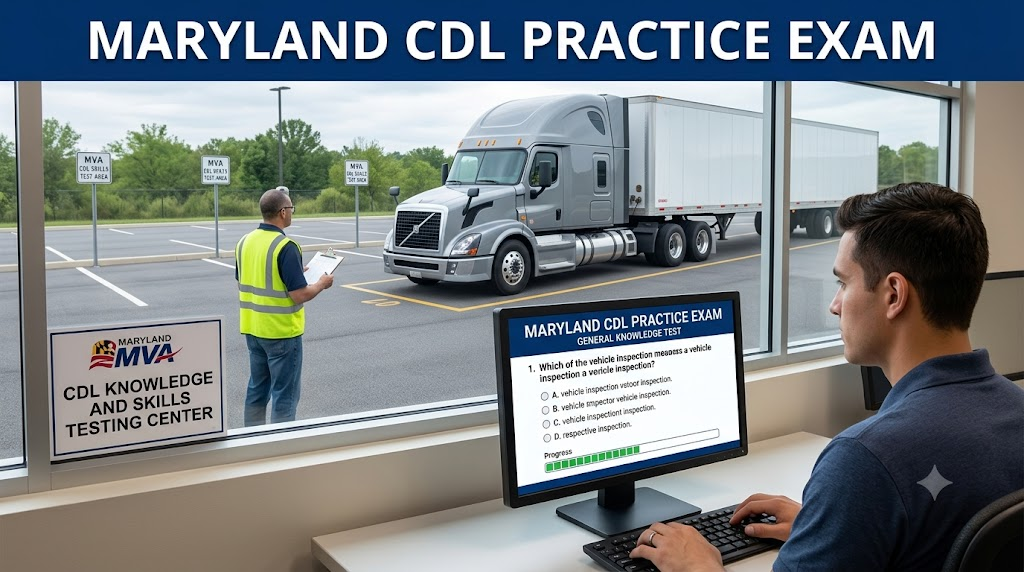
Additional Information
What the Course Entails and Exam Details
Preparing for the CDL in Maryland involves mastering a combination of theoretical and practical knowledge. The core topics covered in the comprehensive curriculum include:
General Knowledge: A foundational requirement, this section covers safety, cargo handling, pre-trip vehicle inspection, equipment operations, and fundamental state regulations.
Air Brakes: Critical for most large commercial vehicles, this endorsement requires specific knowledge of how air brake systems function and how to safely inspect and operate them.
Combination Vehicles: Essential for Class A applicants, focusing on the safe coupling, uncoupling, and handling of vehicle-trailer combinations.
Additional Endorsements: Students may also opt for training in specialized areas, including:
Passenger (P): For vehicles designed to transport people.
School Bus (S): Specific to school bus safety and operation.
Tanker Vehicles (N): For carrying liquid or gas cargo.
Hazardous Materials (H): A rigorous section covering the transportation of hazardous substances.
Doubles/Triples (T): For pulling multiple trailers.
The knowledge portion of the exam is conducted electronically, while the skills test evaluates your ability through a hands-on examination involving vehicle inspection and driving maneuvers.
What to Expect in the Final Exam
The actual Maryland CDL examination is divided into distinct stages.
The Knowledge Test
Format: Computer-based, multiple-choice questions.
Number of Questions: The General Knowledge test typically consists of 50 questions, while additional endorsement tests vary in size (e.g., 25–30 questions).
Passing Score: A minimum of 80% is required to pass each knowledge test section (e.g., 40 out of 50 for General Knowledge).
Language: The exam is administered in English only.
Restrictions: No reference materials, cell phones, or cheat sheets are permitted.
The Skills Test
Upon successful completion of the knowledge tests, you will receive a Commercial Learner’s Permit (CLP). After a mandatory minimum holding period and completing any required Entry-Level Driver Training (ELDT), you can schedule the skills test.
Format: Hands-on practical examination.
Three Key Sections:
Pre-Trip Inspection: A comprehensive inspection of the vehicle to identify potential safety issues.
Basic Control Skills: Demonstrated mastery of maneuvers like parallel parking, backing, and docking.
On-Road Driving: A guided drive on public roads to evaluate real-world driving competence.
How to Study and Exam Centers
Effective preparation is paramount.
How to Study
Official Manual: Read and study the official Maryland CDL Manual repeatedly. This is your primary resource.
Online Practice Tests: Take numerous online practice exams that simulate the computer-based format and question style of the actual Maryland test. These are an excellent way to gauge your readiness and identify weak areas.
CDL Training Schools: Enrollment in an authorized CDL training school in Maryland provides structured instruction, hands-on practice, and required ELDT.
Study Guides: Utilize well-structured study guides that break down complex topics into digestible content.
Exam Centers and Testing
Knowledge Tests: All electronic CDL knowledge tests are administered at full-service Maryland Motor Vehicle Administration (MVA) offices.
Skills Tests: Skills testing can be scheduled and taken at designated MVA skills testing facilities or through authorized third-party testers, including some commercial driving schools.
Requirements: You must pass all required knowledge tests to obtain a CLP and complete required training before the skills test. Ensure you have all necessary documentation, including a valid Maryland driver's license and a DOT Medical Certificate.
Job Opportunities from the Course
A Maryland CDL opens doors to a diverse and stable array of career opportunities. Successful candidates can apply for the following specific job titles:
CDL Class A Driver
CDL Class B Driver
Local Delivery Driver
Regional Truck Driver
Over-the-Road (OTR) Driver
Bus Driver (School, Charter, or Airport Shuttle)
Tractor-Trailer Operator
Flatbed Driver
Tanker Driver
Hazmat Transporter
Owner-Operator
Frequently Asked Questions
Reviews
5.0
Based on 0 reviews
Leave a Review
No reviews yet. Be the first to review!