
Manual Handling Practice Test
$69.00
- Buy to unlock unlimited access to all Quiz questions.
- After purchase you can print a PDF of the whole quiz at any point. The PDF will contain the questions and the correct answers.
About this Exam
Welcome to your essential study guide for the Manual
Handling Practice Exam. Manual handling is an integral skill in countless
industries, from construction and warehousing to healthcare and retail. It
encompasses any activity that requires a person to lift, lower, carry, push, or
pull a load using bodily force.
A manual handling certification is often a mandatory safety requirement, proving that you possess the necessary knowledge and practical skills to perform these tasks without causing injury to yourself or others. This practice test is specifically designed to help students, job-seekers, and professionals assess their readiness for the real certification exam, build confidence, and identify areas for further study. It's a proactive step towards a safer, more productive work life and new career opportunities
Ready to test your knowledge?
Buy Now to Access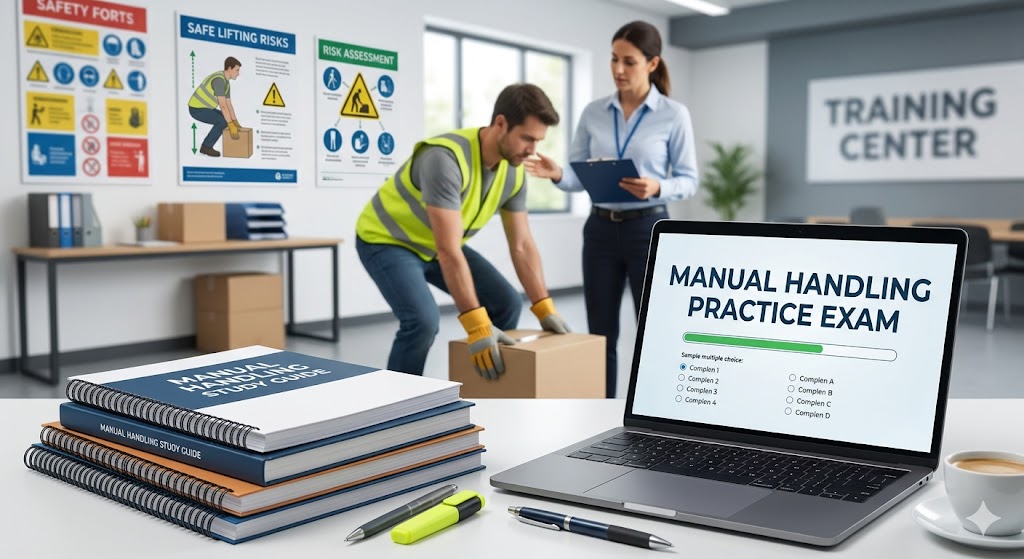
Additional Information
What the Course Entails and Exam Details
A manual handling course, and the corresponding exam,
focuses on teaching and evaluating safe working practices and the theoretical
principles behind them. This practice test aims to reflect the breadth of these
topics.
Core areas typically covered include:
- Understanding
Manual Handling: Definitions, the importance of safe practices, and
common injuries associated with poor technique.
- Legislation
and Responsibilities: A basic overview of health and safety laws,
employer duties, and employee responsibilities.
- Anatomy
and Physiology: How the body, particularly the spine, works during
lifting and the mechanics of potential injury.
- Risk
Assessment: Learning to identify hazards before any manual task and
the application of assessment tools like TILE (Task, Individual, Load,
Environment).
- Safe
Handling Principles: The core rules for lifting, carrying, lowering,
pushing, pulling, and teaming up to move objects. This includes posture,
grip, and foot positioning.
- Mechanical
Aids and Equipment: Recognizing when to use tools (trolleys, cranes,
etc.) to reduce risks.
The exact syllabus of a specific qualification may vary, but
these fundamentals remain constant and form the core of your practice test
questions.
What to Expect in the Final Exam
While formats can differ depending on the specific
certifying body or training provider, here is a general overview of what you
might encounter in a formal manual handling qualification exam. The practice
test you are preparing for is an simulation of this reality.
Theoretical Component (The common format for practice
tests):
- Format:
The primary component is often a multiple-choice question (MCQ) paper,
completed either online or in a physical testing center.
- Number
of Questions: Expect anywhere from 20 to 50 questions, each with a
single correct answer.
- Time
Limit: Typical time limits range from 30 minutes to an hour. It’s
crucial to manage your time effectively during the test.
- Passing
Score: Requirements can vary, but generally, a high score is expected
to demonstrate competence, often between 70% and 90%. Many providers
require a high percentage to pass.
Practical Component (Sometimes included in the full
qualification):
- Format:
In many cases, especially for full accredited qualifications, a practical
assessment will also be included. You will be observed by an instructor as
you demonstrate your ability to safely lift, move, or handle various
loads. You might be asked to assess risks, use safe techniques, and
potentially operate relevant aids. Passing the theoretical test is often a
prerequisite to the practical assessment. This practice test is focused on
the theoretical knowledge.
Be sure to confirm the specific format, number of questions,
passing mark, time, and whether a practical assessment is required for the
specific certification you are aiming for.
How to Study and Exam Centers
Preparation is key. Here are effective strategies to make
the most of your study time and approach your test with confidence.
- Engage
with Official Study Materials: If you're enrolled in a course,
carefully review the manuals, handbooks, online modules, or presentation
slides provided.
- Utilize
This Practice Test and Others: Take practice tests multiple times. Use
them not just to get a score, but to analyze why you got questions right
or wrong. Focus on the explanation of correct answers.
- Create
Study Aids: Use flashcards for key terms, legislation names, risk
assessment steps, and safe lifting rules.
- Study
the Laws and Guidelines: Familiarize yourself with the basic
principles of relevant health and safety legislation and guidelines
mentioned in your course materials.
- Apply
and Observe: Physically practice (with appropriate supervision and
caution!) the safe lifting techniques you learn. Observe others in the
workplace (with a safe distance and proper permission) and identify safe
versus unsafe practices.
- Form
a Study Group: Discussing concepts and quizzing each other can
reinforce learning.
- Time
Yourself: When comfortable with the material, take a practice test
under timed conditions to simulate the real exam pressure.
How & Where to Take the Real Exam:
When you are ready for the actual certification exam, the
process is typically as follows:
- Online
Portals: Many certifications, especially theoretical ones or the final
steps of an online course, can be taken through the training provider’s
secure online testing portal. You’ll log in and complete the test at a
scheduled time or at your own pace within a given timeframe.
- Testing
Centers: Some qualifications require you to take the exam at a
dedicated physical testing center. Major companies like Pearson VUE have
extensive networks of testing locations globally.
- Training
Schools and Employers: If your training is through a specific
authorized school or as part of workplace training, your exam will likely
be conducted directly by that institution or your employer, either at
their facilities or via a designated system they use.
Check with your training provider to understand the exact
procedures for scheduling and taking the final exam.
Job Opportunities from the Course
A manual handling certification is highly valued—and often
required—across many dynamic industries, significantly enhancing your
employability. Passing the manual handling test can unlock numerous job
opportunities and career paths.
Some common roles where this certification is essential or
highly beneficial include:
- Warehouse
Operative
- Construction
Labourer
- Healthcare
Assistant
- Support
Worker
- Delivery
Driver
- Courier
- Retail
Assistant
- Maintenance
Technician
- Factory
Worker
- Cleaner
- Gardener
/ Landscaper
- Removals
Packer
- Logistics
Coordinator
- Stock
Controller
Frequently Asked Questions
Reviews
5.0
Based on 0 reviews
Leave a Review
No reviews yet. Be the first to review!