
MAH SSC Practice Test & Exam Prep | India
$69.00
- Buy to unlock unlimited access to all Quiz questions.
- After purchase you can print a PDF of the whole quiz at any point. The PDF will contain the questions and the correct answers.
About this Exam
The Maharashtra State Secondary School Certificate (SSC) is the vital Class 10 examination conducted by the Maharashtra State Board of Secondary and Higher Secondary Education (MSBSHSE). This exam is a key milestone for students in Maharashtra, marking the successful completion of secondary education and opening diverse streams for higher studies (Class 11 & 12). Covering essential subjects like languages, mathematics, sciences, and social sciences, the MAH SSC is a foundation for future academic and career choices. Our comprehensive MAH SSC Practice Exam resource is designed to help students evaluate their readiness, identify knowledge gaps, and build the confidence necessary to excel in this life-altering examination. Strategic preparation ensures not only passing but achieving excellent grades for greater opportunities.
Ready to test your knowledge?
Buy Now to Access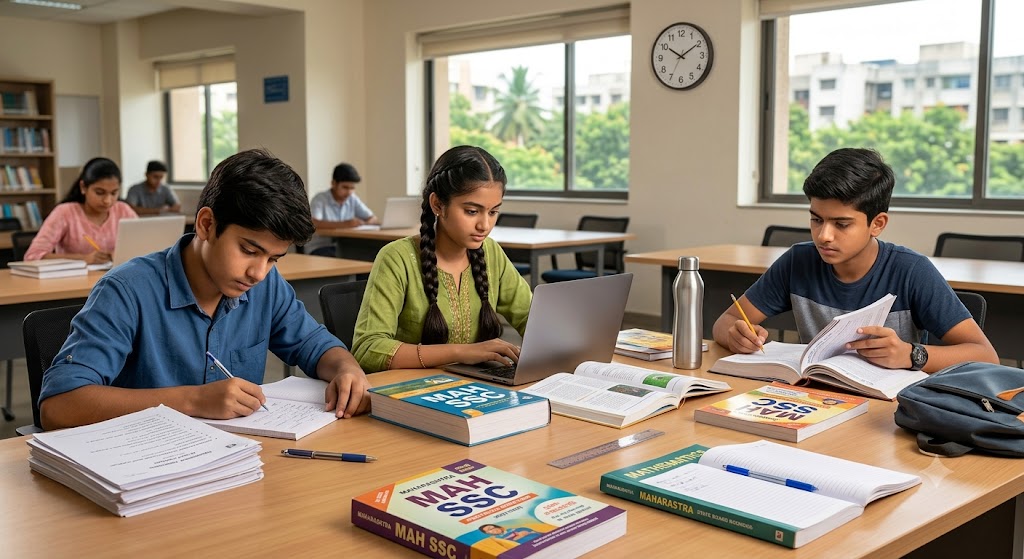
Additional Information
What the Course Entails and Exam Details
The MAH SSC curriculum encompasses a comprehensive range of subjects stipulated by the state board, aiming to build strong fundamental knowledge. The standard set of core subjects typically includes:
Languages: Students study multiple languages, often choosing from Marathi (First Language), Hindi, English (Second Language), or other optional languages, with a focus on literature, grammar, and composition.
Mathematics: Divided into Algebra and Geometry, emphasizing problem-solving skills, logical reasoning, theorems, and practical applications.
Science: A combined subject integrating concepts from Physics, Chemistry, Biology, and sometimes Environmental Science, covering fundamental scientific principles, laws, and experimental understanding.
Social Sciences: History, Political Science, Geography, and Economics, providing a foundational understanding of social structures, historic events, global geography, and economic systems.
Each subject's syllabus is thoroughly detailed by the board, ensuring a robust academic foundation. While students learn these subjects throughout the academic year in standard 10, the board exam comprehensively evaluates this entire learning across theoretical, practical, and internal assessments.
What to Expect in the Final Exam
The actual MAH SSC final examination is a combination of written theoretical papers and practical assessments.
Format: The primary component consists of lengthy, descriptive written examinations. These papers feature various question types, including very short answers, brief explanations, analytical questions, descriptive answers, problems requiring calculations and diagrams, and language compositions (essays, letter writing). Many practice tests also incorporate multiple-choice questions (MCQs) for efficient self-evaluation.
Practical Exams: Science subjects, computer science, and some technical or vocational subjects have integrated practical examinations that contribute significantly to the final score.
Scores and Grading: Marks are typically aggregated from written papers, internal school-based assessments, and practical scores. A minimum passing score of 35% is generally required in each subject to succeed. A comprehensive marksheet and grade point average are issued.
Time Limits: Theory papers for major subjects generally have a duration of about three hours, with specific time slots for language and other papers. The complete schedule spans over several days or weeks.
Rules and Conduct: Strict rules apply at examination centers, including prohibitions on electronic devices, strict adherence to timings, and standard board exam protocols. Hall tickets (Admit Cards) are mandatory for entry.
How to Study and Exam Centers
Strategic preparation is fundamental to excelling in the MAH SSC exam. Consider these effective strategies:
Structured Study Plan: Create a realistic and consistent study schedule covering all subjects, allocating extra time for challenging areas.
Understand Concepts: Focus on building a deep conceptual understanding rather than resorting to rote memorization. Practice explaining concepts to reinforce learning.
Practice with Previous Papers: Solving past years' board question papers and taking full-length, timed practice tests is arguably the most critical aspect of preparation. This builds speed, accuracy, and familiarity with the exam pattern.
Official Materials: Use official Maharashtra State Board textbooks as your primary study resource, supplementing with reliable reference materials, online content, and teacher guidance.
Regular Revision and Notes: Make concise revision notes, summarizing key formulas, definitions, and important points for rapid review. Schedule frequent revision sessions.
Seek Clarifications: Don't hesitate to ask teachers, mentors, or peers for help when you encounter difficulties. Consider joining group studies or coaching if needed.
Exam Centers: The physical examination centers for the MAH SSC are assigned to students across various schools and colleges throughout Maharashtra by the MSBSHSE. Your specific center information will be provided on your official Hall Ticket or Admit Card. Students typically register for the exams through their respective schools. Direct registration on external portals for the general board seats is not standard for school-going students. Private candidates follow specific state board guidelines. Ensure you locate your center beforehand and plan your logistics to arrive on time.
Job Opportunities from the Course
Achieving success in the MAH SSC acts as the crucial gateway to numerous educational and career pathways. While direct high-paying jobs solely on the basis of Class 10 are limited, it is an essential foundation for long-term career growth.
Post-SSC Educational and Career Paths:
Higher Secondary Education (Class 11 & 12): This is the most common trajectory, allowing specialization in streams like Science (paving way for Engineering, Medicine, Research), Commerce (for Chartered Accountancy, Management, Finance), or Arts/Humanities (leading to Law, Civil Services, Social Sciences, Media).
Polytechnic or Diploma Courses: Direct entry into technical diplomas in engineering or other fields, providing skilled job opportunities or lateral entry into undergraduate degrees.
Industrial Training Institute (ITI) Certifications: Practical training in technical trades (e.g., Electrician, Fitter, Mechanic), offering excellent direct employment prospects in industries, semi-government, and government sectors.
Vocational and Skill-based Courses: Short-term or long-term training in fields like travel, hospitality, retail, healthcare, design, and other services.
Paramedical and Nursing Assistant Courses: Basic entry-level health sector training.
Examples of Job Opportunities and Roles (Often with limited direct entry and/or further competitive exams or training):
Entry-Level Administrative Assistant (in small businesses or offices)
Data Entry Operator (requires computer proficiency)
Office Attendant or Peon (common in government and private sectors, often requiring competitive entry)
Skilled Tradesperson (Electrician, Fitter, Plumber, Mechanic - typically post ITI certification)
Technical Assistant (with specific diplomas)
Customer Service Representative
Sales Executive / Retail Associate
Delivery Personnel / Logistics Support
Entry-Level roles in Hospitality, Travel, and Tourism
Various positions in Armed Forces (Soldiers, etc., requiring physical tests and other criteria)
Some state and central government jobs (Group C & D posts, through specific competitive exams)
Frequently Asked Questions
Reviews
5.0
Based on 0 reviews
Leave a Review
No reviews yet. Be the first to review!