
MAH HSC Practice Test & Exam Prep | India
$69.00
- Buy to unlock unlimited access to all Quiz questions.
- After purchase you can print a PDF of the whole quiz at any point. The PDF will contain the questions and the correct answers.
About this Exam
The MAH HSC, or Maharashtra Higher Secondary Certificate examination, is a critical milestone for Class 12 students across the state of Maharashtra, India. Conducted by the Maharashtra State Board of Secondary and Higher Secondary Education (MSBSHSE), this exam serves as the qualifying gateway for students wishing to pursue higher education. Whether you are aiming for engineering, medicine, commerce, arts, or professional diplomas, your performance in the HSC exam is pivotal for securing admission to colleges and universities. It is designed to test the comprehensive understanding and academic readiness of students after two years of higher secondary education.
Ready to test your knowledge?
Buy Now to Access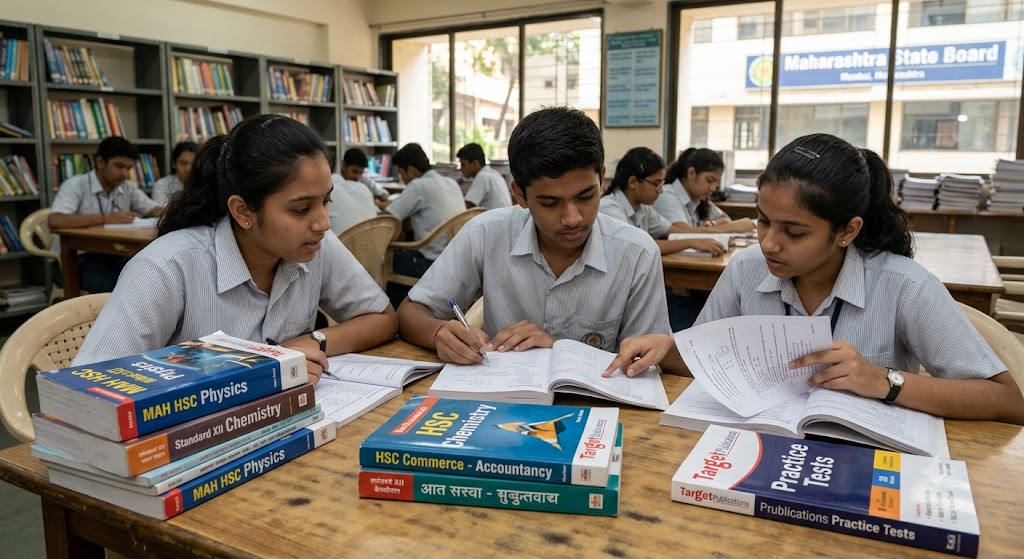
Additional Information
What the Course Entails and Exam Details
The HSC curriculum is diverse, offering specialized streams that cater to different academic and career interests. Students typically choose from one of three main streams: Science, Commerce, or Arts, alongside compulsory language subjects (usually English and a regional language).
Science Stream: Focuses on foundational scientific principles. Core subjects include Physics, Chemistry, Biology, and Mathematics. The syllabus covers advanced topics preparing students for competitive entrance exams in engineering and medical fields.
Commerce Stream: Concentrates on business and financial fundamentals. Key subjects include Book-keeping and Accountancy, Economics, Organization of Commerce and Management (OCM), and Secretarial Practice (SP) or Mathematics.
Arts Stream: Explores social sciences and humanities. Common subjects include History, Geography, Political Science, Sociology, Psychology, and Economics.
In addition to these stream-specific core subjects, students must also study compulsory languages and often have options for vocational subjects or IT.
What to Expect in the Final Exam
The MAH HSC final exams are primarily offline, pen-and-paper assessments conducted annually during February and March at designated centers across the state.
Exam Format: The major part of the assessment consists of descriptive written theory papers for each subject, typically ranging from 80 to 100 marks. For Science stream subjects and certain other courses, practical examinations or internal assessments (orals, projects) are also mandatory and contribute to the final score.
Time Limit: Most theory exam papers have a duration of 3 hours. It is essential for students to manage their time effectively to answer all descriptive, short answer, and objective questions within the given time.
Passing Criteria: To pass the HSC exam, students must secure a minimum percentage (usually 35%) in each subject, including both theory and practical/internal assessments where applicable.
How to Study and Exam Centers
Preparation for the MAH HSC requires a strategic approach and consistent effort. Utilizing quality practice tests and exam prep strategies is key to performing well.
Key Study Strategies:
Master the Syllabus: Thoroughly understand the prescribed MSBSHSE syllabus for all your subjects and prioritize topics based on their weightage in the exam.
Use State Board Textbooks: The official Balbharati textbooks are the primary resource. Study them meticulously, as the vast majority of exam questions are directly based on the content of these books.
Solve Previous Years’ Question Papers: This is perhaps the most crucial strategy. Practicing past papers helps you understand the exam pattern, question types, and time management requirements.
Take Online Practice Tests and Mock Exams: Take advantage of MAH HSC practice test platforms to simulate real exam conditions, assess your performance, identify weak areas, and improve your speed and accuracy.
Create a Study Schedule: Organize your study time effectively with a realistic timetable that covers all subjects, allowing dedicated time for revision and practice.
Exam Centers:
The MAH HSC examinations are conducted at numerous authorized schools and colleges (junior colleges) that serve as designated testing centers. The MSBSHSE assigns each registered student a specific exam center, which is clearly mentioned on the student's admit card (Hall Ticket). Students are required to travel to their assigned center to appear for the written theory and practical exams. It is not an online or home-based exam.
Career Paths and Higher Education Opportunities Unlocked by HSC
Successfully completing the MAH HSC unlocks diverse pathways for further education and eventual career opportunities. It is important to remember that most specialized careers require degree or diploma qualifications after the HSC.
Engineering Fields: Requires Science stream with Physics, Chemistry, and Mathematics (PCM), followed by entrance exams like MHT-CET or JEE for degree programs (B.E./B.Tech.).
Medical & Healthcare Professions: Requires Science stream with Physics, Chemistry, and Biology (PCB), followed by the NEET entrance exam for MBBS, BDS, AYUSH, and other allied health science courses.
Chartered Accountancy (CA) / Company Secretary (CS): Popular for Commerce students, requiring registration with professional bodies (ICAI/ICSI) and passing subsequent levels of examinations.
Business Management: Open to students of all streams, leading to BBA or BMS degrees, and later MBA programs.
Law (Integrated): Students can pursue 5-year integrated law programs (B.A. LL.B./B.B.A. LL.B.) after HSC through law entrance exams like MH CET Law (5 Years).
Information Technology & Computer Applications: Leads to BCA or B.Sc. (CS/IT) degree programs, offering entry into the software and IT industry.
Hospitality and Hotel Management: Offers degree or diploma courses in hotel management and catering technology.
Design & Architecture: Requires passing NATA (for B.Arch) or other design entrance exams (for B.Des).
Arts & Humanities Careers: Pursuing B.A. or B.A. (Hons.) degrees can lead to careers in teaching, journalism, social work, content writing, and public administration.
Government Sector Jobs (Entry Level): Certain entry-level government positions (e.g., clerks, constables) accept HSC as the minimum qualification, usually requiring additional competitive examinations.
Frequently Asked Questions
Reviews
5.0
Based on 0 reviews
Leave a Review
No reviews yet. Be the first to review!