
Lpi Practice Test & Exam Prep
Unlock the full practice quiz
Get complete access to the questions, explanations and printable quiz resources.
About this Exam
The Linux Professional Institute (LPI) Linux Essentials certificate is the foundational step into the world of open-source technology.
It is explicitly designed for students, career changers, and IT professionals who want to validate their fundamental knowledge of the Linux operating system and the open-source software landscape.
This vendor-neutral certification is an excellent entry point, verifying that a candidate can work with the Linux command line and understands basic productivity tools, security concepts, and administrative tasks. Earning this certificate shows employers you have a solid, practical understanding of Linux, making you a strong candidate for introductory IT roles.
Ready to test your knowledge?
Buy Now to Access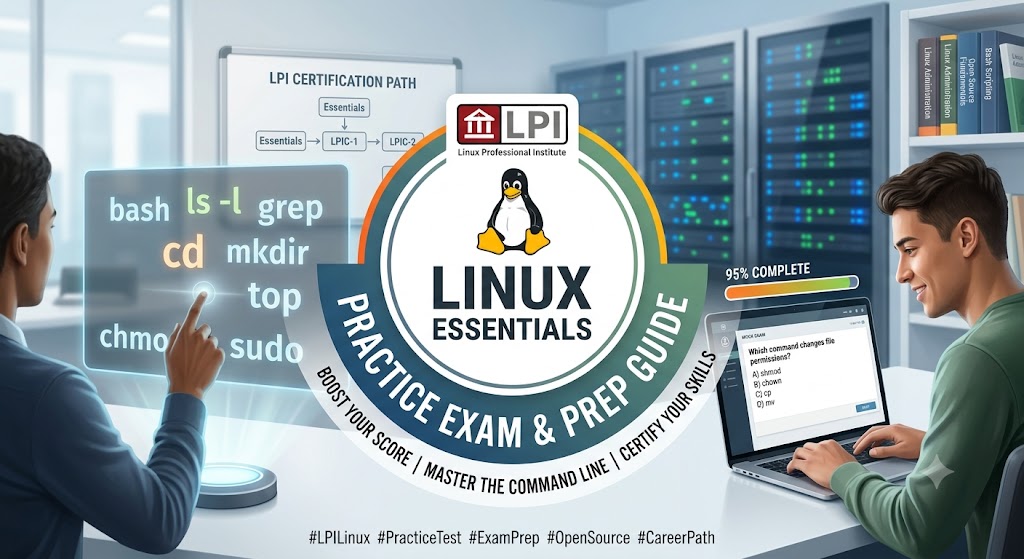
Additional Information
What the Course Entails and Exam Details
The Linux Essentials course or self-study material covers a fundamental syllabus essential for any Linux beginner. You can expect to dive into core topics such as:
The Linux community and a career in open source: Understanding the history, philosophy, and major distributions.
Finding your way on a Linux system: Navigating the command line, understanding file systems, and managing files and directories.
The power of the command line: Learning basic commands, using pipes and redirection, and scripting concepts.
The Linux operating system: Examining standard directories, important files, and how the system works.
Security and file permissions: Understanding user accounts, groups, and basic security measures.
Network configuration and troubleshooting: Basic networking concepts and tools relevant to Linux.
The detailed objectives are readily available on the LPI website, providing a clear roadmap for your study.
What to Expect in the Final Exam
The final LPI Linux Essentials exam is typically a multiple-choice and fill-in-the-blank test, often administered via computer. You will have a limited time to answer numerous questions covering the topics outlined in the syllabus. While specific details can change, you can generally expect:
Format: Primarily multiple-choice with some fill-in-the-blank questions.
Number of Questions: Around 40 questions.
Time Limit: Roughly 60 minutes.
Passing Score: LPI uses a scaled scoring system, with a pass typically requiring a score of 500 on a scale of 200 to 800. Be sure to check current requirements as they can be adjusted.
Exam Integrity: The exam is proctored, either in a physical center or increasingly through online platforms, ensuring fairness and validity.
How to Study and Exam Centers
Preparation is key to success on the Linux Essentials exam. Here are some actionable strategies:
Practice, Practice, Practice: The command line is best learned by doing. Practice commands and concepts in a virtual machine or a dedicated Linux environment. There are also many excellent online practice exams and quizzes available that simulate the real test format.
Utilize Official Resources: The LPI website provides detailed objectives and may offer recommended study guides or training partners. Leverage these official materials as your primary source of information.
Explore Study Guides and Books: Numerous publishers offer comprehensive study guides tailored to the Linux Essentials exam. Choose well-reviewed and up-to-date resources.
Engage with the Community: Online forums, study groups, and local Linux user groups can be invaluable for asking questions, sharing insights, and staying motivated.
Locating Exam Centers: You have options for taking the exam:
Physical Testing Centers: Use the Pearson VUE website to find authorized testing centers near you. These provide a structured environment for taking the proctored exam.
Online Proctoring: Pearson VUE also offers online proctoring, allowing you to take the exam from the comfort of your home or office, provided you meet certain technical and environmental requirements. Check for availability and current policies on the Pearson VUE and LPI websites.
Authorized Training Partners/Schools: Some academic institutions and training companies are authorized to administer LPI exams. Inquire locally about these opportunities.
Job Opportunities from the Course
Earning your Linux Essentials certification can open doors to various exciting career paths. While an entry-level cert, it demonstrates foundational knowledge highly valued in today's IT landscape. Potential job titles and roles include:
IT Support Specialist: Troubleshooting basic Linux-related issues.
Junior Linux System Administrator: Assisting with server maintenance and basic administrative tasks.
System Administrator Trainee/Apprentice: Starting a path towards full administration.
Cloud Support Engineer (Entry Level): Working with cloud platforms that heavily rely on Linux.
Network Associate (with Linux knowledge): Understanding foundational operating system concepts for networking.
Technical Support Engineer (Basic Linux Support): Providing support for products and services interacting with Linux systems.
Field Service Technician: Troubleshooting and maintaining computer systems, some of which may run Linux.
Help Desk Analyst (with Linux exposure): Providing initial support for Linux-using departments.
Junior DevOps Engineer (Entry Level): Assisting with deployment and infrastructure tasks, often Linux-based.
Data Center Technician: Helping with the physical and basic software maintenance of servers, largely running Linux.
Related Quizzes
Certified Wireless Network Administrator (CWNA)
Artificial Intelligence Programming Practice Exam
Frequently Asked Questions
Reviews
5.0
Based on 0 reviews
Leave a Review
No reviews yet. Be the first to review!