
Lower Saxony Abitur Practice Test & Exam Prep | Germany
$69.00
- Buy to unlock unlimited access to all Quiz questions.
- After purchase you can print a PDF of the whole quiz at any point. The PDF will contain the questions and the correct answers.
About this Exam
The Lower Saxony Abitur is the definitive certificate of general higher education entrance qualification within the German state of Niedersachsen. It represents the pinnacle of secondary education for students completing their studies at a Gymnasium or cooperative/integrated comprehensive school. Passing this exam grants graduates the formal right to study at any university in Germany and many institutions abroad. This pivotal examination is designed for high school students in their final two years of the "Qualifikationsphase."
Ready to test your knowledge?
Buy Now to Access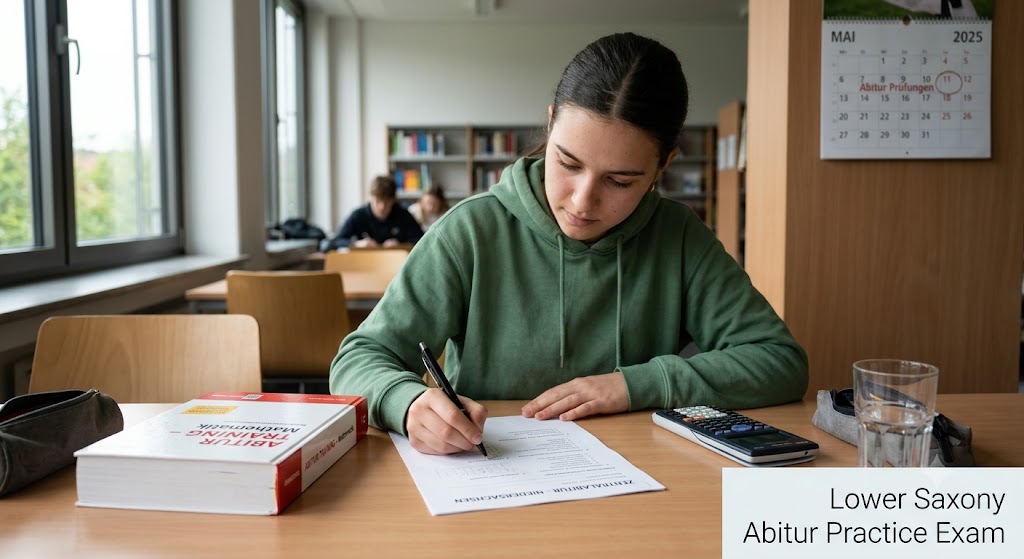
Additional Information
What the Course Entails and Exam Details
The preparation "course" isn't a single class but a comprehensive two-year curriculum known as the "Qualifikationsphase" (Q1 and Q2). Students select five examination subjects, classified from P1 to P5, which form the core of their final Abitur grade. Subjects P1, P2, and P3 are taken at an "erhöhtes Anforderungsniveau" (advanced level), requiring rigorous analytical skills. Subjects P4 and P5 are taken at a "grundlegendes Anforderungsniveau" (basic level). All examination subjects must cover three main academic fields: language/literature/arts, social sciences, and mathematics/natural sciences/technology. Furthermore, students choose a specific profile (Schwerpunkt) such as linguistic, mathematical-natural scientific, social scientific, or artistic-musically. The syllabus for each centralized exam is strictly regulated by the Lower Saxony Ministry of Education.
What to Expect in the Final Exam
The final Abitur examination consists of two main components: centralized written exams and one oral exam. The centralized written exams are administered for subjects P1, P2, P3, and P4 and typically last between three to five hours depending on the subject and level. For modern foreign languages, the written component also includes a standardized listening and speaking assessment. The fifth subject, P5, is always an oral examination held directly at the student’s school, focusing on presentation skills and impromptu dialogue. The scoring system differs from the standard German grading scale; students receive points ranging from 0 (insufficient) to 15 (excellent) in each exam. To pass the examination block, a candidate must achieve at least 100 points across the five exams, with at least three exams having a minimum of 5 points. Strict rules regarding authorized aids, such as calculators or dictionaries, vary significantly by subject and are published well in advance.
How to Study and Exam Centers
Success in the Lower Saxony Abitur requires a proactive and consistent study strategy over several months. You should transition from passive reading to active practice by regularly solving "Zentralabitur" problems from previous years. Dedicating specific time blocks to each subject helps maintain a balanced review schedule and reduces last-minute stress. Forming study groups can be highly effective for discussing complex topics and practicing the oral presentation for your P5 subject. Regarding "Exam Centers," you do not need to register at external testing centers like Pearson VUE. Your authorized Gymnasium or comprehensive school in Lower Saxony serves as your official examination center. The written exams are held simultaneously across the state, while your oral exam schedule is managed internally by your school.
Job Opportunities from the Course
While the Abitur itself is an academic qualification rather than vocational training, it is the fundamental requirement for prestigious higher education and competitive career paths. It unlocks the formal opportunity to apply for any university course, from Medicine and Law to Engineering and Psychology. It also makes you an ideal candidate for "Duales Studium" (Dual Study) programs, combining university theory with practical vocational training. The skills acquired—analytical thinking, research methodology, and discipline—are highly valued by employers globally. A strong Abitur performance establishes a foundation for diverse professional careers including:
Physician or Medical Researcher
Architect or Civil Engineer
Lawyer or Judge
Secondary School Teacher
IT Specialist or Software Engineer
Economist or Financial Analyst
International Business Manager
Frequently Asked Questions
Reviews
5.0
Based on 0 reviews
Leave a Review
No reviews yet. Be the first to review!