
Leea Practice Test & Exam Prep | United Kingdom
$69.00
- Buy to unlock unlimited access to all Quiz questions.
- After purchase you can print a PDF of the whole quiz at any point. The PDF will contain the questions and the correct answers.
About this Exam
The LEEA (Lifting Equipment Engineers Association) qualification is the gold standard for professionals working in the lifting and material handling industry across the United Kingdom and globally. This rigorous examination is designed specifically for engineers, inspectors, and technicians responsible for the thorough examination, maintenance, and testing of lifting equipment. Achieving LEEA certification demonstrates a high level of technical competence, ensuring compliance with stringent UK health and safety regulations, such as LOLER (Lifting Operations and Lifting Equipment Regulations 1998). It validates your expertise to employers and clients, confirming you are qualified to ensure the safety and integrity of critical lifting machinery
Ready to test your knowledge?
Buy Now to Access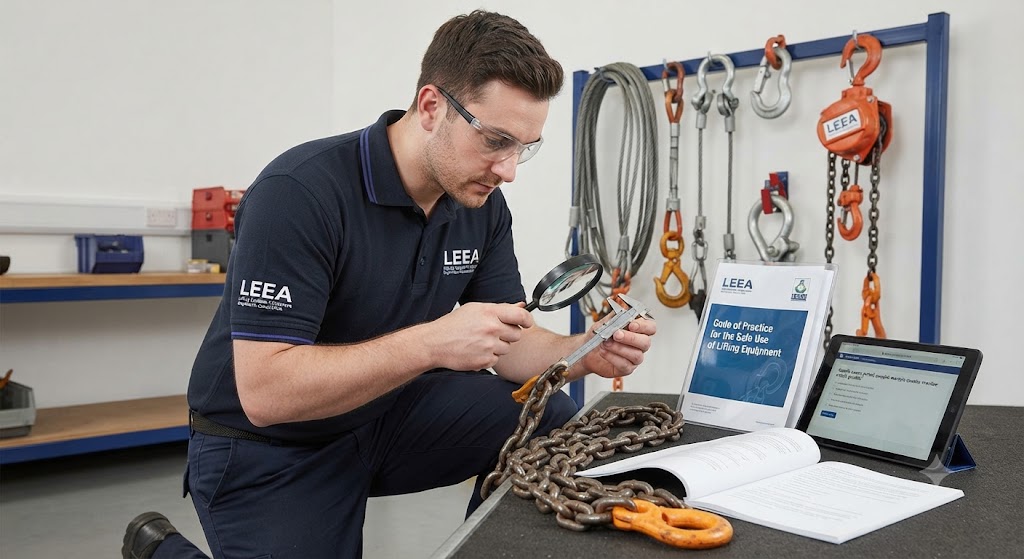
Additional Information
What the Course
Entails and Exam Details
To sit the final examination, candidates typically undertake
comprehensive training courses provided by LEEA-accredited training members,
either through classroom instruction, practical workshops, or structured
e-learning. The syllabus is extensive and meticulously crafted to cover both
theoretical knowledge and practical application. Core topics generally include:
- Legislation
and Standards: An in-depth understanding of UK regulations (primarily
LOLER and PUWER), relevant British Standards (BS EN), and ISO standards.
- Equipment
Identification and Terminology: Correctly identifying various types of
lifting gear and understanding their components.
- Theory
of Mechanics: Applying principles of stress, strain, friction, and
load distribution to lifting operations.
- Inspection
Procedures: Learning how to conduct thorough examinations, identify
defects (wear, corrosion, deformation), and determine when equipment must
be removed from service.
- Specific
Equipment Modules: Depending on the chosen qualification path,
candidates will study specific disciplines in detail, such as:
- Wire
Rope and Slings
- Chain
Slings and Components
- Lifting
Machines (manual and powered)
- Runway
Beams and Overhead Cranes
- Offshore
Container Inspection
The exam is challenging because it requires candidates to
apply their knowledge to real-world scenarios, often involving complex
technical diagrams and detailed inspection reports.
What to Expect in the Final Exam
The LEEA final examinations are notoriously thorough and are
conducted under strict conditions. The format typically involves two distinct
components that assess both theoretical understanding and practical judgment:
- Written
Theory Paper: This section often includes multiple-choice questions,
short-answer questions, and longer, essay-style questions that require
candidates to explain inspection procedures, cite relevant legislation,
and solve mechanical problems. The questions are designed to test not just
recall, but the ability to interpret and apply standards.
- Practical
Assessment: This is a crucial part of the LEEA examination process. Candidates
are presented with actual items of lifting equipment and are required to
perform a simulated thorough examination. They must identify pre-planted
defects, determine the serviceability of the equipment, and formally
record their findings on a mock Report of Thorough Examination (often
referred to as a "Report of Thorough Examination").
Passing Scores and Timing: The pass mark for LEEA
exams is typically high, reflecting the safety-critical nature of the role. For
most papers, a mark of 70% or higher is required to achieve a pass, with higher
distinctions often available for exceptional performance (e.g., 85% or 90%+).
Time limits are strictly enforced; candidates must complete the theory paper
within a set period (e.g., two to three hours) and the practical assessment is
also timed.
Key Rules: The examinations are closed-book.
Candidates are generally not permitted to bring textbooks, notes, or
personal electronic devices into the exam hall. In the UK, exams are overseen
by LEEA-appointed invigilators to ensure impartiality and integrity.
How to Study and
Exam Centers
Success in the LEEA exam requires a strategic and dedicated
study approach that goes beyond simply reviewing course notes.
Actionable Study Strategies:
- Master
the Course Manuals: Treat the official LEEA course materials as your
primary textbooks. Read them thoroughly, take detailed notes, and ensure
you understand every concept and procedure.
- Focus
on Legislation: You must have a comprehensive grasp of LOLER and
PUWER. Don't just know that a regulation exists; know what
it requires you to do in a specific inspection scenario.
- Practice
Defect Identification: The practical exam requires you to spot flaws.
Whenever you encounter lifting equipment in your workplace (safely and
with permission), practice identifying potential wear patterns, cracks,
corrosion, or distortions.
- Formulate
Inspection Reports: Practice writing out inspection findings clearly
and concisely. Your reports must be professional, accurate, and correctly
reference any standards used. Review past examiner reports if available to
understand common pitfalls.
- Use
LEEA Resources: Utilize any revision materials, sample questions, or
mock practical assessments provided by your LEEA training center.
- Group
Study: Discussing complex technical scenarios with colleagues who are
also preparing for the exam can deepen your understanding and reveal
knowledge gaps.
Exam Centers and Booking:
- Authorized
Training Centers: In most cases, you will sit your final exam at the
same approved training center where you completed your course. These
centers are audited by LEEA to ensure they meet strict examination
standards.
- LEEA
Events: Occasionally, LEEA may organize centralized examination
sessions, particularly for candidates who studied via e-learning or in
regions without a nearby accredited center.
- Booking:
Your training provider will typically manage the exam registration process
for you. It is essential to confirm the exact date, time, and location
well in advance. Ensure you are registered for the correct module (e.g.,
LEEA Lifting Equipment General Diploma, or specialized units like Advanced
Programme).
Job Opportunities
from the Course
Achieving LEEA certification is a significant career
milestone that opens doors to specialized and highly respected roles within the
engineering and safety sectors. Employers in industries such as construction,
oil and gas, manufacturing, maritime, and logistics actively seek qualified
LEEA personnel.
This certification unlocks the following career paths:
- Lifting
Equipment Engineer: Designing, testing, and certifying complex lifting
systems.
- Competent
Person (LOLER): Officially authorized to conduct thorough examinations
of lifting equipment as legally required.
- Principal
Inspector: Leading inspection teams and mentoring junior technicians.
- Technical
Surveyor: Providing expert consultancy on lifting safety and
compliance.
- Marine
Surveyor: Specializing in the inspection of lifting gear on ships,
ports, and offshore installations.
- NDE
Technician (Lifting Gear): Utilizing Non-Destructive Testing methods
(like MPI or Dye Penetrant) to inspect critical components of lifting
equipment.
- Safety
Officer / Manager: Specializing in the development and enforcement of
lifting operations safety protocols.
- Training
Instructor: Teaching LEEA-accredited courses to the next generation of
lifting engineers
Frequently Asked Questions
Reviews
5.0
Based on 0 reviews
Leave a Review
No reviews yet. Be the first to review!