
Lean Principles in Six Sigma Projects Practice Test
$69.00
- Buy to unlock unlimited access to all Quiz questions.
- After purchase you can print a PDF of the whole quiz at any point. The PDF will contain the questions and the correct answers.
About this Exam
The Lean Principles in Six Sigma Projects evaluation is
designed for professionals seeking to validate their knowledge of integrating
Lean methodology within standard Six Sigma project structures.
This specialized test focuses on the tools and concepts
necessary to accelerate processes by eliminating non-value-added activities
(waste) and optimizing flow.
It is ideal for current Yellow Belts, Green Belts, and Black
Belts, as well as project managers and continuous improvement specialists who
want to sharpen their efficiency toolkit.
Earning proficiency in this area demonstrates your ability
to not only deliver high-quality, defect-free products using Six Sigma
variation reduction but also to deliver them faster and more efficiently using
Lean speed and waste reduction.
This credential validates that you possess the duality of
understanding quality and efficiency, a combination that is highly coveted in
modern operational management.
Ready to test your knowledge?
Buy Now to Access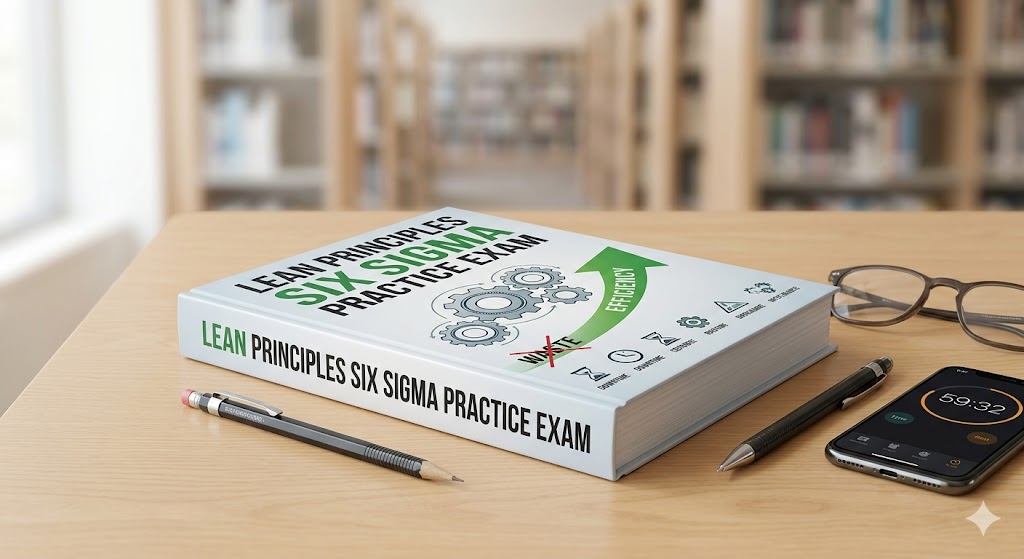
Additional Information
What the Course
Entails and Exam Details
To master this segment, candidates must understand how Lean
methodology complements the traditional Six Sigma DMAIC (Define, Measure,
Analyze, Improve, Control) framework.
The syllabus primarily covers the identification and removal
of the eight types of waste (known by the mnemonic DOWNTIME): Defects,
Overproduction, Waiting, Non-Utilized Talent, Transportation, Inventory,
Motion, and Extra-Processing.
Core competencies included within this focus area are the
application of Value Stream Mapping to visualize the flow of materials and
information, recognizing bottlenecks, and establishing a "pull"
production system.
Furthermore, students learn how to implement standard 5S
workplace organization, Kaizen (continuous improvement) events, Standardized
Work, and Jidoka (autonomation) to ensure process stability and reliability
during the "Improve" and "Control" phases.
Ultimately, the exam tests your ability to apply these tools
practically, ensuring that you can identify where a Six Sigma project needs to
lean on speed tools to succeed.
What to Expect in the Final Exam
While the exact structure is set by the specific certifying
body (e.g., ASQ, IASSC, or organizational specific certifiers), this practice
test is built to simulate a rigorous standard evaluation.
You should expect the final examination to consist primarily
of multiple-choice questions that assess both theoretical knowledge and
situational application.
A typical modular exam of this type may contain between 40
and 60 questions, depending on the difficulty and weight of the subject within
your certification path.
The passing score for these specialized modules is often set
relatively high, typically around 70% to 80% to ensure true proficiency.
You will usually have a strict time limit, ranging from 60
to 90 minutes, meaning you must be fluent with the terminology and tools to
answer efficiently.
Most of these exams are conducted as "closed-book"
tests, and depending on your chosen format, they may be proctored online or in
person.
How to Study and Exam Centers
The key to succeeding in this evaluation is a balanced
approach of study and application.
First, solidify your theoretical understanding by reviewing
your Lean Six Sigma training materials, paying special attention to standard
terminology like Muda (waste), Mura (unevenness), and Muri (overburden).
Next, apply that knowledge practically by analyzing your own
daily work or a real project for potential waste sources and creating a quick
Value Stream Map.
Finally, utilize this dedicated Practice Test as your
primary assessment tool; use it to discover your weak areas and revise those
topics until you achieve a consistent high score within the time limit.
When you are ready, you can take the official exam through
several avenues.
The most common option is an online proctored exam via
authorized portals such as PeopleCert or through a professional association's
recognized testing interface.
Alternatively, you may sit the exam in-person at physical
testing centers, such as those run by Pearson VUE, or at authorized business
schools and training academies where you completed your coursework.
Job Opportunities
from the Course
A certification that validates your ability to integrate
Lean and Six Sigma principles dramatically boosts your marketability across
diverse industries.
This skill set is sought after by organizations aiming to
maximize customer value while minimizing resources.
Specific career paths this specialized credential unlocks
include:
- Continuous
Improvement Specialist
- Lean
Six Sigma Project Manager
- Process
Analyst or Process Engineer
- Quality
Assurance Engineer
- Supply
Chain Analyst or Manager
- Operations
Manager or Supervisor
- Performance
Improvement Coordinator
- Lean
Practitioner
Frequently Asked Questions
Reviews
5.0
Based on 0 reviews
Leave a Review
No reviews yet. Be the first to review!