
KSEAB SSLC Third Language Practice Test & Exam Prep | India
$69.00
- Buy to unlock unlimited access to all Quiz questions.
- After purchase you can print a PDF of the whole quiz at any point. The PDF will contain the questions and the correct answers.
About this Exam
The KSEAB SSLC Third Language exam is a crucial component of the Secondary School Leaving Certificate (SSLC) examinations conducted by the Karnataka School Examination and Assessment Board (KSEAB). It represents a significant academic milestone for Class 10 students in Karnataka, testing their proficiency in a chosen third language—often Hindi, English, Kannada, or Sanskrit—and playing a key role in their overall SSLC score and future academic eligibility. Designed for students completing their secondary education, achieving a strong result in this exam is essential for matriculation and progression to higher secondary studies (Pre-University College/Class 11 & 12) within the state and across India.
Ready to test your knowledge?
Buy Now to Access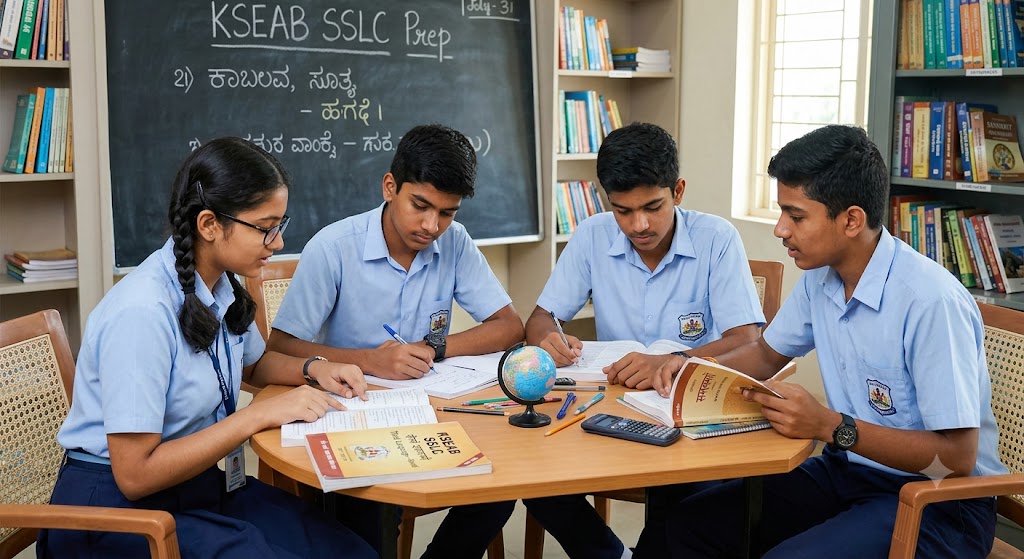
Additional Information
What the Course Entails and Exam Details
The syllabus for the KSEAB SSLC Third Language exam is structured to develop comprehensive language skills, covering reading comprehension, writing, grammar, and literature (where applicable). Students are required to choose one language to focus on, and the course aims to ensure they can communicate effectively, both written and orally (though the formal exam is written), in that chosen medium.
Key components commonly included in the curriculum and exam include:
Reading Comprehension: Analysis of unseen passages, poems, or short stories.
Writing Skills: Essay writing on various topics, letter writing (formal and informal), paragraph construction, and translation.
Grammar and Vocabulary: Extensive testing of grammar rules (tenses, parts of speech, active/passive voice, idioms, phrases), syntax, and vocabulary usage specific to the chosen language.
Literature (varies by language): Study of prescribed texts, which may include prose, poetry, and short plays, testing analysis, character understanding, and thematic interpretation.
Oral/Internal Assessment: A portion of the final grade may be allocated to internal assessments conducted by the school, evaluating speaking and listening abilities.
The final written exam typically carries 80 marks, with the remaining 20 marks coming from internal continuous and comprehensive evaluation (CCE) in school.
What to Expect in the Final Exam
The KSEAB SSLC Third Language final examination is a structured, pen-and-paper test conducted annually. While specific formats can vary slightly depending on the language chosen, the general structure includes:
Format: A written question paper featuring a mix of question types: objective (multiple choice, fill-in-the-blanks, true/false), short answer, and long answer/essay questions.
Duration: The total time allotted for the exam is generally 3 hours.
Total Marks: The written paper is typically out of 80 marks.
Passing Score: Students must achieve a minimum passing percentage—typically 35% overall (written + internal) to clear the exam, adhering to the broader SSLC passing requirements.
Rules: The exam is administered under strict invigilation in designated examination centers. Students must use standard blue or black ink and are prohibited from bringing any unauthorized materials into the exam hall.
How to Study and Exam Centers
Effective preparation for the KSEAB SSLC Third Language exam involves a combination of consistent study, practice, and smart strategy. Here are actionable methods:
Master the Syllabus and Textbooks: Thruoughly study the prescribed textbooks provided by KSEAB, as they form the core of the exam.
Solve Previous Year Question Papers: Practice solving multiple years' worth of past SSLC question papers under timed conditions to familiarize yourself with the question formats, weightage, and time management.
Focus on Grammar and Vocabulary: Dedicate significant time to mastering grammar rules and expanding your vocabulary daily, as this area is heavily tested.
Develop Writing Skills: Practice writing essays, letters, and paragraphs regularly, focusing on clarity, structure, correct grammar, and spelling. Seek feedback from teachers.
Utilize KSEAB Model Papers: The board often releases official model question papers, which are invaluable for understanding the expected structure and difficulty level of the upcoming exam.
Exam Centers: The final written examinations are held in numerous authorized physical centers (mostly registered high schools) across the state of Karnataka. Students are assigned specific exam centers based on their school and district, which will be clearly indicated on their official hall tickets issued by KSEAB prior to the examinations.
Job Opportunities from the Course
Successfully clearing the SSLC examination, including the Third Language requirement, primarily serves as a gateway to further education rather than direct career opportunities. It is the fundamental qualification for entry into Pre-University Colleges (PUC, Class 11 and 12) or equivalent higher secondary programs in India. Higher education levels and specialized certifications are typically needed for professional roles. However, possessing strong language skills acquired through this course can be beneficial for foundational roles such as:
Customer Service Representative (handling basic interactions in the third language)
Data Entry Operator
Office Assistant/Junior Clerk
Retail Sales Associate
Basic Translator (for routine documents, with further experience)
Content Writer/Proofreader (basic level, after intermediate studies)
Language Tutor (primary levels, with further certification)
Frequently Asked Questions
Reviews
5.0
Based on 0 reviews
Leave a Review
No reviews yet. Be the first to review!