
KSEAB SSLC Practice Test & Exam Prep | India
$69.00
- Buy to unlock unlimited access to all Quiz questions.
- After purchase you can print a PDF of the whole quiz at any point. The PDF will contain the questions and the correct answers.
About this Exam
The KSEAB SSLC (Secondary School Leaving Certificate) is the pivotal milestone for 10th-grade students in Karnataka, India. This comprehensive examination serves as the gateway to higher education, determining eligibility for Pre-University Courses (PUC) and various vocational training paths. The curriculum is specifically designed by the Karnataka School Examination and Assessment Board to test core competency across key academic disciplines. Passing this exam is often a mandatory prerequisite for both advanced academic pursuits and entry-level employment opportunities within India.
Ready to test your knowledge?
Buy Now to Access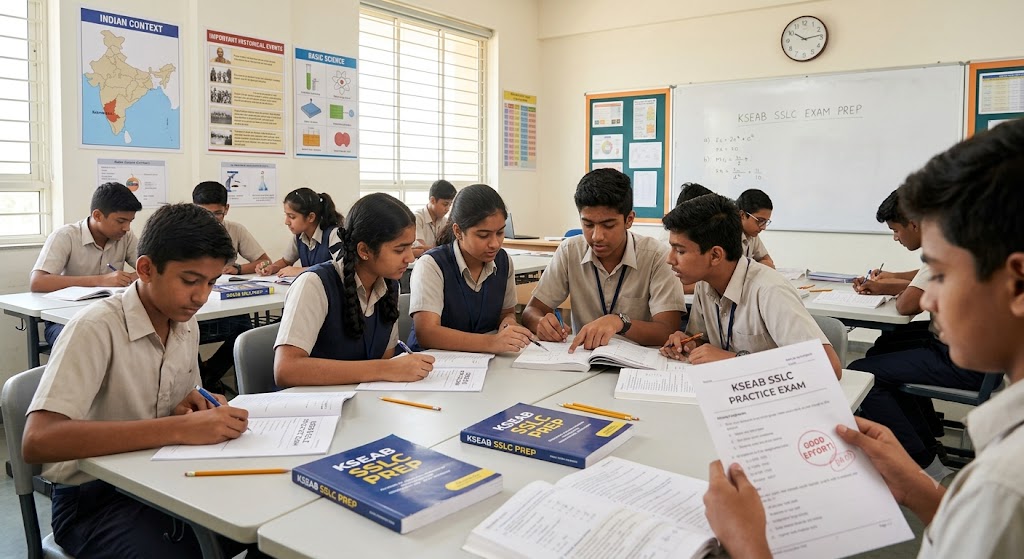
Additional Information
What the Course Entails and Exam Details
The KSEAB SSLC syllabus covers a diverse spectrum of subjects. The core academic disciplines include Mathematics, Science (Physics, Chemistry, and Biology), and Social Science (History, Civics, Geography, and Economics). Additionally, students are required to study three languages, which generally follow a first, second, and third language structure chosen from options such as Kannada, English, Hindi, Sanskrit, or other regional languages. The exam aims to rigorously evaluate a student's fundamental conceptual understanding, problem-solving abilities, and language proficiency developed throughout their secondary school years.
What to Expect in the Final Exam
The final examination typically spans several days, with a dedicated paper for each subject. It primarily utilizes a descriptive format, requiring students to provide detailed written answers, solve mathematical problems, and write essays. Some sections, particularly in the language and science papers, might include objective-type questions like multiple choice or fill-in-the-blanks. The total marks per paper generally range from 80 to 100, and a minimum passing score is required in both individual subjects and the aggregate total. Strict examination protocols are enforced by the board to maintain academic integrity.
How to Study and Exam Centers
To achieve optimal results, students are advised to adopt a consistent and structured study regimen. Reviewing official KSEAB textbooks and solving previous years' question papers is highly recommended to become familiar with the exam pattern and question styles. Utilizing practice tests and model question papers published by the board can significantly enhance time management and performance. The examinations are conducted in authorized, physical centers—often local schools within various districts—which are officially designated and strictly monitored by the board to provide a fair and standardized testing environment.
Job Opportunities from the Course
While a 10th-grade certificate is generally seen as an educational stepping stone, obtaining the KSEAB SSLC provides immediate access to a variety of promising career and vocational paths:
Pre-University Courses (PUC): Enrollment in PUC (Science, Commerce, or Arts), which is essential for almost all professional degrees (e.g., Engineering, Medicine, Business Administration).
Industrial Training Institutes (ITI): Admission to various technical and trade courses like electrical, mechanical, or civil engineering, leading to skilled technician roles.
Polytechnic Diplomas: Access to three-year engineering and technology diploma courses, often serving as a direct path to junior engineer positions.
Defense and Police Services: Eligibility for specific, entry-level recruitment drives (such as Soldier General Duty) within the Indian Armed Forces and state police departments.
Clerical and Administrative Roles: Opportunities to apply for junior clerk or assistant positions in various state government and public sector undertakings that list SSLC as the basic qualification.
Frequently Asked Questions
Reviews
5.0
Based on 0 reviews
Leave a Review
No reviews yet. Be the first to review!