
KSEAB SSLC Jts Practice Test & Exam Prep | India
$69.00
- Buy to unlock unlimited access to all Quiz questions.
- After purchase you can print a PDF of the whole quiz at any point. The PDF will contain the questions and the correct answers.
About this Exam
Welcome to your definitive guide to the KSEAB SSLC Junior Technical School (JTS) practice test and exam preparation path. The Secondary School Leaving Certificate (SSLC) JTS exam is a vital state-level assessment conducted by the Karnataka School Examination and Assessment Board (KSEAB) for 10th-grade students enrolled in Junior Technical Schools across Karnataka, India. This specialized qualification is designed for students seeking a foundation in technical and vocational skills alongside their core academic curriculum. It serves as a crucial stepping stone, validating their readiness for advanced technical education or entry-level roles in various industry sectors.
Ready to test your knowledge?
Buy Now to Access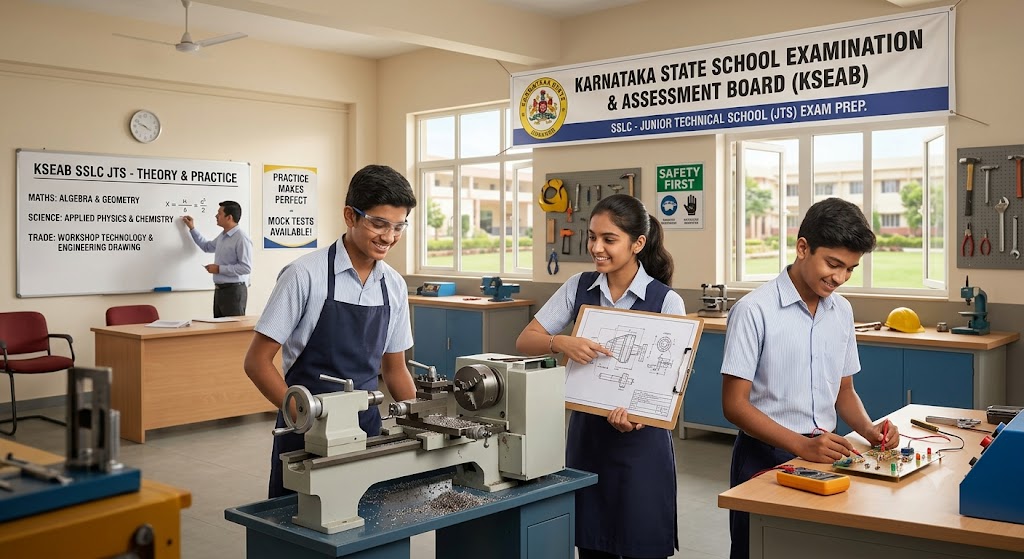
Additional Information
What the Course Entails and Exam Details
The SSLC JTS curriculum is a robust blend of academic learning and hands-on technical training. Students are not only tested on their theoretical knowledge but also on their practical application of skills. The course is structured to provide a well-rounded foundation. The syllabus encompasses a combination of core languages, general subjects, and distinct technical trades.
Core components include three languages (such as Kannada, English, and Hindi/Sanskrit) and core subjects including Mathematics and Science, often tailored to include technical context.
The cornerstone of the JTS program is the dedicated technical trade stream. Students specialize in a practical field, which can include but is not limited to, subjects like Mechanical Engineering Drawing, Electrical and Electronics Technology, Workshop Technology (covering areas like carpentry, fitting, welding), Computer Science applications, or Automotive technology. This focus equips students with pre-vocational skills.
The final evaluation includes a major assessment body: the official KSEAB SSLC board examination, typically held between March and April, consisting of theory papers for all language and core academic subjects.
Additionally, unlike standard SSLC candidates, JTS students must undergo mandatory practical examinations. These assess their proficiency in their chosen technical trade, conducted in authorized workshop and laboratory environments. The final results are a cumulative reflection of performance in both theory and practical components.
What to Expect in the Final Exam
Preparing for the SSLC JTS final exam means understanding its dual structure. The theory portion, mirroring the standard state board, involves offline (pen-and-paper) testing for languages, mathematics, and science. You can expect a mixture of multiple-choice questions (MCQs), very short answers, short answers, and long-form descriptive essays. Most academic theory papers are typically allotted 3 hours and 15 minutes.
The passing requirement is mandatory for success. You must secure a minimum aggregate of 35?ross all subjects to be declared pass. Furthermore, students must obtain at least 30% marks in each individual subject’s theory paper to qualify.
The practical examination is equally significant. It is a time-bound assessment where students are asked to perform a practical task, such as creating a model in the workshop, assembling an electrical circuit, or writing and running a computer program, based on their specialized trade syllabus. External and internal examiners evaluate candidates based on their technique, precision, and final outcome. Candidates must perform adequately in both theory and practicals to secure the overall certification.
How to Study and Exam Centers
Effective preparation for the SSLC JTS exam demands a balanced approach. Create a structured study timetable that gives equal weight to both academic theory and technical practice. For core subjects, rely on your prescribed KSEAB and NCERT textbooks, ensuring thorough conceptual understanding.
Leverage KSEAB SSLC JTS practice tests, previous year question papers, and model papers, available on the official KSEAB portal (kseab.karnataka.gov.in), to familiarize yourself with the question formats and marking schemes. Timed practice is crucial for improving speed and accuracy in theory papers.
For the technical component, utilize your school's workshop and laboratory facilities extensively. Regular hands-on practice is the only way to build speed and accuracy for the practical exam. Understand the logic behind every operation and diagram.
Regarding exam centers, the theory papers of the SSLC JTS examination are conducted in numerous physical testing centers throughout Karnataka, typically primary schools or pre-university colleges authorized by the board.
The practical examinations, requiring specialized equipment, are usually held at the candidates' own Junior Technical Schools or in other authorized technical institutions within the region that possess the necessary facilities. Your school will provide specific details about your assigned theory and practical centers.
Job Opportunities from the Course
A KSEAB SSLC JTS certification is a valuable asset that demonstrates strong foundational pre-vocational and academic skills, unlocking diverse career and educational pathways for students in India.
For many, it is the primary qualifier for direct lateral entry into second-year Diploma courses (Polytechnics) across various engineering branches, significantly shortening the path to becoming a certified Technician. It also provides an excellent foundation for pursuing ITI (Industrial Training Institute) certifications, leading to immediate employment.
Students who hold this certificate possess immediate entry-level job opportunities in several sectors, such as:
Assistant Mechanic in automotive or production industries.
Entry-Level Electrician or Electrical Assistant in maintenance and repair units.
Workshop Assistant in engineering units or manufacturing labs.
Technical Operator in production and assembly lines.
Draughtsman (Junior) for mechanical or architectural drawings.
Data Entry Operator or Junior IT Support in small-scale enterprises.
Many graduates also choose to leverage their practical skills to start their own small-scale technical service businesses or workshops, demonstrating entrepreneurial initiative.
Frequently Asked Questions
Reviews
5.0
Based on 0 reviews
Leave a Review
No reviews yet. Be the first to review!