
Kerala SSLC Practice Test & Exam Prep | India
$69.00
- Buy to unlock unlimited access to all Quiz questions.
- After purchase you can print a PDF of the whole quiz at any point. The PDF will contain the questions and the correct answers.
About this Exam
The Secondary School Leaving Certificate (SSLC) exam is a pivotal milestone for students in Kerala, India. Administered by the Kerala Pareeksha Bhavan (the State Education Board), this examination marks the completion of secondary education (Class 10).
A successful performance in the Kerala SSLC is essential, as it determines a student's eligibility for admission to higher secondary education (Plus Two), vocational higher secondary studies, or various polytechnic and technical courses. This exam tests comprehensive knowledge acquired throughout the 10th-grade curriculum and is a significant step toward future academic and career opportunities.
Ready to test your knowledge?
Buy Now to Access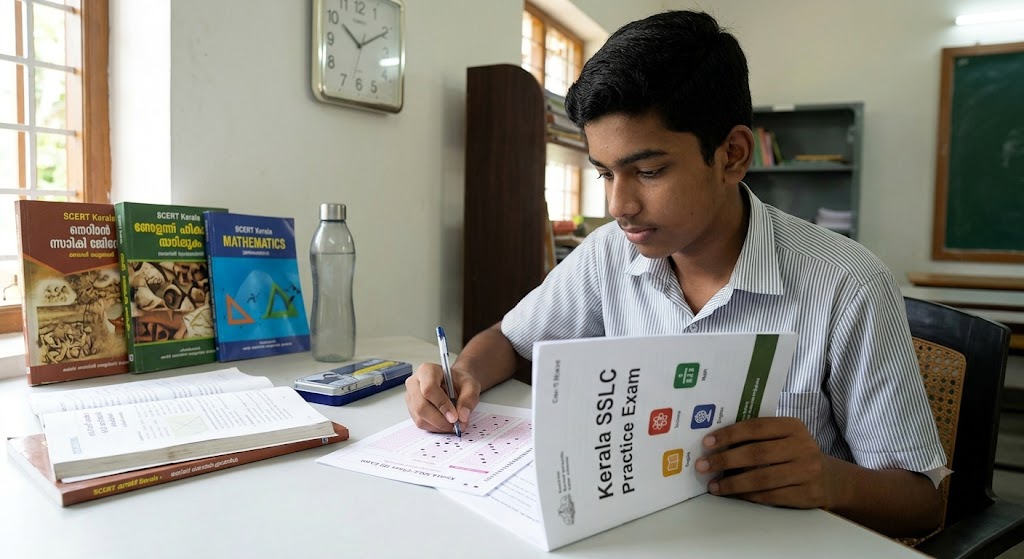
Additional Information
What the Course Entails and Exam Details
The Kerala SSLC curriculum encompasses a wide range of core subjects designed to provide a balanced education. The exam details reflect this broad scope:
Core Subjects: The primary examination covers English, Mathematics, Social Science, Physics, Chemistry, Biology, and First Language (usually Malayalam, Tamil, Kannada, or another approved language). There is also a Third Language option, often Hindi.
Assessment Structure: The final result is a combination of Continuous Evaluation (CE) scores, conducted internally by schools, and the final written public examinations conducted by the state board.
Syllabus: The questions are based on the textbooks and syllabus prescribed by the State Council of Educational Research and Training (SCERT), Kerala.
What to Expect in the Final Exam
The Kerala SSLC final written examinations are typically held over a period of two weeks, usually in March. Students should expect the following format for each subject paper:
Question Format: A mix of objective and descriptive questions. This includes multiple-choice questions (MCQs), very short answers, short descriptive answers, and essay-type questions that require in-depth explanations.
Duration: The exam duration usually varies between 1.5 to 2.5 hours per subject paper, depending on the maximum marks allocated.
Scoring and Grading: Rather than just total marks, the Kerala SSLC results use a comprehensive grading system. Students receive grades (such as A+, A, B+, B, etc.) for individual subjects and an overall grade based on their performance in both CE and written exams.
Strict Adherence to Rules: The examinations are conducted under strict supervision, and students must adhere to all board regulations regarding conduct, arrival times, and prohibited items.
How to Study and Exam Centers
A strategic approach to studying is crucial for success in the Kerala SSLC exam:
Actionable Study Strategies:
Thorough Revision: Focus heavily on the official SCERT textbooks, as they are the primary source for exam questions.
Solve Previous Question Papers: Practice consistently with past years' SSLC question papers. This helps familiarize you with the question patterns, mark distribution, and time management.
Utilize Mock Tests: Taking timed practice tests is essential for building confidence and improving speed. Focus on weak areas identified during these practice sessions.
Create a Timetable: Organize a balanced study schedule allocating dedicated time to each subject, ensuring consistent revision.
Exam Centers:
The Kerala SSLC examinations are not taken through online portals like Pearson VUE. They are conducted offline in designated physical testing centers.
These centers are typically government schools, aided schools, and some private schools across the state of Kerala and also include centers in Lakshadweep and select Gulf countries (for students studying in affiliated schools there).
Students are assigned specific exam centers based on their school and are notified well in advance.
Job Opportunities from the Course
While the Kerala SSLC is primarily an academic qualification enabling further education, achieving this certificate is a mandatory prerequisite for numerous career paths, including various entry-level government and technical positions. It unlocks several opportunities:
Eligibility for Higher Secondary (Plus Two) education.
Admission to Polytechnic Engineering Diploma courses.
Eligibility for Vocational Higher Secondary Education (VHSE).
Entry into Industrial Training Institutes (ITI) for technical trade courses.
Mandatory requirement for applying to numerous government jobs, including positions like Lower Division Clerk (LDC), Village Extension Officer (VEO), Police Constable, Last Grade Servants (LGS), and Indian Railway Group D posts.
Required for clerical and support staff roles in the private sector.
Frequently Asked Questions
Reviews
5.0
Based on 0 reviews
Leave a Review
No reviews yet. Be the first to review!