
K12 State Practice Test & Exam Prep
$69.00
- Buy to unlock unlimited access to all Quiz questions.
- After purchase you can print a PDF of the whole quiz at any point. The PDF will contain the questions and the correct answers.
About this Exam
State testing is a foundational component of every K-12 student's academic journey, assessing progress and ensuring that key educational standards are being met.
These essential assessments are designed for students across various grade levels, from elementary through high school, evaluating proficiency in core subjects and providing valuable insights into both individual student growth and school performance.
While the specific tests vary significantly by state, their collective purpose remains consistent: to measure learning benchmarks and ensure all students receive a quality education.
Ready to test your knowledge?
Buy Now to Access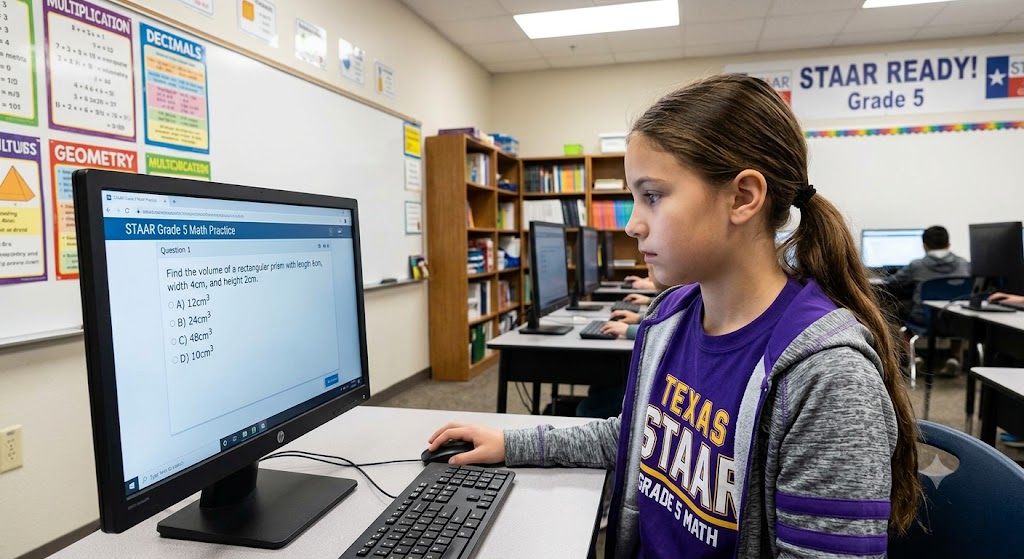
Additional Information
What the Course Entails and Exam Details
As these are assessments reflecting the entire K-12 curriculum, there isn't a single 'course' but rather years of learning across multiple disciplines.
The exam details are entirely specific to each state's department of education, covering essential topics appropriate for the relevant grade level.
Core areas typically tested include English language arts (reading and writing), mathematics, science, and social studies, with complexity increasing progressively.
Students and educators can access specific syllabus information, testing blueprints, and sample questions directly from their state's education website to understand precisely what concepts will be assessed.
What to Expect in the Final Exam
You can generally expect a combination of multiple-choice questions, which assess broad knowledge quickly and efficiently, and potentially short-answer or essay questions in subjects like English language arts to evaluate writing and critical thinking skills.
Most state tests are timed, with specific duration limits for each section, designed to challenge students while still being reasonable for the average prepared test-taker.
Passing score requirements differ widely between states and even specific tests; some states use proficiency levels rather than simple pass/fail scores.
It is crucial to understand that strict rules are enforced during administration, typically involving silence, no outside materials, and supervised environments, often within your own school.
How to Study and Exam Centers
Effective preparation is key to success and involves consistent practice using officially released materials and high-quality practice tests, which are invaluable for familiarizing yourself with the format and question types.
Focus your study efforts on understanding core concepts rather than just memorizing facts, and identify any weak areas early on to allow ample time for improvement.
Simulating test-day conditions during your practice sessions can help build stamina and reduce anxiety, making the actual experience feel more manageable.
For the actual K-12 state tests, these are almost always administered directly within your local school during regular school hours, so your teachers and school administrators will provide detailed schedules and location specifics; unlike professional certifications, you typically won't go to external testing centers like Pearson VUE.
Job Opportunities from the Course
Successful completion of K-12 education, culminating in these state assessments and ultimately a high school diploma, is a vital prerequisite for a vast array of future career opportunities and further education.
While the tests themselves do not grant specific job titles, achieving proficiency demonstrates core competencies that are essential for entry into the workforce and higher learning, opening doors to numerous paths.
Here are just a few examples of diverse career fields and entry-level roles that typically require a high school diploma or equivalent:
Customer Service Representative
Retail Sales Associate
Administrative Assistant
Entry-level Healthcare Support (e.g., Home Health Aide)
Construction Laborer
Food Service Worker
Delivery Driver
Receptionist
Warehouse Associate
Ultimately, strong performance on these exams and overall high school success provides a solid foundation for pursuing technical training, associate degrees, or bachelor's degrees, unlocking even more advanced and specialized career trajectories.
Frequently Asked Questions
Reviews
5.0
Based on 0 reviews
Leave a Review
No reviews yet. Be the first to review!