
K12 Assessment Practice Test & Exam Prep | United Kingdom
$69.00
- Buy to unlock unlimited access to all Quiz questions.
- After purchase you can print a PDF of the whole quiz at any point. The PDF will contain the questions and the correct answers.
About this Exam
Preparing for Key Stage 4 (K12) assessments in the United Kingdom, specifically the General Certificate of Secondary Education (GCSEs), is a pivotal moment in a student’s academic journey. These standardized exams, typically taken by students aged 15-16 (Year 11), are crucial milestones that determine future educational pathways, including A-Levels, T-Levels, apprenticeships, and vocational training.
This comprehensive exam prep resource is designed specifically for UK students, parents, and educators seeking effective, structured practice and revision strategies to navigate the complexities of the GCSE curriculum and maximize exam performance.
Ready to test your knowledge?
Buy Now to Access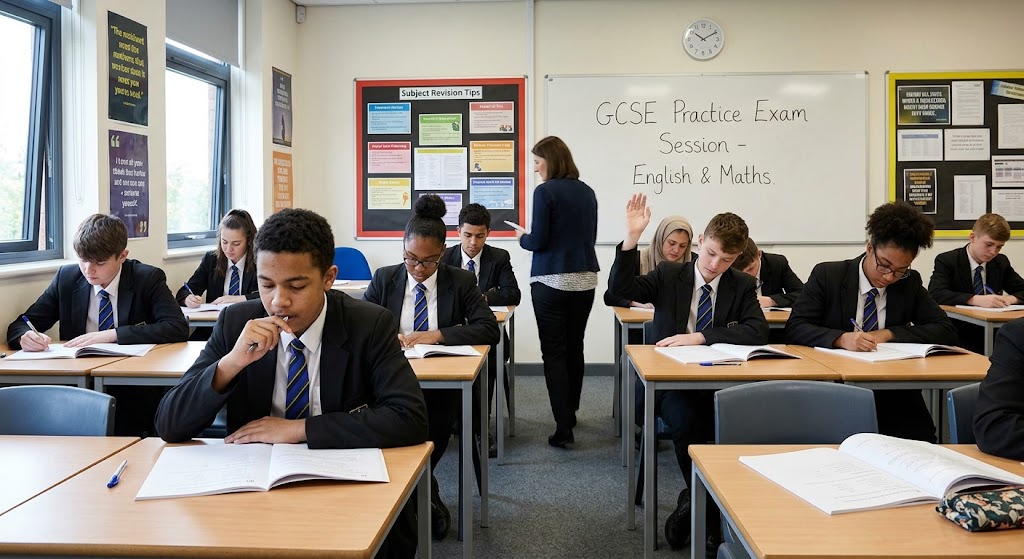
Additional Information
What the Course Entails and Exam Details
The GCSE curriculum covers a wide array of subjects, categorized into core and optional subjects. Students typically study between 7 to 10 subjects.
Core Subjects: These are mandatory for most students in the UK:
English: Including English Language and English Literature.
Mathematics: Covering number, algebra, ratio, geometry, measures, probability, and statistics.
Science: Students take either Combined Science (worth two GCSEs) or separate sciences (Biology, Chemistry, and Physics).
Foundation & Optional Subjects: Schools offer a variety of options based on their resources, including:
Modern Foreign Languages: French, Spanish, German, etc.
Humanities: History, Geography, Religious Studies.
Arts: Art & Design, Music, Drama, Media Studies.
Technical & Vocational: Design & Technology, Computer Science, Physical Education, Business Studies.
The "course" entails two years of study (Years 10 and 11), following strict specifications set by UK examination boards such as AQA, Pearson Edexcel, OCR, and WJEC Eduqas.
What to Expect in the Final Exam
While the exact format varies by subject and exam board, students can expect a mixture of assessment methods:
Exam Format:
Written Exams: The majority of GCSE assessments consist of structured, written papers taken under timed conditions. These include multiple-choice questions, short-answer questions, and longer, essay-style questions.
Non-Examination Assessment (NEA): Some subjects (like Art, Drama, or Design & Technology) include a coursework or practical project component which contributes to the final grade.
Assessment Timeline: The main GCSE exam series takes place annually between May and June. Results are typically released in August.
Passing Score & Grading: GCSEs in England are graded on a numerical scale from 9 (highest) to 1 (lowest).
A Grade 4 is considered a ‘standard pass.’
A Grade 5 is considered a ‘strong pass.’ Students who do not achieve a Grade 4 in English and Mathematics are usually required to retake these subjects in post-16 education.
Time Limits: Written exams vary in length, typically lasting between 1 hour 30 minutes and 2 hours 15 minutes per paper.
How to Study and Exam Centers
Successful GCSE preparation requires a proactive and organized approach.
Actionable Study Strategies:
Practice with Past Papers: This is the most effective strategy. Complete as many past exam papers as possible under timed conditions to familiarize yourself with the question formats, timing, and marking schemes.
Understand the Specification: Download the subject specification (syllabus) from your specific exam board (AQA, Edexcel, etc.). This outlines exactly what topics can be assessed.
Use Active Recall: Don't just re-read notes. Use flashcards, quizzes, and mind maps to actively test your memory.
Create a Revision Timetable: Start early and space out your revision for different subjects (spaced repetition).
Focus on Command Words: Understand what exam questions are asking (e.g., "Describe," "Explain," "Analyze," "Evaluate").
Exam Centers:
Students do not normally book GCSE exams independently through external portals like Pearson VUE.
Registered Schools and Colleges: For the vast majority of students, the school or college where they are studying is their registered exam center. The school handles all administration and entries with the exam boards.
Private Candidates: If you are home-schooled or resitting exams independently, you must find an authorized school or college willing to host you as a private candidate. You will be responsible for finding a center and paying the associated entry fees.
Job Opportunities from the Course
Achieving strong GCSE results is the foundational step required to unlock nearly all subsequent career and educational paths in the UK.
Immediate Progression Routes:
A-Levels: The traditional route to university entry.
T-Levels: Technical qualifications equivalent to 3 A-Levels, focusing on vocational skills.
Apprenticeships: Combining paid work with structured training.
Further Education Colleges: Pursuing Level 3 vocational diplomas (like BTECs).
Frequently Asked Questions
Reviews
5.0
Based on 0 reviews
Leave a Review
No reviews yet. Be the first to review!