
Judiciary Recruitment Practice Test & Exam Prep | India
$69.00
- Buy to unlock unlimited access to all Quiz questions.
- After purchase you can print a PDF of the whole quiz at any point. The PDF will contain the questions and the correct answers.
About this Exam
The Judiciary Recruitment Practice Test & Exam Prep is a comprehensive educational resource designed for aspiring legal professionals in India who aim to secure a position in the state judicial services. This exam prep is tailored for law graduates, typically holding an LLB degree, who are preparing for the highly competitive Judicial Services Examination, also known as the PCS (J)—Provincial Civil Service (Judicial) exam. The process selects individuals for appointments to the lower judiciary, placing them on a direct path to becoming a judge within a state's legal system. Our practice materials simulate the rigor of the actual exam, providing candidates with the essential tools and knowledge to excel and begin their career in public service.
Ready to test your knowledge?
Buy Now to Access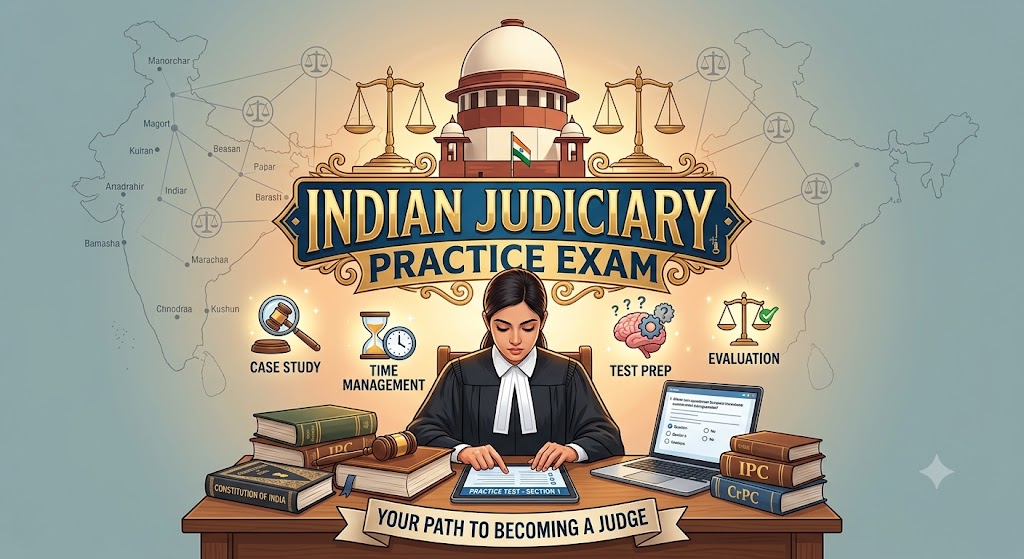
Additional Information
What the Course Entails and Exam Details
This practice exam preparation course meticulously covers
the extensive syllabus required for the Indian Judicial Services Examination,
which can vary slightly from one state to another. The core focus is on
fundamental legal principles and procedural laws that form the bedrock of
judicial work. Candidates will delve into key subjects, including the
Constitution of India, the Indian Penal Code (IPC), the Code of Criminal
Procedure (CrPC), and the Code of Civil Procedure (CPC). Additionally, the prep
entails a deep understanding of the Indian Evidence Act, the Indian Contract
Act, the Transfer of Property Act, specific relief, limitation laws, and
personal laws (Hindu and Muslim laws). Many state-specific exams also include
papers on general knowledge, current affairs, language proficiency, and local
laws. Our comprehensive prep includes simulated tests, detailed explanations,
and performance analytics to ensure a thorough grasp of every topic.
What to Expect in
the Final Exam
The official final examination for Judiciary Recruitment in
India is not a single test but a competitive process comprising three
sequential stages: Preliminary, Mains, and the Interview (Viva-Voce).
Preliminary Examination: This is the first hurdle,
consisting of objective-type Multiple Choice Questions (MCQs). It serves as a
qualifying round, and the scores are not typically added to the final merit
list. The syllabus for the Prelims includes law subjects and often a general
knowledge or aptitude paper, depending on the state.
Mains Examination: Candidates who clear the Prelims
are eligible for the Mains, which is a subjective, written exam. This stage
includes multiple descriptive papers, each focusing on a specific area of law,
general knowledge, and language skills (translation, essay writing). It is a
rigorous assessment of a candidate’s in-depth legal knowledge, analytical
ability, and writing skills.
Interview (Viva-Voce): The final stage is a personal
interview conducted to assess the candidate's personality, character,
suitability for the role of a judge, and general awareness. The final selection
is made based on the combined marks of the Mains and the Interview. Specific
passing marks and time limits for each paper differ across states, making it
crucial to check the official notification for the respective State Public
Service Commission or High Court.
How to Study and
Exam Centers
Effective preparation requires a multi-pronged strategy.
Candidates should begin with a thorough reading of the Bare Acts, as a strong
grip on statutory language is fundamental. Making concise notes, focusing on
landmark judgments and recent legal developments, and practicing answer writing
for the Mains are critical steps. Regular mock tests and practicing previous
years' question papers help in time management and understanding the exam
pattern. The practice materials, including simulated tests and sectional preps,
are designed for flexible, online access, allowing you to study anytime and
anywhere via dedicated educational portals.
However, it is essential to distinguish between the practice
platform and the official final exam. The actual Judicial Services Examinations
are not conducted online by private vendors. They are official examinations
managed by the respective State Public Service Commissions or state High
Courts. The final exams are almost always held as pen-and-paper or
computer-based tests in designated, physical testing centers across various
cities within that particular state, as notified in the official exam
notification.
Job Opportunities from the Course
Successfully navigating the Indian Judicial Services
Examination opens a prestigious and rewarding career path within the state
judiciary. The examination directly recruits individuals into the Lower
Judiciary, which serves as the foundational level of the judicial system. Upon
selection and successful completion of training, the career trajectory
typically progresses through the following roles and ranks:
- Civil
Judge (Junior Division) / Judicial Magistrate (Second Class)
- Civil
Judge (Senior Division) / Chief Judicial Magistrate (CJM) / Chief
Metropolitan Magistrate (CMM)
- Additional
District Judge (ADJ) / Additional Sessions Judge
- District
and Sessions Judge
Frequently Asked Questions
Reviews
5.0
Based on 0 reviews
Leave a Review
No reviews yet. Be the first to review!