
Jee Arch Practice Test & Exam Prep | India
$69.00
- Buy to unlock unlimited access to all Quiz questions.
- After purchase you can print a PDF of the whole quiz at any point. The PDF will contain the questions and the correct answers.
About this Exam
The JEE Arch (Joint Entrance Examination Main Paper 2) is a rigorous, national-level entrance test in India designed for students aspiring to pursue undergraduate architecture and planning programs (B.Arch and B.Plan) at prestigious institutions like National Institutes of Technology (NITs), and other leading technical universities. It assesses a candidate's aptitude for drawing, visualization, and general awareness relevant to the world of design and construction, selecting those with the creative and analytical potential to shape the future of our built environment.
Ready to test your knowledge?
Buy Now to Access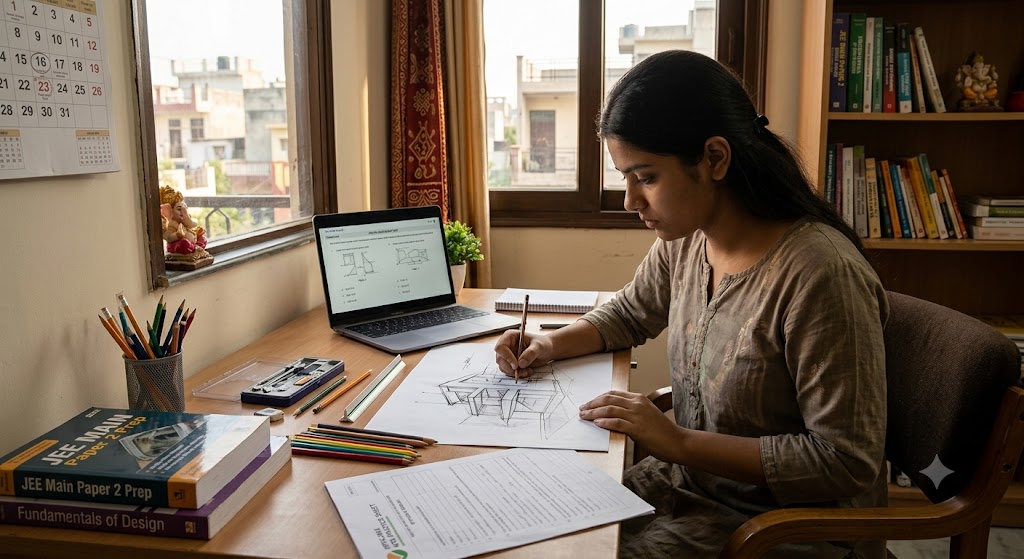
Additional Information
What the Course Entails and Exam Details
The JEE Arch examination covers distinct sections crucial for future architects and planners. The Drawing Test evaluates essential skills such as observation, imagination, 2D and 3D visual creation, perspective sketching, and architectural rendering. Candidates must produce intricate sketches and designs within a limited timeframe. The Aptitude Section tests reasoning, space perception, general awareness of building design and materials, and creative ability through various question formats. Additionally, the Mathematics Syllabus covers key concepts typical of higher secondary education (e.g., algebra, trigonometry, coordinate geometry, calculus, vectors, and three-dimensional geometry) applicable to the technical aspects of architecture and construction.
What to Expect in the Final Exam
Prepare for a demanding exam structured into two distinct formats over a single session, typically three hours long. The Mathematics and Aptitude sections are conducted as a Computer Based Test (CBT), featuring Multiple Choice Questions (MCQs) and specific numerical input questions designed to measure speed and analytical accuracy. The unique Drawing test, however, is a supervised Pen-and-Paper based assessment. You will be provided with specific paper, but you must bring your own drawing and sketching materials (pencils, geometry instruments, colored pencils/crayons, as allowed in the official guidelines). Rankings are determined by performance across all segments, emphasizing the need for excellence in both technical and creative abilities.
How to Study and Exam Centers
Effective preparation for the JEE Arch requires a balanced approach to creative skill building and academic study. Maintain a consistent practice schedule, dividing time among Mathematics revision, Aptitude reasoning practice, and, most importantly, regular timed sketching and design exercises to enhance speed and visualization. Utilize high-quality study guides, previous years’ question papers, and comprehensive mock tests to familiarize yourself with the exam environment and improve time management. Dedicated and structured practice is key.
The JEE Arch exam is administered at numerous physical test centers across major cities in India, chosen by the National Testing Agency (NTA). You will select your preferred test center location during the online registration process on the official NTA website. Your exact exam center assignment for both the online and drawing portions will be indicated on your admit card, so ensure you check this well in advance and plan your travel accordingly.
Job Opportunities from the Course
Successfully clearing the JEE Arch and earning an undergraduate degree in Architecture or Planning (B.Arch or B.Plan) opens doors to a diverse range of rewarding and impactful career paths in the dynamic field of design and the built environment. Specific job opportunities and career paths include:
Licensed Architect
Urban and Town Planner
Interior Designer
Landscape Architect
Conservation Architect
Architectural Drafter/Technologist
CAD/BIM Manager
Architectural Professor or Researcher
Project Manager (Construction and Design)
Entrepreneur in Design and Architecture
Frequently Asked Questions
Reviews
5.0
Based on 0 reviews
Leave a Review
No reviews yet. Be the first to review!