
ITI NCVT Automotive Practice Test & Exam Prep | India
$69.00
- Buy to unlock unlimited access to all Quiz questions.
- After purchase you can print a PDF of the whole quiz at any point. The PDF will contain the questions and the correct answers.
About this Exam
The National Council for Vocational Training (NCVT) Automotive certifications are among the most respected and comprehensive vocational programs in India, operating under the Craftsman Training Scheme (CTS). These courses are specifically designed for students (typically 10th or 12th pass) who have a passion for automobiles and want to build a hands-on technical career in the bustling Indian automotive industry.
Whether you are specializing as a Mechanic Motor Vehicle (MMV) or Diesel Mechanic, this program equips you with the fundamental skills required by global manufacturers and local service centers.
The accompanying practice tests are your final frontier before the actual examination, designed to simulate the pressures of the NCVT CBT and validate both your theoretical engineering knowledge and your understanding of practical repair workshop protocols.
Ready to test your knowledge?
Buy Now to Access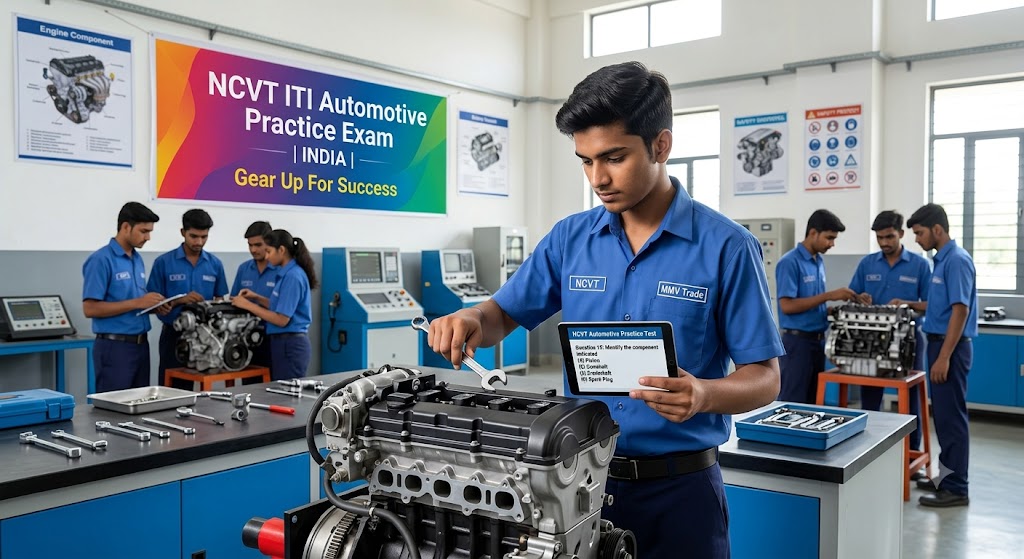
Additional Information
What the Course Entails and Exam Details
The ITI Automotive curriculum is a dynamic blend of workshop practice and classroom engineering science, structured to turn you into an industry-ready technician.
The core syllabus covers the complete anatomy of vehicles, including the detailed working principles of petrol and diesel internal combustion engines, fuel injection systems, and emission control standards (like BS-VI).
You will gain mastery over transmission systems (clutches, gearboxes, differentials), suspension geometry, steering mechanisms, and modern braking systems, including ABS and EBD.
A significant portion of the course now focuses on vehicle electronics, teaching you how to use diagnostic tools to troubleshoot Electrical Control Units (ECUs), sensors, actuators, and basic wiring faults that are common in modern computerized cars.
In addition to technical skills, you will be trained in employability skills, workshop safety, and engineering drawing, which are vital for career progression.
What to Expect in the Final Exam
The final NCVT trade assessment is a rigorous process that tests you on every aspect of the automotive trade.
The examination is split into two major components: the Trade Practical and the Trade Theory (CBT).
The Trade Theory exam is a Computer-Based Test (CBT) consisting of Multiple-Choice Questions (MCQs) that focus on your engineering knowledge, workshop calculation, and science.
Simultaneously, you will sit for the high-stakes Trade Practical exam, where you must demonstrate your hands-on skills before examiners by performing tasks like dismantling an engine, servicing a brake system, or diagnosing an electrical fault.
To pass and earn your National Trade Certificate (NTC), you generally need to secure a minimum of 40% in the Theory paper and a higher benchmark, usually 60%, in the Practical component.
The total duration of the exam varies by year but typically spans 2 to 3 hours for the CBT, with the practical exams extending over one or two days.
How to Study and Exam Centers
Effective preparation is the key to conquering the NCVT Automotive exam, beginning with a thorough understanding of the official syllabus.
The single best study strategy is to solve previous years’ NCVT question papers; this will familiarize you with the recurring question patterns, difficulty levels, and time management requirements of the CBT.
You must utilize online ITI mock test portals dedicated to the MMV and Diesel Mechanic trades; these timed tests are essential for building speed and accuracy for the multiple-choice section.
Do not overlook your practical training; dedicate extra time to your ITI workshop to master the actual use of tools, gauges, and diagnostic machinery, as theoretical knowledge alone will not pass the practical exam.
The theoretical CBT exam is conducted at specialized testing centers across India, which you must register for through the official NCVT MIS portal.
Your critical practical examination, however, will always be held at your respective Government or Private ITI center where you underwent your vocational training.
Job Opportunities from the Course
Earning your NCVT certification is a major milestone that unlocks numerous career paths within India’s massive automotive ecosystem.
Graduates are highly sought after by automobile manufacturers (OEMs) and their authorized service networks.
You can start your career with specific job titles such as Automotive Technician, Mechanic Motor Vehicle (MMV), or Diesel Mechanic.
Specialized roles are also available, including Auto Electrician, Service Advisor, Workshop Assistant, or Spare Parts Specialist.
Public sector opportunities exist in state transport corporations (like MSRTC, DTC) and Indian Railways.
Furthermore, this certification provides a solid foundation for entrepreneurship, enabling experienced technicians to start their own independent multi-brand garages or service centers.
Frequently Asked Questions
Reviews
5.0
Based on 0 reviews
Leave a Review
No reviews yet. Be the first to review!