
Irse Practice Test & Exam Prep | United Kingdom
$69.00
- Buy to unlock unlimited access to all Quiz questions.
- After purchase you can print a PDF of the whole quiz at any point. The PDF will contain the questions and the correct answers.
About this Exam
The Institution of Railway Signal Engineers (IRSE) Exam is the definitive professional benchmark for Railway Signal Engineers, both in the United Kingdom and internationally. This rigorous assessment is designed for aspiring and experienced engineers who wish to validate their expertise and gain formal recognition within the railway industry.
Achieving IRSE certification demonstrates a comprehensive understanding of railway signalling principles, technology, safety, and operational requirements. It is an essential qualification for career progression in the highly regulated UK rail sector, serving as a mark of competence for roles ranging from design and maintenance to project management and consultancy.
Ready to test your knowledge?
Buy Now to Access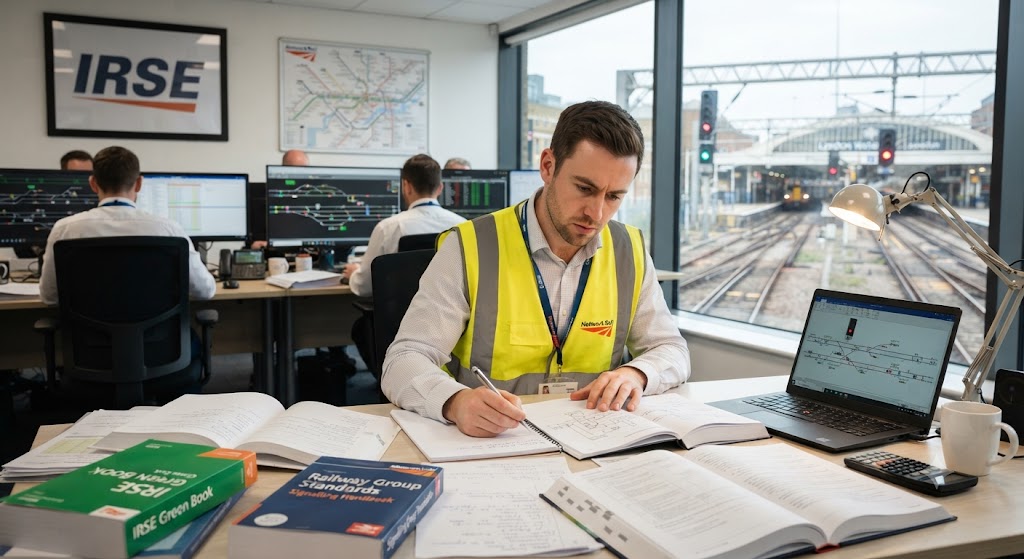
Additional Information
What the Course
Entails and Exam Details
The IRSE Exam is not based on a single, standardized course;
rather, it tests a candidate's overall knowledge accumulated through experience
and study across the broad scope of Railway Signalling and Telecommunications
(S&T) engineering. The syllabus is structured into several core modules
designed to assess both theoretical knowledge and practical application.
Candidates must demonstrate proficiency in key areas,
including:
- Fundamental
Signalling Principles: Understanding interlocking, train detection
systems (track circuits, axle counters), and signals.
- Legislation,
Standards, and Safety: Deep knowledge of the UK’s Railway Group
Standards, ORR (Office of Rail and Road) regulations, and the vital
importance of safety integrity (SIL levels).
- Signalling
Technology: Expertise in various types of signalling equipment,
including points operation, level crossings, and train protection systems
(e.g., TPWS, ETCS/ERTMS).
- System
Design and Engineering: The ability to design safe and efficient
signalling systems, including principles, schematics, and installation.
- Project
Management and Maintenance: Understanding the lifecycle of signalling
projects, from conception and design to installation, testing, and ongoing
maintenance.
The IRSE Exam structure involves a series of modules
(typically Modules 1 through 7, although this can vary based on the specific
certification level, such as the Professional Examination). Candidates must
often pass a combination of these modules to achieve the full IRSE Diploma or
License. The examination itself is known for being challenging, requiring
candidates to apply complex technical knowledge to real-world scenarios.
What to Expect in the Final Exam
The IRSE Exam format is primarily written, designed to test
depth of knowledge, analytical thinking, and the ability to communicate complex
engineering solutions clearly.
Here is what you can generally expect during the final
assessment:
- Exam
Format: The exams are typically essay-based or involve detailed
problem-solving questions. Candidates are often required to produce
sketches, diagrams, or calculations to support their answers. Multiple-choice
questions are rare; the focus is on demonstrating comprehensive
understanding.
- Time
Limits: Each module typically has a strict time limit, usually ranging
from two to three hours per paper. Time management is critical, as
candidates must answer multiple in-depth questions within this period.
- Content
Depth: The questions do not just test recall of facts; they test
application. You may be presented with a hypothetical signalling failure
or a design challenge and asked to propose a solution that adheres to all
safety and operational standards.
- Passing
Score: The required passing score for IRSE exams is generally set at a
high level (often 60% or higher per module) to reflect the professional
standard required.
- Exam
Rules: The exams are conducted under strict, formal conditions. Only
approved materials (such as specific, permitted standard documents) may be
allowed. Calculators and other electronic devices are usually prohibited
or strictly controlled.
How to Study and Exam Centers
Preparing for the IRSE exam requires a disciplined and
strategic approach. Because the exam covers such a vast field, passive reading
is insufficient.
Actionable Study Strategies:
- Master
the Syllabus: Obtain the official IRSE syllabus and use it as your
roadmap. Allocate study time to each module based on its weight and your
knowledge gaps.
- Study
the Standards: Your primary resources should be the relevant Railway
Group Standards (RGS) and the IRSE "Green Books" (the Signalling
Handbook series). You must be able to cite and apply these standards
accurately.
- Review
Past Papers: This is perhaps the most crucial strategy. IRSE publishes
past exam papers and examiners' reports. Analyze these reports to
understand what examiners are looking for, common pitfalls, and the
required level of detail in answers.
- Practice
Essay Writing: Under timed conditions, practice writing out answers to
past questions. Focus on structuring your response logically: identify the
core issue, cite the relevant standard/principle, explain the solution,
and justify your reasoning.
- Mentorship
and Discussion: Engage with colleagues who have already passed the
exam. Participate in local IRSE section meetings or online forums to
discuss technical problems and exam strategies.
Exam Centers and Registration:
The IRSE Professional Examination is held annually,
typically in October.
- Registration:
Candidates must register via the official IRSE website. You must ensure
your membership is up-to-date and that you meet the eligibility criteria
for the specific modules you wish to take.
- Exam
Centers: The IRSE organizes exam centers globally. In the United
Kingdom, exams are typically held in major cities (e.g., London,
Birmingham, York) to accommodate candidates nationwide. The specific
location of your exam center will be confirmed by the IRSE closer to the
exam date. It is essential to check the IRSE website for the exact dates,
registration deadlines, and a list of available UK centers.
Job Opportunities
from the Course
Achieving IRSE certification is a significant career
milestone for Railway Signal Engineers. It provides employers with tangible
proof of your competence and commitment to the profession.
This certification unlocks opportunities for advanced roles
and increased responsibilities across the UK rail industry:
- Senior
Signalling Designer: Leading the design of complex signalling schemes
for major projects (e.g., Network Rail renewals, HS2).
- Signalling
Principles Engineer: Acting as the technical authority for signalling
design, ensuring compliance with all safety and operational standards.
- Contractor's
Engineering Manager (CEM): Holding key technical leadership roles
within major railway infrastructure projects.
- IRSE
License Holder: Obtaining the formal IRSE License (at various levels,
e.g., 1.1.160 Signalling Designer, 1.1.230 Signalling Principles Designer)
which is often a contractual requirement for key roles on UK projects.
- Project
Engineer/Manager (Signalling): Managing the delivery of
multi-disciplinary signalling upgrade and renewal projects.
- Engineering
Consultant: Providing specialist expertise and independent
verification services to clients across the rail sector.
- Head
of Engineering / Technical Director: Progressing into senior executive
roles, responsible for the overall technical strategy and safety
performance of an engineering team or consultancy.
Frequently Asked Questions
Reviews
5.0
Based on 0 reviews
Leave a Review
No reviews yet. Be the first to review!