
Iit Jam Practice Test & Exam Prep | India
$69.00
- Buy to unlock unlimited access to all Quiz questions.
- After purchase you can print a PDF of the whole quiz at any point. The PDF will contain the questions and the correct answers.
About this Exam
The IIT JAM (Joint Admission Test for Masters) is a prestigious all-India entrance examination conducted annually for admission to Master of Science (M.Sc.) and other post-bachelor degree programs at the Indian Institutes of Technology (IITs), the Indian Institute of Science (IISc), Bangalore, and other premier Centrally Funded Technical Institutes (CFTIs). This highly competitive exam is designed specifically for undergraduate students in science streams who aspire to pursue higher education and research at India's top academic institutions. Qualifying IIT JAM opens doors to world-class faculty, state-of-the-art research facilities, and excellent career opportunities in academics and industry.
Ready to test your knowledge?
Buy Now to Access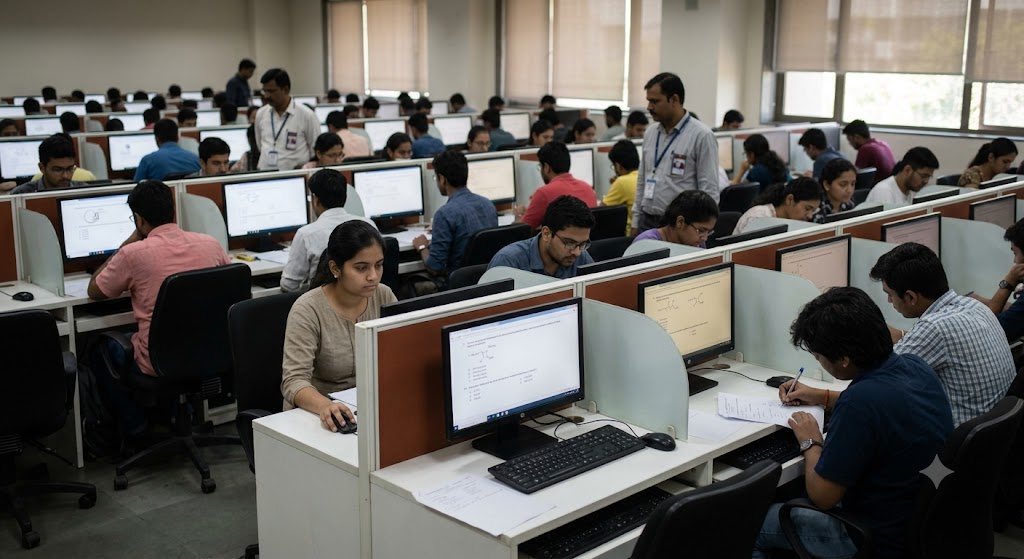
Additional Information
What the Course Entails and Exam Details
The IIT JAM essentially evaluates candidates' understanding of concepts taught at the undergraduate level in various science subjects. There is no specified "course" associated with the exam itself; rather, students are tested on the standard B.Sc. syllabus prescribed by most Indian universities for the relevant subject. IIT JAM is conducted for seven specific test papers. Candidates can choose to appear for one or two test papers (subject to certain restrictions based on scheduling). The test papers offered are:
Biotechnology (BT)
Chemistry (CY)
Economics (EN)
Geology (GG)
Mathematics (MA)
Mathematical Statistics (MS)
Physics (PH)
What to Expect in the Final Exam
The IIT JAM is conducted as a Computer Based Test (CBT), meaning candidates take the exam on a computer at designated test centers. The exam lasts for 3 hours, and the total marks are 100. The question paper consists of 60 questions, divided into three sections:
Section A: Multiple Choice Questions (MCQs) – Each question has four choices, and only one choice is correct. This section typically has negative marking for incorrect answers.
Section B: Multiple Select Questions (MSQs) – Each question is similar to an MCQ but may have one or more correct choices. Marks are awarded only if all correct choices (and no incorrect ones) are selected. There is no negative marking in this section.
Section C: Numerical Answer Type (NAT) Questions – For these questions, the answer is a real number that needs to be entered using the virtual numeric keypad on the computer screen. No choices are given, and there is no negative marking. Candidates are usually provided with scribble pads for rough work, which must be returned after the examination. The specific distribution of questions and marks across these sections varies slightly between the different test papers but follows this general structure.
How to Study and Exam Centers
Preparation for IIT JAM requires a disciplined approach and deep conceptual understanding. Effective Study Strategies:
Understand the Syllabus: Throroughly review the official JAM syllabus for your chosen subject. This is your roadmap for preparation.
Strengthen Concepts: Focus on building solid fundamental concepts using standard B.Sc. textbooks recommended by experts.
Practice with Previous Papers: Solving previous years' JAM question papers is crucial. It helps you understand the exam pattern, the types of questions asked, and the difficulty level.
Take Mock Tests: Regularly taking full-length mock tests under timed conditions is essential for improving speed, accuracy, and time management skills.
Identify Weak Areas: Use mock test results to pinpoint your weak areas and devote extra time to strengthening them. Exam Centers and Enrollment: IIT JAM is conducted at numerous designated test centers located in major cities across India. Candidates must select their preferred city/test center while filling out the online application form (usually through the JAM Online Application Processing System or JOAPS portal). The organizing institute assigns the final test center based on availability and candidate preferences. On exam day, candidates must present their Admit Card along with a valid original photo ID at the test center.
Job Opportunities from the Course
Qualifying IIT JAM is the first major step towards significant academic and professional growth. While the exam itself is for admission to M.Sc./Ph.D. programs, completing these programs at IITs or IISc unlocks numerous high-impact career opportunities:
Research Scientist (R&D): Opportunities in premier national laboratories (DRDO, ISRO, CSIR labs), research institutions, and the R&D divisions of major companies in pharmaceuticals, biotechnology, and technology.
Project Fellow/Project Associate: Working on sponsored research projects within IITs or other institutions, often a stepping stone to further research or industrial roles.
Lecturer/Assistant Professor: Pursuing a career in academia at universities and colleges across India (requires further qualification like CSIR NET/GATE and Ph.D. typically).
Jobs in Public Sector Undertakings (PSUs): Companies like ONGC, IOCL, and GAIL sometimes recruit Master's degree holders from premier institutes for scientific and technical roles.
Scientific Officer/Scientist Positions: Roles within various government departments and ministries that require strong scientific expertise.
Opportunities in Data Analytics and Finance: Specifically for graduates in Mathematics and Mathematical Statistics, high-demand roles are available in finance, insurance, and analytics firms.
Frequently Asked Questions
Reviews
5.0
Based on 0 reviews
Leave a Review
No reviews yet. Be the first to review!