
Iesl Qualifying Practice Test & Exam Prep | Sri Lanka
$69.00
- Buy to unlock unlimited access to all Quiz questions.
- After purchase you can print a PDF of the whole quiz at any point. The PDF will contain the questions and the correct answers.
About this Exam
The Institution of Engineers, Sri Lanka (IESL) Qualifying Examination is a critical milestone for aspiring professional engineers in the country. This rigorous assessment is specifically designed for engineering graduates whose academic qualifications are not directly accredited or recognized by the IESL for the Graduate Member status (AMIESL).
Passing this examination validates that a candidate possesses the fundamental engineering knowledge and competencies required to practice at a professional level in Sri Lanka. It bridges the gap between academic achievement and the rigorous standards set by the IESL, paving the way toward eventual Corporate Membership (CEng) and registration with the Engineering Council, Sri Lanka (ECSL).
Ready to test your knowledge?
Buy Now to Access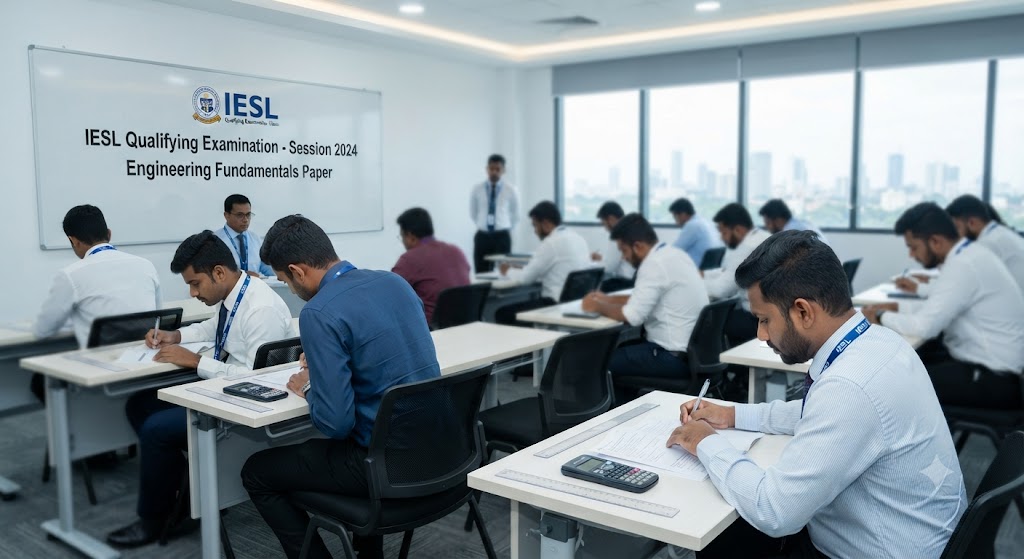
Additional Information
What the Course Entails and Exam Details
While the IESL Qualifying Examination does not typically
involve a singular preparatory "course" provided directly by the
institution, it is based on a defined syllabus that mirrors core engineering
principles. Candidates are expected to master subjects relevant to their
specific engineering discipline (e.g., Civil, Mechanical, Electrical,
Chemical).
The examination is structured into two main parts, ensuring
a comprehensive assessment of both theoretical knowledge and practical
application:
- Part
1: Engineering Fundamentals: This section generally covers
foundational topics essential to all engineering branches. It often
includes subjects like Mathematics, Applied Mechanics, Thermodynamics,
Fluid Mechanics, Engineering Materials, and Basic Electrical and
Electronic Engineering.
- Part
2: Discipline-Specific Knowledge: This part delves deeper into
advanced topics tailored to the candidate’s chosen branch of engineering
(e.g., Structural Design, Geotechnical Engineering, Power Systems, Control
Systems, Manufacturing Processes).
Candidates must demonstrate a thorough understanding of
these subjects as applied to real-world engineering problems.
What to Expect in the Final Exam
The IESL Qualifying Examination is known for its high
standards. Candidates should be fully prepared for a challenging assessment
format designed to test both speed and depth of understanding.
- Exam
Format: The examination typically consists of written papers, often
featuring a combination of multiple-choice questions (MCQs) to test
breadth of knowledge and structured essay/problem-solving questions to
evaluate analytical skills and application. In some cases, a practical or
oral component may be included depending on the specific requirements of
the discipline.
- Time
Limits: Each paper is strictly timed. Candidates must manage their
time effectively across different sections to ensure all questions are
attempted. Time management is often as critical as subject knowledge in
this exam.
- Passing
Score Requirements: To pass the overall examination, candidates
usually need to achieve a minimum specified mark in each paper, as well as
a required aggregate total across all subjects. The specific pass marks
are determined by the IESL examinations board and are set to ensure only
qualified candidates proceed.
- Rules
and Regulations: Strict examination hall protocols are enforced. Candidates
must present valid identification (National Identity Card or Passport) and
their Examination Attendance Notice. The use of only IESL-approved
calculators and reference materials is permitted; unauthorized items are
strictly prohibited.
How to Study and
Exam Centers
Success in the IESL Qualifying Examination requires
disciplined preparation and a strategic approach. Relying solely on past
knowledge is rarely sufficient.
- Actionable
Study Strategies:
- Master
the Syllabus: Obtain the official syllabus from the IESL website and
use it as your roadmap. Allocate study time proportionally to the
weighting of each topic.
- Utilize
Past Papers: This is the most crucial strategy. Solve as many past
IESL Qualifying Examination papers as possible under timed conditions.
This familiarizes you with the question style, difficulty level, and
recurring themes.
- Group
Study: Collaborate with fellow candidates to discuss complex
engineering problems and clarify doubts. Teaching concepts to others is
an excellent way to reinforce your own understanding.
- Referenced
Textbooks: Do not rely only on lecture notes. Consult standard,
internationally recognized textbooks recommended for each subject area.
- Structured
Revision: Create a realistic study timetable leading up to the exam
date, ensuring dedicated time for regular review and mock exams.
- Exam
Centers and Administration:
- The
IESL Qualifying Examination is typically administered directly by the
IESL.
- All
details regarding registration, fees, examination timetables, and
specific venues are published on the official IESL website (www.iesl.lk).
- Examinations
are usually held at the IESL Headquarters in Colombo, although
regional centers may be utilized depending on the number of candidates.
Candidates must complete the formal application process by the stipulated
deadlines to be eligible to sit for the exam.
Job Opportunities from the Course
Successfully passing the IESL Qualifying Examination and
obtaining Graduate Membership (AMIESL) is a transformative step in an
engineer’s career in Sri Lanka. It unlocks numerous prestigious opportunities
and is often a mandatory requirement for senior roles.
This qualification is a direct pathway to the following
career paths and job titles:
- Corporate
Member of IESL (AMIESL): Validates your status as a qualified
professional engineer.
- Chartered
Engineer (CEng): Achieving AMIESL is the prerequisite for undertaking
the Professional Review to become a Chartered Engineer, the highest
standard of engineering professionalism in the country.
- Registered
Engineer: Enables registration with the Engineering Council, Sri Lanka
(ECSL), which is legally required to practice as a professional engineer.
- Senior
Project Engineer: Leading large-scale infrastructure and engineering
projects.
- Engineering
Manager: Overseeing technical teams and departmental operations.
- Chief
Design Engineer: Responsible for complex engineering designs and
approvals.
- Academic
Roles: Lecturer or Senior Lecturer in engineering faculties at
universities and technical institutes.
- Government
Sector Positions: Eligibility for senior engineering grades in
government departments, statutory boards, and local authorities.
- Specialized
Consultant: Providing expert consultancy services in specialized
engineering fields.
Frequently Asked Questions
Reviews
5.0
Based on 0 reviews
Leave a Review
No reviews yet. Be the first to review!