
Identity and Access Management Question CISSP Course Practice Test
$69.00
- Buy to unlock unlimited access to all Quiz questions.
- After purchase you can print a PDF of the whole quiz at any point. The PDF will contain the questions and the correct answers.
About this Exam
The [Identity and Access Management Question CISSP Course Practice Test] is a vital resource designed for cybersecurity professionals and candidates preparing for the highly respected Certified Information Systems Security Professional (CISSP) certification. This specific test focuses exclusively on Domain 5 of the CISSP common body of knowledge: Identity and Access Management (IAM). It provides a simulation of the exam, designed to challenge and evaluate your understanding of key IAM concepts, processes, and technologies. This practice test is an essential educational tool for individuals who have completed a CISSP course or wish to gauge their readiness for the comprehensive IAM section of the actual certification.
Ready to test your knowledge?
Buy Now to Access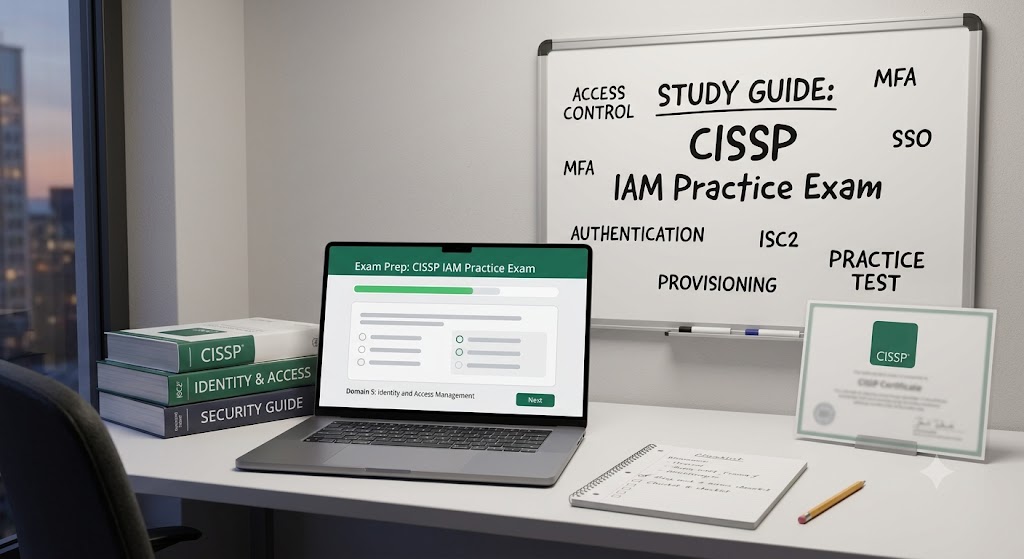
Additional Information
What the Course Entails and Exam Details
The practice test covers the core topics of the CISSP IAM
domain. You will be tested on access control models including discretionary,
mandatory, and role-based access. The exam evaluates knowledge of robust
identification and authentication methods, encompassing technologies like
multi-factor authentication (MFA) and single sign-on (SSO). Expected content
includes authorization mechanisms, provisioning and de-provisioning of user
identities, and account lifecycle management. It also covers identity
governance and the integration of relevant IAM standards and technologies. The
practice test itself typically features multiple-choice questions similar in
style, difficulty, and format to those in the actual CISSP exam. The exact
number of questions and time allowed can vary by the specific practice
platform, but it aims to rigorously mimic the final testing experience.
What to Expect in
the Final Exam
While this is a practice test, the goal is to prepare you
for the ultimate challenge: the official, full CISSP exam. The official, final
CISSP exam is famously rigorous and covers all eight domains, not just IAM. It
is often administered as a computer adaptive test (CAT), where the difficulty
of subsequent questions adjusts based on your performance. The official exam
spans several hours and contains approximately 100 to 150 questions (for the
CAT version) or 250 questions (for linear versions). Expect various question types,
including standard multiple-choice, complex scenarios, and advanced innovative
questions. A passing score of 700 out of 1000 is required, and the environment
is highly structured, including requirements for photo ID and prohibited items.
Success on this focused practice test is a strong indicator of readiness for
the IAM component of this major milestone.
How to Study and Exam Centers
Your preparation should be multi-faceted and rigorous for
both this practice test and the actual CISSP certification. Review official
ISC2 textbooks, participate in dedicated CISSP courses, and engage with
professional study groups. Consistently taking and analyzing your results from
[Identity and Access Management Question CISSP Course Practice Test] is a
powerful strategy. It helps you identify specific areas of weakness in your IAM
knowledge, allowing you to focus your subsequent study. To take the practice
test, you will generally access it through the online portal or educational
platform where you enrolled in the CISSP course. For the actual, official CISSP
exam, registration is done through the ISC2 website. The official exam is
administered at authorized Pearson VUE physical testing centers worldwide or
via online proctoring where permitted by ISC2.
Job Opportunities
from the Course
<!--[if mso & !supportInlineShapes & supportFields]> SHAPE \* MERGEFORMAT <![endif]--><!--[if gte vml 1]>
A strong foundation in IAM and the prestigious CISSP
certification significantly boosts your career trajectory in cybersecurity.
Potential specific job opportunities and career paths unlocked by these
combined skills include: A specialized role as an Identity and Access
Management (IAM) Specialist, focusing on the entire lifecycle of user access.
The position of an IAM Architect, responsible for designing and implementing
complex identity and access solutions. A sought-after Cybersecurity Manager,
overseeing and making strategic decisions about identity governance and
security overall. Roles such as a Cloud Security Engineer, demanding expertise
in managing identities within complex cloud environments. Opportunities as an
Information Security Auditor, using a deep understanding of IAM controls to
assess organizational compliance and security posture. General leadership roles
in information security within corporate structures. The demand for these
combined skills is exceptionally high across all industries.
Frequently Asked Questions
Reviews
5.0
Based on 0 reviews
Leave a Review
No reviews yet. Be the first to review!