
Ica Compliance Practice Test & Exam Prep | United Kingdom
$69.00
- Buy to unlock unlimited access to all Quiz questions.
- After purchase you can print a PDF of the whole quiz at any point. The PDF will contain the questions and the correct answers.
About this Exam
The International Compliance Association (ICA) offers a suite of qualifications that serve as the gold standard for compliance professionals in the United Kingdom and globally. These certifications are designed for individuals working in financial services, legal sectors, and other regulated industries who need to demonstrate a high level of competence in managing regulatory risk.
From entry-level certificates to advanced diplomas, the ICA path is crafted for compliance officers, money laundering reporting officers (MLROs), risk managers, and internal auditors. By studying for these qualifications, professionals validate their understanding of complex regulatory frameworks and commit to maintaining the integrity of the UK's financial system.
Ready to test your knowledge?
Buy Now to Access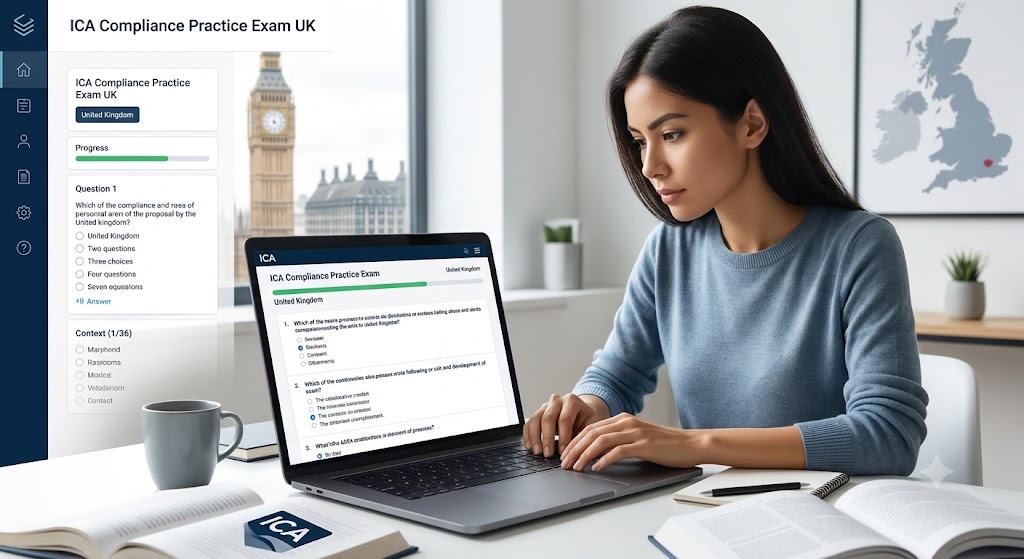
Additional Information
What the Course Entails and Exam Details
ICA courses are rigorous and practically focused, ensuring
that the skills learned can be immediately applied in the workplace. The
syllabus for a typical compliance qualification covers a wide spectrum of
essential topics.
Core subject areas include a deep dive into governance
principles, risk management frameworks, and regulatory oversight (specifically
the FCA and PRA handbooks in the UK). Students explore the roles and
responsibilities of the compliance function, the intricacies of financial crime
prevention—including anti-money laundering (AML) and counter-terrorist
financing (CTF)—and the principles of managing cultural and conduct risk.
The skills covered go beyond rote memorization; they focus
on analytical thinking, interpreting regulatory requirements, and implementing
effective compliance strategies within an organization.
What to Expect in
the Final Exam
While specific formats vary between certificates, diplomas,
and specialist qualifications, ICA examinations are known for being thorough.
Most certificates utilize an online assessment consisting of
multiple-choice questions. For more advanced qualifications, such as the
Diploma in Governance, Risk and Compliance, the examination is often split into
multiple components. This can include practical assignments or case studies
completed throughout the course, followed by a final, timed assessment which
may involve essay-style questions or a proctored online exam.
The passing score for most ICA qualifications is 50%, with
distinctions and merits available for higher achievement. Time limits depend on
the qualification level but generally range from one to three hours. It is
crucial to check the specific requirements for your chosen qualification path,
as the ICA regularly updates its assessment methods to align with professional
standards.
How to Study and Exam Centers
Effective preparation for an ICA exam combines thorough
reading of the syllabus with practical application.
Start by deeply reviewing the provided core manuals and
attending all scheduled workshops or webinars. Active learning is key—create
mind maps for complex regulations and summarize key concepts. The most
actionable strategy is to practice using sample questions and past assessment
themes, when available. This helps familiarize you with the wording of
questions and improves your time management.
ICA exams and assessments are primarily delivered online,
offering significant flexibility. Students can take their exams through a
proctored online portal from their home or office in the UK. For courses
requiring physical attendance or workshops, these are typically held at
authorized teaching centers or partner locations in major UK cities like
London, Birmingham, and Manchester.
Job Opportunities
from the Course
Earning an ICA qualification significantly enhances your
credibility and employability in the competitive UK market.
This certification unlocks a clear career path and a variety
of job titles across different sectors, including banking, insurance, asset
management, fintech, and legal services. Key job opportunities include:
- Compliance
Officer/Analyst
- Senior
Compliance Manager
- Head
of Compliance
- Money
Laundering Reporting Officer (MLRO)
- AML
Investigator
- Regulatory
Risk Manager
- GRC
(Governance, Risk, Compliance) Consultant
- Internal
Auditor (with a compliance focus)
- Financial
Crime Specialist
Frequently Asked Questions
Reviews
5.0
Based on 0 reviews
Leave a Review
No reviews yet. Be the first to review!