
IAHCSMM CRCST Practice Test Chapter 2 Medical Terminology for Sterile Processing Technicians
$69.00
- Buy to unlock unlimited access to all Quiz questions.
- After purchase you can print a PDF of the whole quiz at any point. The PDF will contain the questions and the correct answers.
About this Exam
The Certified Registered Central Service Technician (CRCST) certification, administered by the Healthcare Sterile Processing Association (HSPA, formerly IAHCSMM), is the primary professional credential for individuals working in sterile processing and central service departments. This essential role is the backbone of any surgical facility, responsible for decontaminating, inspecting, assembling, and sterilizing surgical instruments and equipment to ensure patient safety.
The CRCST program is designed for new and experienced sterile processing technicians who wish to demonstrate their comprehensive knowledge of sterilization practices, infection control, and the critical processes that prevent healthcare-associated infections (HAIs). Successfully earning your CRCST proves to employers that you have the skills required to manage the lifecycle of medical devices safely. To receive full certification, candidates must not only pass the examination but also document 400 hours of hands-on experience in a sterile processing department.
Ready to test your knowledge?
Buy Now to Access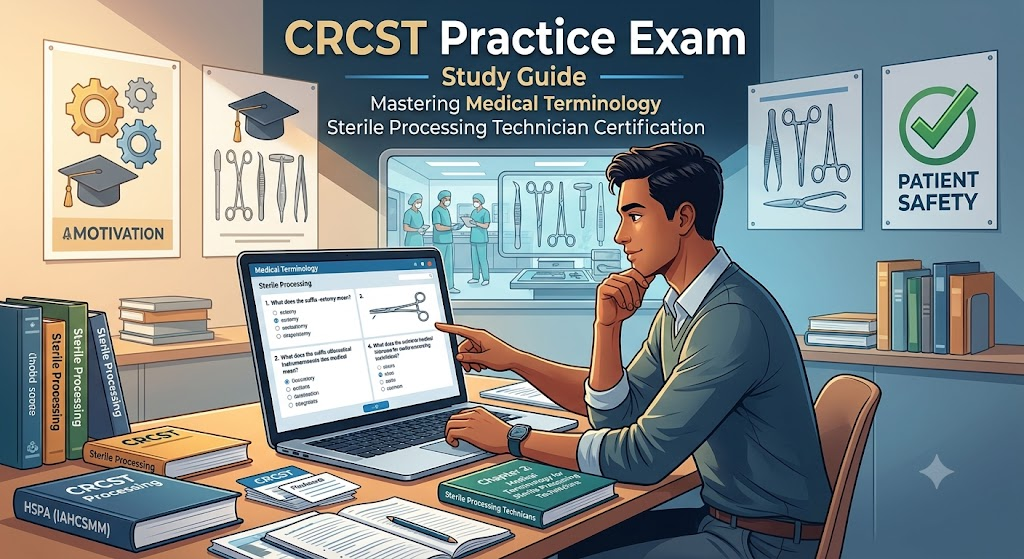
Additional Information
What the Course Entails and Exam Details
The foundation of safe sterile processing is the ability to understand the language of the operating room. Chapter 2 of the CRCST curriculum focuses exclusively on Medical Terminology for Sterile Processing Technicians. While the full CRCST course covers seven major domains, this specific chapter is a prerequisite for all other technical knowledge.
A successful technician must be able to break down complex medical terms, understand the function and structure of the human body, and accurately interpret surgical schedules to prepare the correct instrument sets. This practice test is designed to evaluate your mastery of these foundational skills.
The core topics covered in this chapter and practice test include:
Understanding Word Parts: The "building blocks" of medical terminology: prefixes, combining roots, and suffixes. You will learn to decipher terms by breaking them into their component parts (e.g., Gastroenteritis = Gastr/ (stomach) + enter/ (intestine) + -itis (inflammation)).
Common Prefixes: Learning prefixes that indicate number, location, time, and status (e.g., Pre-, Post-, Hyper-, Hypo-, A-/An-).
Medical Roots: Memorizing common roots that refer to body systems and organs (e.g., Cardi/ (heart), Nephr/ (kidney), Oste/ (bone)).
Suffixes: Understanding suffixes that describe conditions, procedures, or diagnoses (e.g., -ectomy (surgical removal), -otomy (incision into), -ology (study of)).
Surgical Abbreviations and Symbols: Recognizing the official and common abbreviations used to describe surgical procedures and anatomical locations on a doctor’s order or surgical schedule (e.g., OR, BX, I&D, CABG).
What to Expect in the Final Exam
While the practice test focuses solely on Chapter 2, it is vital to understand the structure of the full CRCST certification exam.
The official CRCST exam is a computer-based, multiple-choice test. You are allotted 3 hours (180 minutes) to complete the examination. The test consists of 150 questions. Of these, 125 are scored questions and 25 are unscored (pre-test) questions. The unscored questions are randomly distributed throughout the exam, and you will not know which questions they are, so it is essential to answer every question as if it counts toward your score.
There is no published numerical passing score (e.g., 70% or 80%). The exam results are reported as Pass or Fail. This is because HSPA uses multiple forms of the test, and a statistician has determined the minimum level of knowledge required to demonstrate competency for each form. Candidates are typically notified of their preliminary Pass/Fail status immediately after submitting the computer-based exam. You must bring a physical form of valid government identification with your photo and signature to the testing center.
How to Study and Exam Centers
Preparation is key to succeeding on both the Medical Terminology practice test and the final CRCST exam.
Study Strategies for Medical Terminology (Chapter 2):
Use Flashcards: Create digital or physical flashcards for the individual word parts (prefixes, roots, and suffixes). This is a game-changer for medical terminology. Test yourself daily until you can recall the meaning of each part instantly.
Focus on Deconstruction: When taking the practice test, do not just memorize the answers. Practice breaking down each term. Identify the root and the associated suffix and prefix to understand the full meaning.
Cross-Reference with the Manual: Use the HSPA Sterile Processing Technical Manual as your primary source. It will provide medical terminology in the context of the equipment and procedures you will encounter daily.
Take Timed Practice Drills: Use the Chapter 2 practice test in a timed setting to simulate the pressure of the real exam and improve your recall speed.
Exam Centers for the Final CRCST Exam:
You cannot take the final CRCST exam online or at an unauthorized location. HSPA partners with an independent testing agency, Prometric, to administer the exam in a secure, proctored computer testing environment. You can schedule your examination at an authorized Prometric Testing Center globally.
Once your 400 hours of experience have been verified and you have paid the exam fee, HSPA will issue you a scheduling letter with an eligibility number. You then use this number to schedule your preferred date, time, and location through the Prometric website or their toll-free number.
Job Opportunities from the Course
Earning your CRCST certification is a prerequisite for a stable and fulfilling career in a hospital’s central service department. It is often the minimum requirement listed in job descriptions for sterile processing roles. This course unlocks a clear pathway into multiple career options within healthcare.
Completing the CRCST program and gaining experience can lead to the following specific job titles:
Certified Sterile Processing Technician (CRCST)
Sterile Processing Technician
Central Service Technician
Surgical Instrument Technician
Sterile Core Technician
Lead Sterile Processing Technician
Sterile Processing Supervisor
Sterile Processing Manager/Educator
These positions are crucial to the safe operation of any surgical environment, and certified professionals are in high demand across the country.
Frequently Asked Questions
Reviews
5.0
Based on 0 reviews
Leave a Review
No reviews yet. Be the first to review!