
IAHCSMM CRCST Practice Test – Chapter 14 High-Temperature Sterilization
$69.00
- Buy to unlock unlimited access to all Quiz questions.
- After purchase you can print a PDF of the whole quiz at any point. The PDF will contain the questions and the correct answers.
About this Exam
The Certified Registered Central Service Technician (CRCST) certification, administered by the Healthcare Sterile Processing Association (HSPA) — formerly known as IAHCSMM — is the premier credential for sterile processing professionals. It is designed to validate the knowledge and skills necessary for the crucial role of disinfecting, preparing, and sterilizing medical instruments for reuse, thereby ensuring patient safety across healthcare facilities. This specific guide is tailored for students preparing to master Chapter 14, "High-Temperature Sterilization," which is a core component of the sterile processing curriculum.
Ready to test your knowledge?
Buy Now to Access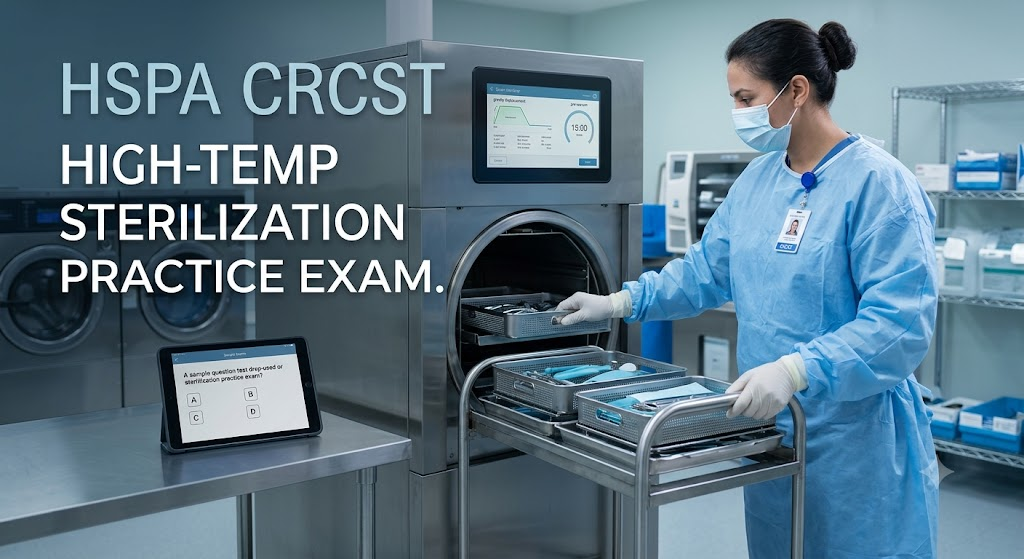
Additional Information
What the Course Entails and Exam Details
To master Chapter 14, you must dive deep into the science, mechanics, and best practices of high-temperature sterilization. The primary focus of this chapter is the most common and effective method: Steam Sterilization. Your study will encompass the fundamental components of steam sterilizers, including the chamber, jacket, thermostatic trap, and air-removal systems. You will learn to differentiate between gravity displacement cycles, which rely on steam's natural density to displace air, and dynamic air-removal (pre-vacuum) cycles, which use a vacuum pump for active air removal.
The content covers the critical sterilization parameters of time, temperature, and saturated steam, and how each is measured to confirm a cycle's success. You will explore monitoring techniques, including the use of physical monitors, chemical indicators, and biological indicators, with a special emphasis on the Bowie-Dick test for detecting air leaks. Furthermore, this chapter details proper loading techniques, such as placing peel pouches on edge and rigid containers on the bottom shelf, to allow for optimal steam penetration and air removal. A strong understanding of factors that can lead to wet packs and the importance of thorough documentation are also included.
What to Expect in the Final Exam
While the high-temperature sterilization chapter is robust, the actual CRCST certification exam is a comprehensive assessment covering the entire sterile processing landscape. The final exam consists of 150 multiple-choice questions, which must be completed within a three-hour timeframe. It is not limited to a single chapter; instead, questions on high-temperature sterilization will be a component of the "Sterilization Process" section, which typically accounts for approximately 21% of the total exam content, along with preparation and packaging.
The passing score requirement is set at a specific scaled score by HSPA, and the exam is psychometrically validated to ensure fairness and consistency. You can expect scenario-based questions that test your ability to apply sterilization principles to real-world situations, alongside factual recall. This practice guide is specifically designed to help you build confidence and precision in the critical domain of high-temperature sterilization.
How to Study and Exam Centers
Effective preparation for the CRCST exam, especially Chapter 14, requires a combination of structured study and active practice. Your primary resource should be the HSPA Central Service Technical Manual (currently the 8th or 9th edition). We recommend a multi-step approach: first, thoroughly read the chapter to understand all key concepts; second, use the review questions at the end of each chapter to identify knowledge gaps; and third, utilize this dedicated HSPA CRCST High-Temp Sterilization Practice Exam to simulate the test-taking experience.
For the official certification exam, you must submit an application to HSPA. Candidates can apply under either full certification or provisional certification pathways, with full status requiring documentation of 400 hours of hands-on experience. The computerized exam is taken at a designated testing center, such as Pearson VUE or Prometric, located in many physical testing centers and authorized schools throughout the country. You will select your preferred location and schedule your appointment after your application is approved.
Job Opportunities from the Course
Mastering high-temperature sterilization is an absolute necessity for launching and advancing a career in sterile processing. The CRCST certification is highly respected and often a mandatory prerequisite for employment in healthcare systems. Successfully passing the exam and demonstrating expertise in sterilization principles unlocks a clear path to many rewarding roles, including:
Sterile Processing Technician
Lead Sterile Processing Technician
Sterilization Specialist
Central Service Instrument Technician
Department Supervisor or Manager
Sterile Processing Educator
With the continuing demand for skilled technical professionals in healthcare, achieving CRCST certification proves your dedication and can significantly enhance your earning potential and career mobility.
Frequently Asked Questions
Reviews
5.0
Based on 0 reviews
Leave a Review
No reviews yet. Be the first to review!