
HSPT Quantitative Skills Practice Test OLD
$69.00
- Buy to unlock unlimited access to all Quiz questions.
- After purchase you can print a PDF of the whole quiz at any point. The PDF will contain the questions and the correct answers.
About this Exam
The High School Placement Test (HSPT), administered by the Scholastic Testing Service, is a comprehensive entrance exam utilized by many Catholic and private high schools across the country to assess the academic readiness of eighth-grade applicants. The scores are often a significant factor in admission decisions, placement in honors courses, and scholarship opportunities. The Quantitative Skills section of the HSPT is a specialized component that measures a student's ability to analyze and solve problems using numbers and mathematical concepts, focusing more on logical reasoning than complex calculations. This practice test is specifically designed to simulate the format and content of previous versions of the HSPT Quantitative Skills subtest, providing a focused training tool for ambitious students aiming for admission to their top-choice high schools.
Ready to test your knowledge?
Buy Now to Access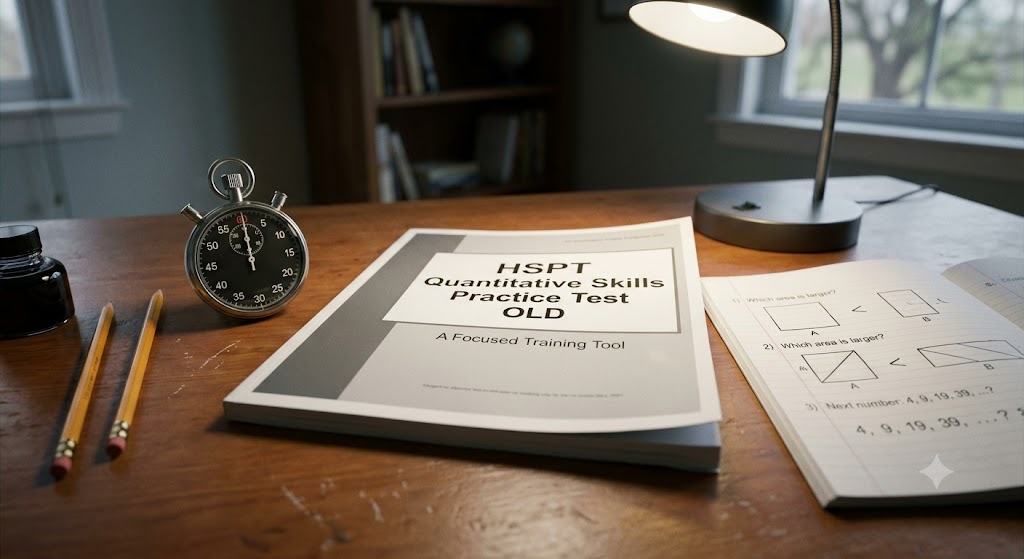
Additional Information
What the Course Entails and Exam Details
The HSPT Quantitative Skills section does not require advanced algebra or geometry, but it demands speed, accuracy, and strong reasoning abilities. The core areas covered in this practice guide include:
Number Series: Identifying the missing number or the next logical step in a sequential pattern of numbers.
Geometric Comparison: Comparing two figures or parts of a figure—such as areas, angles, perimeters, or volumes—and determining their relationship based on reasoning rather than calculation.
Non-geometric Comparison: Comparing the quantitative values of different numerical expressions to determine which is greater, smaller, or if they are equal.
Number Manipulation: Mentally performing basic arithmetic operations (addition, subtraction, multiplication, and division), percentages, and working with fractions and decimals to find a solution.
What to Expect in the Final Exam
While the exact number of questions can vary slightly between old and current versions, this practice test, based on the older format, typically includes the following specifics:
Exam Format: Entirely multiple-choice questions (A, B, C, D).
Number of Questions: Approximately 52 questions.
Time Limit: A highly demanding 30 minutes, emphasizing the need for quick, decisive reasoning and time management.
Calculator Use: Calculators are strictly prohibited.
Scoring: Your score is based on the number of correct answers. There is no penalty for guessing, so it is in your best interest to fill in an answer for every question.
Passing Score: Individual schools set their own score requirements for admission and placement. The goal is to achieve the highest possible raw score, which is then converted into a standardized, percentile-rank score.
How to Study and Exam Centers
Effective preparation for this test combines content knowledge with test-taking strategy. Here are proven study methods:
Simulate Exam Conditions: Take practice tests with a strict 30-minute timer in a quiet room. Learn to pace yourself, aiming for about 35 seconds per question.
Practice Reasoning, Not just Math: Focus on identifying patterns, logical relationships, and reasoning short-cuts. Do not get bogged down in long calculations.
Practice Mental Math: Build your fluency with multiplication tables, fractions, decimals, and basic geometric formulas without a calculator.
Target Weaknesses: Use your results from this practice exam to pinpoint which question types (e.g., number series or geometric comparison) challenge you the most.
Where to Take the Exam:
For this specific [HSPT Quantitative Skills Practice Test OLD], you can take it from any computer in a controlled environment. However, it is essential to understand that the actual, official HSPT is a standardized, paper-based test administered only once, typically at the specific high school to which a student is applying. The practice materials you are using are for your own skill development.
Job Opportunities from the Course
While the HSPT is a high school placement tool, achieving a strong score, particularly in the critical Quantitative Skills section, demonstrates high academic potential. Success on this test can lead to placement in advanced mathematics and science tracks in top-tier high schools. These competitive programs, in turn, open the door to prestigious university programs, ultimately unlocking high-demand and lucrative career paths that require advanced logical reasoning and analytical skills, including:
Civil, Mechanical, Electrical, and Aerospace Engineer
Architect and Urban Planner
Financial Analyst and Investment Banker
Actuary and Statistician
Data Scientist and Machine Learning Engineer
Economist
Software Developer
Cryptographer
Frequently Asked Questions
Reviews
5.0
Based on 0 reviews
Leave a Review
No reviews yet. Be the first to review!