
GED Social Studies Practice Test 2025: Reading and Historical Analysis
$69.00
- Buy to unlock unlimited access to all Quiz questions.
- After purchase you can print a PDF of the whole quiz at any point. The PDF will contain the questions and the correct answers.
About this Exam
The GED Social Studies test is a crucial component for individuals seeking their high school equivalency credential. Specifically, the "Reading and Historical Analysis" focus is designed to assess your ability to read, understand, and interpret various social studies texts and historical documents. This portion isn't just about memorizing dates; it's about evaluating evidence, reasoning with data, and understanding complex social and historical context. Candidates are typically adults who did not complete high school and are aiming to advance their educational or career prospects.
Ready to test your knowledge?
Buy Now to Access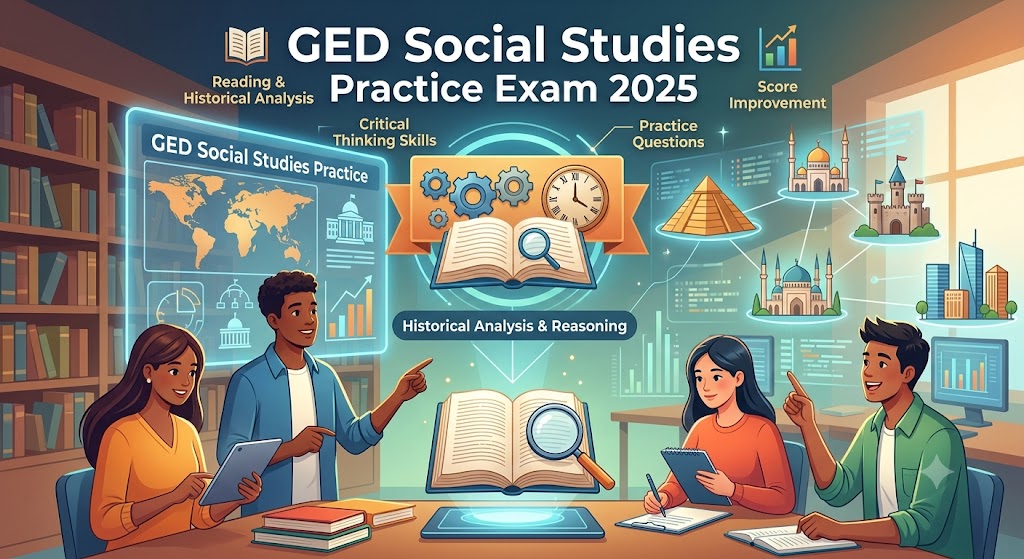
Additional Information
What the Course Entails and Exam Details
This practice guide focuses intently on mastering the reasoning skills required for the Social Studies section. The core skills you will develop and be tested on include:
Analyzing Complex Texts: Reading a wide range of documents, from political speeches and historical accounts to contemporary articles, and extracting key arguments, central ideas, and supporting evidence.
Interpreting Historical Documents: Understanding the context and perspective of primary and secondary sources, and analyzing their reliability.
Reasoning with Evidence: Using evidence from multiple sources to draw conclusions, make inferences, and evaluate different interpretations of events.
Data Analysis: Interpreting informational graphics like maps, charts, graphs, and photographs to understand historical and contemporary social trends.
Understanding Point of View and Bias: Identifying an author's or speaker's perspective and evaluating how bias can influence a text.
What to Expect in the Final Exam
The actual GED Social Studies final exam is a comprehensive assessment that often incorporates the skills covered in this practice. The typical structure includes:
Format: The exam predominantly consists of multiple-choice questions, though it may also feature enhanced question types such as fill-in-the-blank, drag-and-drop, and hot-spot questions, all designed to test critical thinking.
Time Limit: You will have approximately 70 minutes to complete this section.
Passing Score: While scores may vary slightly by state, generally, a passing score on the GED test is around 145 on a scale of 100 to 200 for each subject.
Stimulus-Based Questions: Most questions are not about recall. They are based on a provided text passage, map, graph, or other primary source, requiring you to analyze the given material.
No Essay: It’s important to note that the GED Social Studies test no longer includes a separate extended response (essay) section.
How to Study and Exam Centers
Preparing effectively is key to succeeding on the GED Social Studies test. Here are actionable strategies:
Practice with Diverse Materials: Use practice tests and sample questions that use a wide variety of sources: newspapers, historical texts, data reports, and primary source documents.
Focus on Active Reading: Don't just skim. Read carefully, take notes on main points, and identify the author's argument. Ask yourself, "What is this document trying to achieve?"
Analyze Answers: After taking practice questions, review both correct and incorrect answers. Understand why the correct answer is the best choice and where your reasoning might have gone wrong.
Time Yourself: Build your pacing skills by timing your practice sessions to match the 70-minute exam limit.
Exam Centers: To take the actual GED, you must register through the official GED website (ged.com). The site provides access to authorized testing centers near you, which are often located at community colleges, adult education centers, and Pearson VUE testing locations. Depending on your state, an online proctored option may also be available.
Job Opportunities from the Course
Successfully passing the GED Social Studies test, as part of your full GED credential, dramatically opens up your career and educational horizons. It allows you to:
Apply for many jobs that require a high school diploma or equivalent.
Enlist in the military.
Enroll in college or university programs.
Pursue career-focused technical and vocational training.
Here are specific entry-level job roles and career paths commonly accessible to those with a GED:
Administrative Assistant
Customer Service Representative
Sales Associate
Healthcare Support Worker (e.g., Certified Nursing Assistant)
Construction or Trades Apprentice
Manufacturing Technician
Logistics and Warehouse Staff
Hospitality and Food Service Worker
IT Support Technician (entry-level)
Frequently Asked Questions
Reviews
5.0
Based on 0 reviews
Leave a Review
No reviews yet. Be the first to review!