
GCAA Practice Test & Exam Prep | United Arab Emirates
$69.00
- Buy to unlock unlimited access to all Quiz questions.
- After purchase you can print a PDF of the whole quiz at any point. The PDF will contain the questions and the correct answers.
About this Exam
The GCAA (General Civil Aviation Authority) certification is the mandatory cornerstone for any professional seeking a career in the United Arab Emirates' robust and rapidly growing aviation sector. It serves as official validation of knowledge and skills, ensuring that all personnel operating within the UAE's airspace—from pilots and air traffic controllers to aircraft maintenance engineers—adhere to the highest international safety and operational standards.
This certification is designed for aspiring and existing aviation professionals who wish to work in safety-sensitive roles. Whether you aim to command an airliner, maintain complex aircraft systems, or manage air traffic flow, obtaining the relevant GCAA license is your non-negotiable first step in the United Arab Emirates.
Ready to test your knowledge?
Buy Now to Access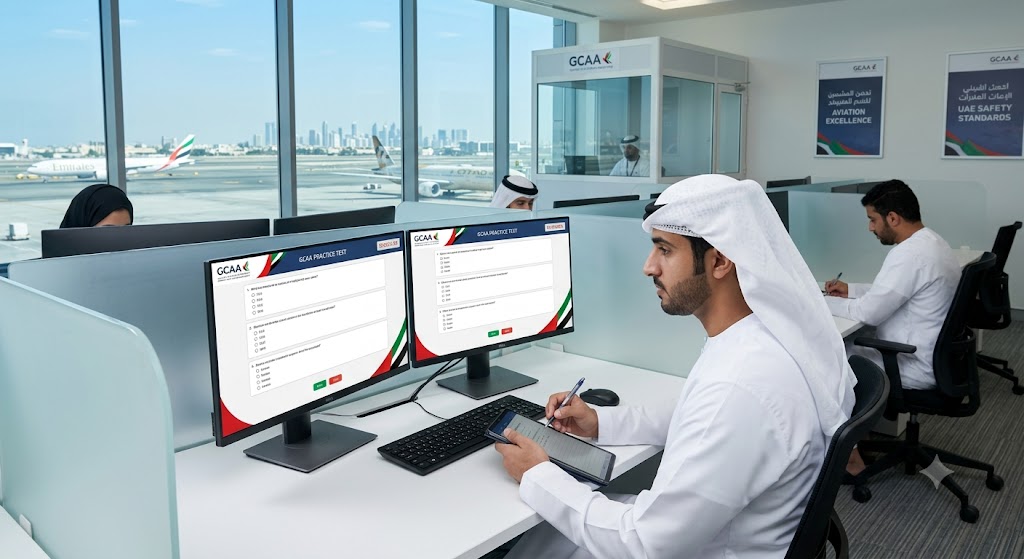
Additional Information
What the Course Entails and Exam Details
A GCAA "course" is typically a comprehensive training program offered by a GCAA-authorized Training Organization (ATO) or maintenance training school, designed to prepare you for the theoretical and practical licensing exams. The specific content varies significantly depending on the license you are pursuing.
For Pilots (CPL, ATPL, PPL): The theoretical syllabus covers fundamental subjects like Meteorology, General Navigation, Aircraft General Knowledge, Principles of Flight, Flight Performance and Planning, Human Performance, and crucial UAE Air Law.
For Aircraft Maintenance Engineers (GCAA CAR-66): The syllabus is structured into 17 distinct modules, matching international standards. These include Mathematics, Physics, Electrical Fundamentals, Electronic Fundamentals, Digital Techniques, Materials and Hardware, Maintenance Practices, Basic Aerodynamics, and Module 10, which is specialized UAE Aviation Legislation.
For Air Traffic Controllers (ATC): The training involves intricate knowledge of airspace management, navigation aids, communication procedures, radar operations, and emergency protocols specific to the UAE region.
Practice tests are an essential component of these courses. They simulate the final exam environment, helping candidates identify knowledge gaps, practice time management, and become familiar with the phrasing of technical questions.
What to Expect in the Final Exam
The final GCAA theoretical exams are rigorous and designed to test not only rote memorization but also the practical application of aviation principles. Here is what candidates should expect:
Exam Format: The vast majority of the theoretical exams are Computer-Based Tests (CBT). They exclusively use Multiple Choice Questions (MCQs), where you must select the best possible answer from four options.
Time Limits: Every exam paper or module has a strictly enforced time limit. These limits are designed to challenge your ability to recall and apply information quickly and accurately, simulating the fast-paced nature of aviation operations.
Passing Score: The standard passing score for GCAA theoretical exams is 75%. While this might seem high, it reflects the critical nature of the material where a thorough understanding is paramount for safety.
Exam Rules: The exam environment is highly controlled. Candidates must present valid identification (such as an Emirates ID or passport). No external aids, electronic devices, smartwatches, or personal study materials are permitted inside the examination room.
How to Study and Exam Centers
Effective preparation for a GCAA exam requires a structured and disciplined approach. Do not rely solely on third-party question banks; the best strategy is a combined one:
Study Official Materials First: Your foundation must be the official GCAA Civil Aviation Regulations (CARs), GCAA publications, and the specified training manuals provided by your ATO. Pay extremely close attention to Module 10 (Legislation) for engineers and Air Law for pilots, as these are UAE-specific.
Utilize Authorized Practice Exams: Practice with reputable, GCAA-aligned practice exams. These are vital for benchmarking your progress and refining your technique. Look for resources that provide detailed explanations for correct and incorrect answers.
Hands-on Practice: For engineering and navigation subjects, practice using relevant charts, formula interpretation, and calculation tools until they become second nature.
Enroll in a GCAA ATO: Serious candidates almost always enroll in a course. ATOs provide the structured ground school, experienced instructors, and access to the necessary specialized training equipment required to bridge theoretical knowledge with practical skills.
Where to Take the Exam: Theoretical exams must be taken at GCAA-authorized testing centers. Primary locations include:
The GCAA Headquarters (Abu Dhabi): A central hub for licensing and examinations.
Authorized Aviation Academies: Facilities like Fujairah Aviation Academy, Horizon International Flight Academy (Al Ain), and Emirates Flight Training Academy (Dubai) are approved to conduct exams for their students and sometimes external candidates.
GCAA Portal and UAE Pass: Candidates must register and book their exams through the official GCAA e-services portal. Accessing these services frequently requires a verified UAE Pass account.
Job Opportunities from the Course
Successfully navigating the GCAA examination process and obtaining your license unlocks a vast array of prestigious and high-growth career paths within the United Arab Emirates and the wider region.
This certification unlocks specific job titles including:
Airline Transport Pilot (ATPL)
Commercial Pilot (CPL)
Licensed Aircraft Maintenance Engineer (CAR-66 B1 – Mechanical)
Licensed Aircraft Maintenance Engineer (CAR-66 B2 – Avionics)
Air Traffic Controller (ATC)
GCAA Licensed Cabin Crew
Flight Operations Officer / Flight Dispatcher
Drone (UAV) Operator for Commercial Operations
Aviation Safety Inspector (within the GCAA)
Frequently Asked Questions
Reviews
5.0
Based on 0 reviews
Leave a Review
No reviews yet. Be the first to review!