
Gastrointestinal System Practice Questions Answers
$69.00
- Buy to unlock unlimited access to all Quiz questions.
- After purchase you can print a PDF of the whole quiz at any point. The PDF will contain the questions and the correct answers.
About this Exam
Are you pursuing a career in healthcare where a deep understanding of the human body's digestive processes is essential? The Gastrointestinal (GI) System Practice Exam is a meticulously crafted learning tool designed for a broad range of students and professionals. This practice exam is ideal for aspiring doctors, nurses, medical assistants, EMTs, nutritionists, and other health science students preparing for various licensing and certification examinations. It provides a comprehensive opportunity to assess and reinforce your knowledge of the structure, function, common disorders, and diagnostic procedures related to the gastrointestinal system. Mastering this section is crucial, as the GI tract is a common focus area in general anatomy and physiology, medical, and nursing exams.
Ready to test your knowledge?
Buy Now to Access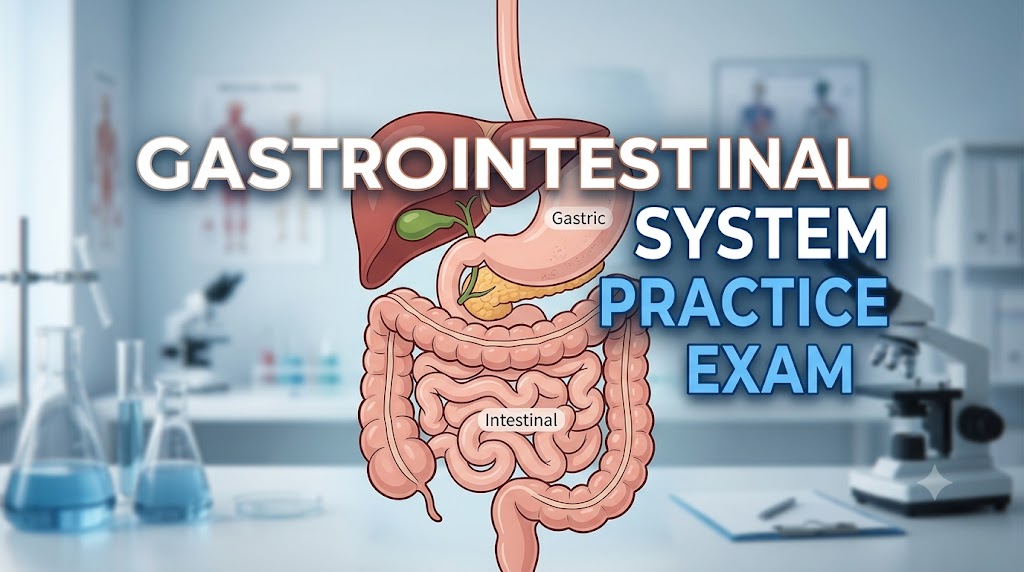
Additional Information
What the Course Entails and Exam Details
While not a "course" itself, this comprehensive practice exam is designed to mirror the content and rigour found in real certification and licensing tests. Its focus is on demonstrating proficiency in:
Anatomy and Physiology: Detailed knowledge of the GI tract organs from mouth to anus, accessory organs (liver, pancreas, gallbladder), and their respective roles in ingestion, digestion, absorption, and elimination. Understand the cellular structure, neural and hormonal regulation, and the overall mechanical and chemical processes involved.
Gastrointestinal Conditions: In-depth knowledge of common and critical disorders such as GERD, peptic ulcers, inflammatory bowel disease (Crohn's disease, ulcerative colitis), irritable bowel syndrome (IBS), gastritis, various types of hepatitis, pancreatitis, and gastrointestinal cancers.
Diagnostic and Therapeutic Procedures: Understanding the purpose, execution, and interpretation of common GI tests and treatments, including endoscopies, colonoscopies, imaging studies (CT scans, barium swallows), laboratory tests (liver function tests, stool tests), and typical pharmacological or surgical interventions.
Pathophysiology: Explaining the underlying mechanisms of disease processes and their clinical manifestations.
Patient Care: While structured as practice questions, the scenarios often test critical thinking regarding appropriate care, patient education, and understanding potential complications.
The practice exam typically consists of multiple-choice questions, which may include case studies, anatomical diagrams to label, or matching questions, depending on the specific practice resource you select. It aims to prepare you for the types of questions and level of knowledge required by major certifying bodies.
What to Expect in the Final Exam
Although a practice exam doesn't have its own final, the exams it prepares you for generally follow standard formats:
Question Type: Predominantly multiple-choice questions with three or four possible answers. Some exams may incorporate more complex questions like multiple-select, ordering, or short answer.
Case-Based Scenarios: Many questions are presented within clinical scenarios, testing your ability to apply theoretical knowledge to practical situations.
Timing: Most certification exams have time limits, typically ranging from 1 to 3 hours, requiring efficient time management during the practice.
Structure: Questions are often structured around body systems (like the GI system), but may also be categorized by task (e.g., patient assessment, intervention, diagnostic testing).
Passing Score: Real-world passing scores vary significantly depending on the specific exam (e.g., NCLEX, CMA, USMLE). Practice exams aim to build confidence and accuracy to achieve well above typical passing thresholds.
Remember, a practice exam prepares you, and your actual exam format and requirements will depend entirely on the specific certification you are pursuing (refer to the official guidelines for your intended exam).
How to Study and Exam Centers
Effectively preparing for any exam with significant GI content requires a strategic approach:
Comprehensive Learning Resources: Start with standard textbooks on anatomy, physiology, microbiology, and medical-surgical nursing, focusing deeply on the GI chapters.
Use Quality Study Guides and Practice Questions: Seek out reputable practice question banks and exam prep books specifically for your target certification (e.g., NCLEX prep, CMA practice tests). Using practice exams like this one is an excellent strategy!
Active Learning: Create flashcards for anatomical structures, common conditions, medications, and diagnostic tests. Draw and label the GI system to solidify anatomy. Explain concepts out loud to a study partner or yourself.
Identify Weaknesses: Use practice exams to pinpoint areas where you struggle. Go back and review those specific topics in your textbooks.
Simulate Real Conditions: Take full, timed practice exams to build stamina and practice time management. Do this in a quiet, distraction-free environment.
Form a Study Group: Collaborate with peers to discuss complex topics and share resources.
Exam Centers: Real-world certification exams are typically administered through secure, proctored testing centers or platforms. Once you are ready and have registered for your specific exam (e.g., via the exam's official website), you will be able to select an available time slot and location:
Pearson VUE: A common administrator for many major medical and professional certifications. They have numerous physical testing centers worldwide.
Other Specialized Centers: Depending on the specific certification, testing might occur at dedicated professional testing sites, authorized schools, or sometimes in secure online environments with remote proctoring.
Always check the official website of your desired certification body for the most accurate information on exam registration, scheduling, and authorized testing locations. This is where you will find the definitive steps to book your test.
Job Opportunities from the Course
A strong understanding of the gastrointestinal system, verified by success on relevant medical or health-related certification exams, opens doors to a vast array of impactful careers within the healthcare and wellness sectors. This specialized knowledge is a critical component for roles such as:
Registered Nurse (RN) / Licensed Practical Nurse (LPN): General and specialized nursing positions, particularly in gastroenterology units, hospitals, clinics, and surgical centers.
Nurse Practitioner (NP) / Physician Assistant (PA): Advanced practice roles focusing on patient assessment, diagnosis, and treatment, often with the ability to specialize in GI conditions.
Gastroenterology Specialist (MD/DO): Highly specialized medical doctor dedicated entirely to digestive health.
Medical Assistant: Clinical roles in various settings, assisting with procedures, patient preparation, and basic care.
Registered Dietitian (RD) / Nutritionist: Specialized expertise in dietary management for GI conditions (e.g., IBS, IBD, Celiac disease).
EMT / Paramedic: Critical for rapid assessment and stabilization of gastrointestinal emergencies in pre-hospital settings.
Surgical Technician: Assisting in various gastrointestinal surgeries.
Medical Laboratory Technician: Performing diagnostic tests related to GI health.
Medical Coder / Biller: Specialized coding and billing related to GI procedures and diagnoses.
Health Educator / Advocate: Focus on digestive health education and patient support.
Achieving certifications that include a strong GI component demonstrates high level proficiency, enhancing job prospects and enabling specialists to make critical differences in patient outcomes across the spectrum of care. Start your preparation with these practice questions today!
Frequently Asked Questions
Reviews
5.0
Based on 0 reviews
Leave a Review
No reviews yet. Be the first to review!