
Free PTCB Practice Test 2 – Pharmacy Technician Certification Practice
$69.00
- Buy to unlock unlimited access to all Quiz questions.
- After purchase you can print a PDF of the whole quiz at any point. The PDF will contain the questions and the correct answers.
About this Exam
The Pharmacy Technician Certification Exam (PTCE), administered by the Pharmacy Technician Certification Board (PTCB), is the gold-standard credential for pharmacy technicians across the United States. Earning your Certified Pharmacy Technician (CPhT) designation proves to employers, colleagues, and patients that you possess the necessary knowledge and skills to assist pharmacists safely and effectively. This certification is designed for individuals who have completed a PTCB-recognized education program or have significant work experience in the field, seeking to validate their competency and advance their career.
Ready to test your knowledge?
Buy Now to Access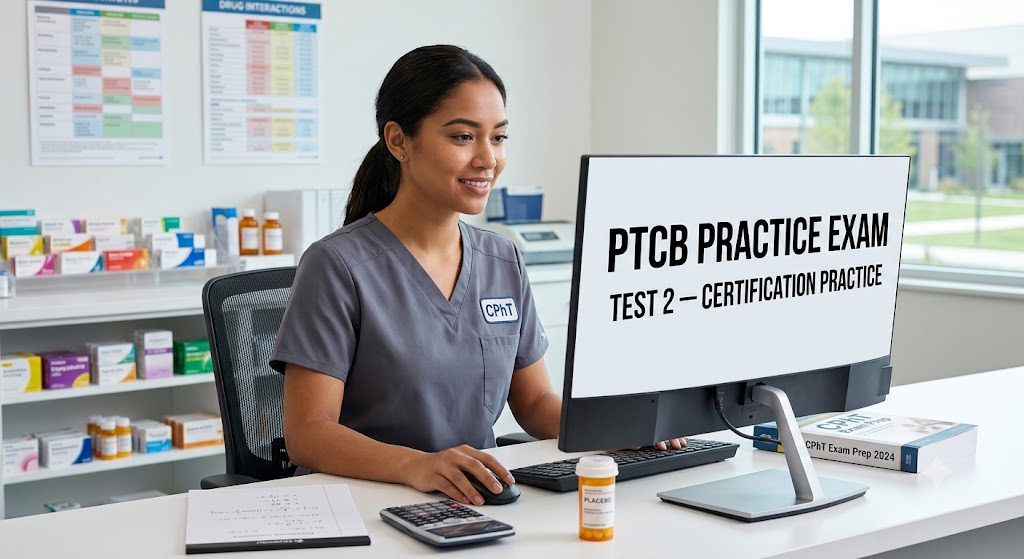
Additional Information
What the Course Entails and Exam Details
To pass the PTCE and earn your CPhT, you must demonstrate proficiency in several critical areas of pharmacy operation. The certification content represents the core knowledge base necessary for safe practice. The final exam organizes this knowledge into four primary domains, rebalanced in the most recent updates to reflect current pharmacy technician responsibilities.
The four knowledge domains covered are:
Medications (approx. 40%): Mastering generic and brand names, drug classifications, therapeutic equivalence, and significant drug interactions.
Federal Requirements (approx. 10%): Understanding legal aspects, including federal laws on controlled substances, safety standards, and regulation of pharmaceutical hazardous waste.
Patient Safety and Quality Assurance (approx. 25%): Focusing on error prevention strategies, infection control, the Pharmacist’s role, and medication storage.
Order Entry and Processing (approx. 25%): Covering the essential skills of interpreting prescriptions, calculating dosages, compounding, and using standard pharmacy equipment.
What to Expect in the Final Exam
The actual PTCB certification exam is a rigorous, computer-based test designed to evaluate your readiness for the field. Knowing the format is the first step to conquering test anxiety. The entire appointment lasts two hours, allowing for a tutorial and a post-exam survey.
You will have one hour and 50 minutes to complete the exam. The PTCE consists of 90 multiple-choice questions. Of these 90 questions, 80 are scored items used to calculate your final score, and 10 are unscored pretest questions used by PTCB for future test statistical purposes. These unscored questions are distributed randomly, so you must treat every question as if it counts toward your final result.
Your official score will be reported on a scale ranging from 1,000 to 1,600. To earn your CPhT, you must achieve a scaled passing score of at least 1,400.
How to Study and Exam Centers
Effective preparation is key to success. Your study strategy should combine deep knowledge review with active retrieval practice. Utilize official PTCB study guides, flashcards for medication names and calculations, and, most importantly, high-quality full-length practice tests, such as this [Free PTCB Practice Test 2].
Focus on your weak areas by analyzing your practice test results. Pharmacy math and medication nomenclature often require extra dedication. Create a study schedule and stick to it over several weeks to build long-term retention. Practice under timed conditions to simulate the pressure of the real exam.
When you are ready to take the final step, you will not take the exam online from home. The PTCE is administered strictly through Pearson VUE testing centers throughout the country. You must create a PTCB account, apply for certification, receive your authorization to test (ATT), and then schedule your appointment at a physical Pearson VUE facility closest to you. Ensure you have the appropriate identification requirements ready for the testing center.
Job Opportunities from the Course
Earning your CPhT certification from the PTCB significantly expands your employment opportunities and potential for career growth. Most competitive pharmacy settings require or strongly prefer this certification for hiring and promotion.
Unlock various rewarding career paths, including:
Retail Pharmacy Technician: Working in community settings like drugstores and grocery store pharmacies.
Hospital Pharmacy Technician: Assisting in complex inpatient medication systems, compounding sterile products, and managing technology.
Mail-Order Pharmacy Technician: Processing large volumes of prescriptions in highly automated fulfillment centers.
Long-Term Care Pharmacy Technician: Providing tailored pharmaceutical services to nursing homes and assisted living facilities.
Specialty Pharmacy Technician: Focusing on therapies for chronic or complex medical conditions (e.g., oncology, immunology).
Pharmacy Informatics Technician: Utilizing IT skills to manage automated dispensing systems and electronic health records.
Pharmaceutical Sales Representative: Transitioning technician knowledge to the corporate side of medication distribution.
Lead Pharmacy Technician: Assuming management and supervisory roles within a pharmacy department.
Frequently Asked Questions
Reviews
5.0
Based on 0 reviews
Leave a Review
No reviews yet. Be the first to review!