
FREE Ham Radio Practice Test 2026 Official (Technician and General)
$69.00
- Buy to unlock unlimited access to all Quiz questions.
- After purchase you can print a PDF of the whole quiz at any point. The PDF will contain the questions and the correct answers.
About this Exam
The Amateur Radio Service, often called "Ham Radio," is a unique and vital communication service licensed by the Federal Communications Commission (FCC) in the United States. It is designed for individuals interested in radio technique, communication, and electronics, solely with a personal aim and without pecuniary interest. The service allows operators to experiment with electronics, communicate globally (even without internet or cell service), and provide critical communication support during disasters.
The Technician Class license is the introductory license for most new amateur radio operators. It grants all amateur radio privileges above 30 MHz, allowing licensees to communicate locally and often within their region using handheld and mobile radios, as well as digital modes and satellites. It is designed for beginners who want to get on the air quickly.
The General Class license is the next step up, unlocking the vast majority of amateur radio privileges across all bandwidths, including the HF (High Frequency) bands that allow for reliable long-distance (international) communication. This license is designed for operators who wish to expand their reach and explore the full potential of global radio communication.
Ready to test your knowledge?
Buy Now to Access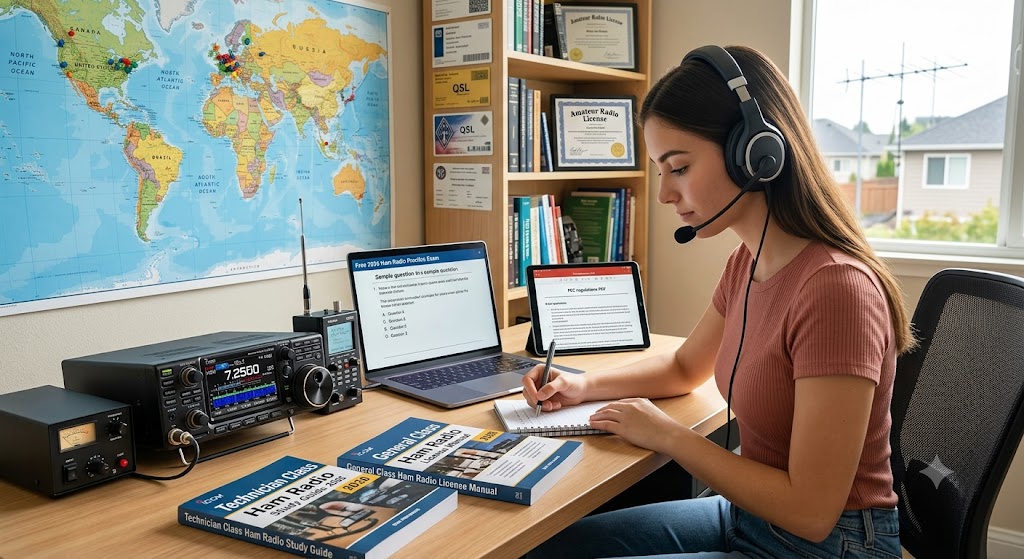
Additional Information
What the Course Entails and Exam Details
This FREE Ham Radio Practice Test 2026 Official (Technician and General) is designed to prepare you for the current FCC exam pools, which are updated every four years by the National Conference of Volunteer Examiners (NCVEC).
Technician Class License Course Details
The Technician course and practice exam cover elementary electronics theory, basic regulations, safety, and operating practices. The key topics include:
FCC rules and regulations for the Amateur Radio Service.
Basic station equipment, setup, and operation.
Operating procedures, including making contacts and public service communication.
Basic electronic theory (voltage, current, resistance, Ohm's law, power).
Antennas and feed lines.
Radio wave propagation characteristics for VHF/UHF bands.
Electrical and RF safety practices.
General Class License Course Details
The General course and practice exam build upon the foundation of the Technician class, diving deeper into advanced theory and broader operating privileges. The core topics include:
Expanded FCC rules and privileges for the HF bands.
Advanced operating procedures for DX (long-distance) communication and digital modes.
Detailed radio wave propagation on HF bands, including solar cycle effects.
Advanced circuit components, schematic diagrams, and electronics theory.
Practical antenna design, Baluns, antenna tuners, and transmission line theory.
Advanced transceiver design and test equipment.
Practical RF safety measurements and standards.
What to Expect in the Final Exam
The official FCC amateur radio license exams are administered by Volunteer Examiners (VEs), who are fellow hams licensed at the General class or higher and accredited by a Volunteer Examiner Coordinator (VEC).
Technician Class Exam Expectations
The Technician exam (Element 2) consists of 35 multiple-choice questions. These questions are selected from a public pool of hundreds of possible questions covering the topics listed above. To pass, you must achieve a score of 74%, which means answering at least 26 questions correctly. There is no official time limit, but most VEs allow ample time, usually around 45 to 60 minutes, which is sufficient for most applicants. The exam is often taken in a written (paper) format, although some VE teams use computer-based testing.
General Class Exam Expectations
The General exam (Element 3) also consists of 35 multiple-choice questions, selected from its own distinct public pool of questions. Like the Technician exam, a passing score of 74% is required, meaning you must correctly answer at least 26 questions. Ample time is provided for this exam as well. If you already hold a Technician license (or a 'grandfathered' Technician license that gives you credit), you only need to pass the General exam. Many applicants choose to study for both exams and take them during the same session, which is permitted.
How to Study and Exam Centers
Preparation is key to passing the FCC exams. We recommend a structured study approach combining comprehensive reading with active practice testing.
Top Study Strategies
First, obtain the correct study materials. The ARRL (American Radio Relay League) publishes excellent license manuals for both Technician and General classes. Online courses and video series are also highly effective. Second, utilize this FREE Ham Radio Practice Test 2026 (Technician and General) extensively. Practice tests are critical because they use the exact wording of the actual exam questions. Take the practice test multiple times. Do not just memorize the correct answer; use your study manual to understand why that answer is correct. This reinforces the underlying concepts. Focus your study efforts on your weak areas. If you consistently miss questions on propagation or electronics theory, dedicate extra time to reviewing those chapters in your manual.
How to Locate Exam Centers
The official exam is administered by Volunteer Examiners, not at commercial testing centers like Pearson VUE. To find an exam session near you, you have two primary options:
1. Physical In-Person Testing: Most local amateur radio clubs host regular VE exam sessions. You can find a list of upcoming sessions in your area using the ARRL Exam Session Search tool on the ARRL website. These sessions are usually held in community centers, libraries, or fire stations. The testing fee is nominal (typically around $15) and is set by the VEC.
2. Fully Remote Online Testing: Many VEC organizations now offer fully remote, video-supervised online exam sessions. You take the test from the comfort of your home using a computer with a webcam. This option offers maximum flexibility. You can find accredited online examination opportunities by searching the websites of VECs that support remote testing, such as the Alaska VEC, Laurel VEC, or GLAARG (Greater Los Angeles Amateur Radio Group) VEC.
Note: Before you can take the official exam, you must register with the FCC and obtain a Federal Registration Number (FRN). This is a unique identifier used in all subsequent FCC transactions. Getting an FRN is free and can be done online through the FCC's CORES system. When you attend your exam (either in person or online), you will provide your FRN to the VE team.
Job Opportunities from the Course
While amateur radio is a non-commercial service, the skills and technical knowledge gained by earning an FCC license are highly valued by employers in numerous technical fields. A Ham Radio license on your resume demonstrates self-motivation, a strong technical aptitude, and practical experience with electronics and communications systems.
Earning these certifications can unlock or enhance career paths such as:
Telecommunications Technician: Installing, maintaining, and repairing complex communication equipment and networks.
Electronics Field Engineer: Troubleshooting and servicing electronic systems for aerospace, defense, or manufacturing companies.
Emergency Management Specialist: Utilizing communication expertise in disaster response planning and operations for government agencies or NGOs.
RF (Radio Frequency) Engineer: Designing and testing wireless communication devices, antennas, and RF systems (advanced engineering degree often also required, but the license demonstrates foundational practical knowledge).
Broadcast Engineer: Maintaining the technical equipment and systems for radio and television stations.
Public Safety Communications Officer: Operating and managing the critical communication systems used by police, fire, and EMS services (Dispatcher/Comms operator).
Network Systems Administrator: The understanding of propagation and wireless networking principles (especially with digital modes) is highly transferable to corporate IT networking roles.
Frequently Asked Questions
Reviews
5.0
Based on 0 reviews
Leave a Review
No reviews yet. Be the first to review!