
FREE AFOQT Practice Test 2026 Official Study Guide (PDF)
$69.00
- Buy to unlock unlimited access to all Quiz questions.
- After purchase you can print a PDF of the whole quiz at any point. The PDF will contain the questions and the correct answers.
About this Exam
The Air Force Officer Qualifying Test (AFOQT) is a critical standardized exam used by the United States Air Force to select candidates for officer commissioning programs. This comprehensive assessment goes far beyond basic aptitude testing. It is specifically designed to measure verbal and mathematical abilities, as well as specific aptitudes required for various Air Force career fields.
The AFOQT is a vital component of the application process for aspiring Air Force officers, whether they are pursuing a commission through the Air Force Reserve Officer Training Corps (AFROTC), Officer Training School (OTS), or the Air Force Academy. Ultimately, this exam helps the Air Force identify individuals with the intellectual potential and specific skill sets necessary to succeed as leaders in a complex military environment. A strong performance on the AFOQT is not just a requirement; it is a powerful way to make your application competitive for the career path you desire.
Ready to test your knowledge?
Buy Now to Access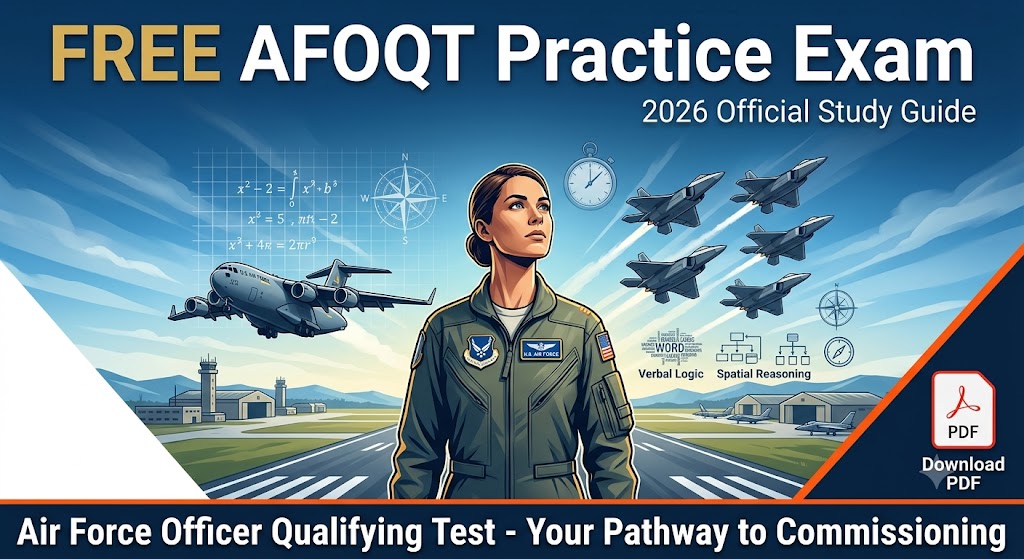
Additional Information
What the Course Entails and Exam Details
Preparing for the AFOQT requires mastering a diverse array
of subjects that span 12 distinct subtests. The core topics covered in this
extensive examination include critical verbal and quantitative skills necessary
for academic and leadership success.
Candidates will face subtests on Verbal Analogies, which
assess the ability to understand relationships between words, and Word
Knowledge, which evaluates vocabulary definition and usage. The math-based
sections include Arithmetic Reasoning, focusing on solving complex word
problems, and Math Knowledge, which covers fundamental concepts up to and
including high school algebra and geometry. Beyond these foundational academic
skills, the AFOQT includes unique sections tailored to specific career
aptitudes.
These specialized subtests include Table Reading (assessing
speed and accuracy in interpreting data grids), Instrument Comprehension
(measuring spatial awareness of aircraft position), Block Counting (testing
three-dimensional visualization), and Aviation Information (evaluating general
knowledge of flight principles and systems). Candidates must also navigate a
Reading Comprehension section and unique assessments like the Situational Judgment
Test, which measures decision-making, and the Self-Description Inventory, which
evaluates personality traits relevant to military service.
What to Expect in
the Final Exam
The AFOQT is a highly structured, paper-and-pencil
standardized test consisting entirely of multiple-choice questions. It is a
grueling, long-duration assessment that takes approximately five hours to
complete, including administrative time and brief, mandatory breaks.
Precise time limits are strictly enforced for each of the 12
subtests, varying from approximately 5 to 40 minutes, depending on the number
and complexity of the questions. Speed and accuracy are both paramount, as many
test-takers find the tight time constraints to be one of the exam's greatest
challenges.
Scoring is unique; you will not receive a pass/fail grade
but rather raw scores converted into percentiles ranging from 1 to 99 in six
composite areas: Pilot, Navigator-Technical, Academic Aptitude, Verbal, and
Quantitative. While minimum qualifying percentile scores vary based on the
specific officer program you are applying for (e.g., higher scores are
typically required for pilot candidates), a consistent requirement is achieving
at least a 15 in Verbal and a 10 in Quantitative composites just to be eligible
for commissioning. Perhaps the most significant rule is the limited retry
policy; candidates are generally only permitted to take the AFOQT twice in
their lifetime, with a mandatory wait period (often 180 days) between attempts,
making focused and thorough preparation using a valid study guide absolutely
essential.
How to Study and Exam Centers
Effective preparation for the AFOQT demands a structured and
consistent study plan. The first step is downloading and thoroughly reviewing
the FREE AFOQT Practice Test 2026 Official Study Guide (PDF), which provides an
invaluable overview of subtests and sample questions directly reflecting the
current test format.
Utilize targeted study materials designed for standardized
tests, focusing heavily on math and verbal sections that can significantly
boost multiple composite scores. Take multiple full-length practice exams under
timed conditions to simulate the pressure of test day, build endurance, and
identify specific weak areas. Dedicate substantial time to drilling dynamic
visualization and spatial awareness, especially using practice tools for the
complex Table Reading and Instrument Comprehension subtests which are highly
timed. It is crucial to remember that calculators are not permitted, so you
must practice performing rapid mental arithmetic and long-hand calculations to
maintain speed during the math sections.
The official AFOQT is administered in controlled
environments at authorized testing locations. Active duty military members
typically take the exam at the base Education Office or Test Control Officer
(TCO) facilities. Aspiring candidates who are currently students may often take
the exam at their local Air Force ROTC detachment, where the test is frequently
administered to cadets. For OTS applicants not currently affiliated with a
college or active duty base, the exam is typically scheduled at a Military
Entrance Processing Station (MEPS) located in major cities throughout the
United States. You must contact an Air Force Recruiter, ROTC Instructor, or
base TCO to schedule your exam, as you cannot simply register at a commercial
testing center like Pearson VUE.
Job Opportunities from the Course
A strong performance on the AFOQT and successful officer
commissioning unlock dozens of diverse, high-impact career opportunities. Your
specific composite scores will determine your eligibility for various
competitive specialties.
While the list below highlights common officer job titles
and career paths, many of which can be heavily influenced by AFOQT results, it
is important to remember that physical and security clearances, as well as
educational background, also play significant roles in ultimate assignment.
- Air
Force Pilot
- Combat
Systems Officer (CSO)
- Remotely
Piloted Aircraft (RPA) Pilot
- Air
Battle Manager (ABM)
- Intelligence
Officer
- Cyberspace
Operations Officer
- Developmental
Engineer
- Acquisitions
Manager
- Public
Affairs Officer
- Medical
Officer (requires doctoral/professional degree)
- JAG
(Judge Advocate General - requires Law degree)
- Special
Investigations (OSI) Officer
- Logistics
Readiness Officer
- Security
Forces Officer
- Meteorologist
/ Weather Officer
- Space
Operations Officer (now largely transitioning to the U.S. Space Force)
This study guide provides the foundation for your journey.
Good luck as you prepare to serve.
Frequently Asked Questions
Reviews
5.0
Based on 0 reviews
Leave a Review
No reviews yet. Be the first to review!