
Food Safety Practice Test & Exam Prep | United Arab Emirates
$69.00
- Buy to unlock unlimited access to all Quiz questions.
- After purchase you can print a PDF of the whole quiz at any point. The PDF will contain the questions and the correct answers.
About this Exam
Food Safety Certification in the United Arab Emirates is a mandatory requirement for every professional working in the country's vast and dynamic hospitality, retail, and food manufacturing sectors. From bustling five-star hotel kitchens in Dubai to community-focused supermarkets in Abu Dhabi and manufacturing plants in Sharjah, a valid Food Safety and Hygiene Certificate ensures public health and safety.
This certification is designed for all "food handlers," a broad term that includes chefs, line cooks, stewards, waiters, restaurant and catering managers, food delivery personnel, and quality control staff. It demonstrates a shared commitment to preventing foodborne illness, maintaining strict hygiene standards, and complying with the stringent regulations set by local authorities, such as the Dubai Municipality (DM) and the Abu Dhabi Agriculture and Food Safety Authority (ADAFSA).
Ready to test your knowledge?
Buy Now to Access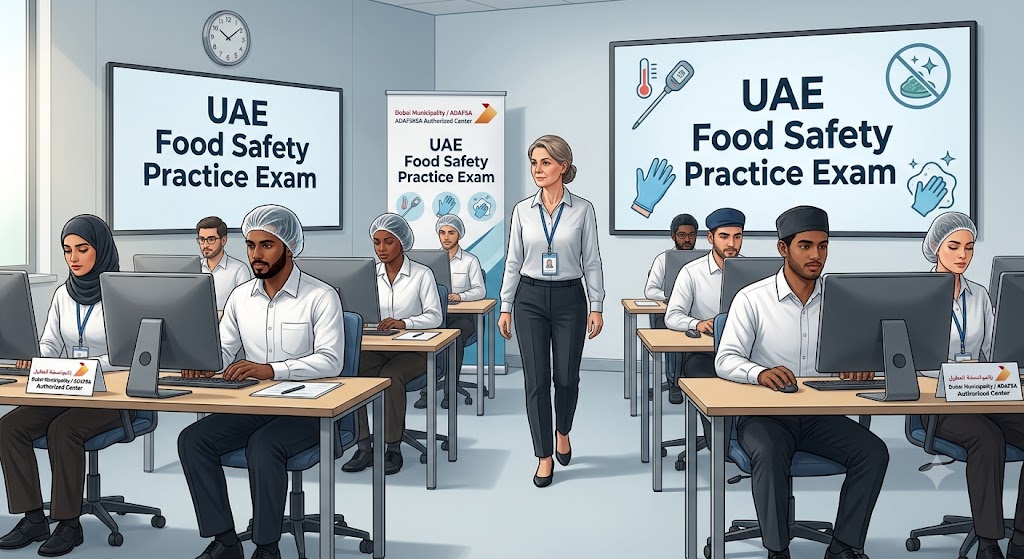
Additional Information
What the Course Entails and Exam Details
While specific program names vary by emirate (e.g., the
Essential Food Safety Training, or EFST, in Abu Dhabi, or the Basic Food Safety
and Person-In-Charge programs in Dubai), the core syllabus is standardized
around international best practices and the critical "4 Cs of Food
Safety."
Key topics covered in the training course include:
- Cleaning
and Disinfection: Master the difference between cleaning (removing
dirt) and disinfecting (destroying bacteria to a safe level), and
understand proper cleaning schedules.
- Cooking
to Safe Temperatures: Learn the exact internal temperatures required
to kill harmful pathogens like Salmonella and E. coli.
- Chilling
and Food Storage: Understand the food safety "danger zone"
and proper methods for receiving, storing, and thawing food.
- Cross-contamination
Prevention: Implement strategies to prevent the transfer of harmful
bacteria and allergens between different foods and surfaces.
- Personal
Hygiene and Handwashing: Grasp the absolute necessity of rigorous
personal cleanliness and the correct handwashing procedure to prevent
contamination.
- UAE
Food Regulations: Gain a fundamental understanding of local laws, such
as Dubai's Law No. 1/2025 on food loss and waste prevention, and
inspection procedures.
A typical exam consists of approximately 30 to 50 questions,
most commonly in a multiple-choice format (MCQ). The passing score is generally
60%, and the certification is typically valid for three years.
What to Expect in the Final Exam
The final exam is not taken in isolation; it is integrated
into a required training course. This means you must first complete the
mandatory hours of training before sitting for the assessment. The entire
process, including the exam, can often be completed in a single day for basic
levels.
Here is a breakdown of what to anticipate:
- Format:
Expect multiple-choice questions that present scenario-based situations
testing your judgment and recall of food safety principles. For example,
"What is the correct procedure for thawing a frozen chicken?" or
"Identify the critical temperature range for the 'danger zone'."
- Duration:
The exam is designed to be efficient, usually lasting between 30 to 60
minutes.
- Passing
Criteria: You will likely need to achieve a score of at least 60% to
be awarded your certificate.
- Online
vs. In-person: Exams are increasingly offered online through
authorized training portals, allowing you to take them in a proctored
digital environment. Some institutes also offer in-person options.
How to Study and Exam Centers
Preparation for the UAE Food Safety exam is straightforward
and focused. Your primary and most effective study tool is the mandatory
training course itself. Pay close attention, participate actively, and review
all materials provided.
Here is an actionable strategy for success:
Fully Engage in the Training:
Take detailed notes during the course, especially on the "4 Cs,"
temperature controls, and hygiene protocols.
Use Course Manuals: Study
guides and handbooks provided by the training center are your definitive
resources.
Practice with Mock Exams:
Seek out online practice tests, sample questions, or "practice exams"
from authorized providers. This is crucial for familiarizing yourself with the
common question types and time limits.
Focus on Local Specifics:
While global principles apply, ensure you know any specific regional laws and
the name of your local regulatory body (e.g., ADAFSA, DM).
Exam Centers: You do not register for a standalone
exam. Instead, you enroll in a "Basic Food Safety," "PIC,"
or "EFST" course through an authorized training center or authorized
school certified by the relevant UAE municipality. These organizations,
which can be easily found via online search and official government portals,
are approved to both deliver the training and administer the accompanying exam.
Both in-person and online/virtual options are widely available.
Job Opportunities from the Course
A valid Food Safety Certificate is an essential passport,
unlocking a diverse range of career paths across the UAE's entire food value
chain.
Possessing this certification makes you an attractive
candidate for numerous roles, including, but not limited to:
- Culinary
Positions: Commis Chef, Demi Chef de Partie, Head Chef, Kitchen
Manager.
- Service
Positions: Waiter/Waitress, Food & Beverage (F&B) Attendant,
Barista, Banquet Supervisor.
- Management
Positions: Restaurant Manager, Catering Manager, Food & Beverage
Director.
- Supply
Chain and Production: Food Delivery Driver, Logistics Coordinator,
Food Production Worker, Quality Control Checker.
- Specialized
Roles: Food Safety Officer, Internal Food Safety Auditor, Food Safety
Trainer (with additional certifications).
By preparing effectively for this exam, you are not just
fulfilling a regulatory requirement; you are equipping yourself with the
knowledge to protect public health and build a successful, compliant career in
the UAE's thriving food industry.
Frequently Asked Questions
Reviews
5.0
Based on 0 reviews
Leave a Review
No reviews yet. Be the first to review!