
Food Safety Practice Test & Exam Prep | Australia
$69.00
- Buy to unlock unlimited access to all Quiz questions.
- After purchase you can print a PDF of the whole quiz at any point. The PDF will contain the questions and the correct answers.
About this Exam
Embarking on a career or seeking advancement within the vibrant Australian food service industry often requires demonstrating high standards of food safety knowledge and practice. This comprehensive study guide and practice exam are specifically tailored for individuals aiming to achieve their Food Safety Supervisor (FSS) certification in Australia. This key qualification is legally mandated for many food businesses across the country, ensuring at least one designated person has the expertise to supervise safe food handling. Whether you're an aspiring chef, a seasoned restaurant manager, or working in catering, childcare, or aged care food services, mastering these principles is essential. This guide is your stepping stone to confidence and compliance, helping you understand crucial food safety concepts and effectively prepare for the official assessment.
Ready to test your knowledge?
Buy Now to Access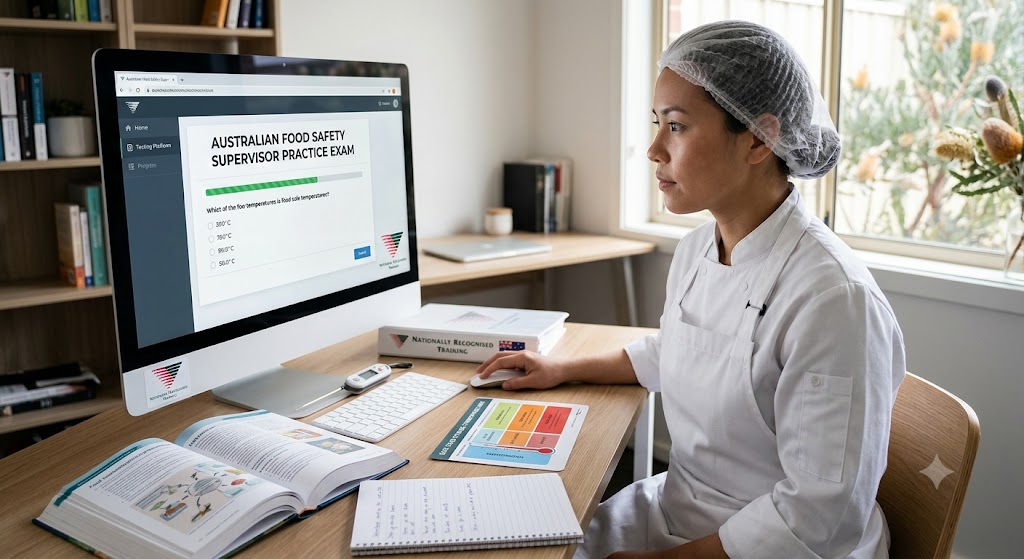
Additional Information
What the Course Entails and Exam Details
A typical Australian Food Safety Supervisor course, often
composed of nationally recognised units of competency like SITXFSA005 and
SITXFSA006 (or industry-specific equivalents), covers a robust range of vital
topics. Students delved into the intricacies of personal hygiene practices to
prevent food contamination, understanding different types of food hazards
(microbiological, chemical, physical), and implementing effective cleaning and
sanitising procedures.
Temperature control is a critical focus, encompassing safe
receiving, storage, display, and transport of potentially hazardous foods to
keep them out of the dangerous 'temperature danger zone'. You will learn about
preventing cross-contamination, safe food handling techniques from preparation
to service, and essential knowledge of allergens and how to manage them safely.
Understanding and implementing basic food safety programs, often based on HACCP
(Hazard Analysis and Critical Control Points) principles, and maintaining
accurate food safety records are also core components.
What to Expect in
the Final Exam
While the exact structure can vary slightly between
different Registered Training Organisations (RTOs) delivering the FSS
certification in Australia, the assessment process generally includes a
significant knowledge component often delivered in a quiz or test format. You
can typically expect a substantial number of multiple-choice questions designed
to thoroughly assess your understanding of all core food safety topics covered
in the course. These questions will challenge your recall of specific
temperature requirements, correct procedures, legal obligations, and best
practices.
The passing score requirements are typically high,
reflecting the critical nature of food safety – often requiring a demonstration
of full competency, which may correspond to scoring close to or exactly 100% on
the knowledge assessment or successfully answering all key questions correctly.
There is usually a reasonable time limit set for the online or in-person exam
part, requiring you to work efficiently but carefully. The assessment is
usually closed-book, meaning you must rely solely on your knowledge and
preparation.
How to Study and Exam Centers
Preparation is paramount for success in your FSS assessment.
Actively engage with your course materials right from the start. Take detailed
notes, use visual aids like charts and diagrams to memorise key temperatures
and procedures, and form study groups if possible. Repetition and active recall
are key, so quiz yourself frequently on safe temperature ranges, cooling times,
and correct handwashing steps.
Practising with a dedicated online Australian Food Safety
Supervisor Practice Exam is one of the most effective strategies. Such
practice resources simulate real exam conditions and question types, helping
you identify areas where you need more study, build confidence, and familiarise
yourself with the format. Focus on understanding the why behind each
safety practice, not just memorising answers. Reviewing relevant sections of
the Australia New Zealand Food Standards Code can also provide valuable
context.
Regarding exam centers, in Australia, the final assessment
is not typically taken at centralised external test centers like Pearson VUE.
Instead, it is integrated into the training program delivered by an authorized
RTO. When you enrol in a Food Safety Supervisor course (many of which are conveniently
offered entirely online), you will usually access and complete the final
knowledge assessment through the RTO's secure online learning portal. For
face-to-face courses, the assessment may be conducted in a classroom setting at
the RTO's premises. Ensure you choose a reputable, nationally recognised RTO
for your training, and they will guide you on how and where to complete all
required assessments, which may also include a practical workplace component to
demonstrate your skills in a real-world environment.
Job Opportunities from the Course
Successfully completing your Australian Food Safety
Supervisor certification unlocks numerous career paths and enhances your
employability across diverse sectors. Here are some key job opportunities that
typically require or significantly benefit from this qualification:
- Head
Chef / Sous Chef / Chef de Partie: Leading a kitchen team requires not
only culinary skill but also a rigorous commitment to food safety. As an
FSS, you ensure entire kitchen operations adhere to critical standards,
protecting both customers and the business's reputation.
- Restaurant
/ Café Manager: Stepping into management often necessitates FSS
certification to oversee overall operations, train staff, and manage legal
compliance within the establishment.
- Kitchen
Supervisor: Directly supervising food preparation and handling, this
role benefits enormously from FSS expertise to mentor staff and maintain
impeccable safety standards daily.
- Catering
Manager / Supervisor: Overseeing food services for events requires
meticulous planning and execution, with food safety paramount due to
potentially complex operations and larger scales.
- Food
& Beverage Supervisor: Ensuring safety and quality control across
both food and drink service is essential in hotels, clubs, and larger
hospitality venues.
- Senior
Food Service Worker (Aged Care / Childcare / Hospitals): Providing
food services to vulnerable populations places an even higher premium on
food safety. FSS certification demonstrates advanced knowledge and
commitment in these sensitive environments.
- Quality
Control / Food Safety Officer (Food Manufacturing): For those looking
beyond hospitality, FSS provides a strong foundation for ensuring
regulatory compliance and safe practices within larger scale food
production facilities.
Australia Food Safety Supervisor Practice Exam -
Visualize Your Success
Prepare for your official Australian Food Safety Supervisor
certification with confidence by engaging with this study guide and using a
dedicated practice exam to sharpen your knowledge. Visualize your progress and
readiness just like the focused individual in this image, dedicated to
mastering safe food practices within the dynamic Australian food industry.
Frequently Asked Questions
Reviews
5.0
Based on 0 reviews
Leave a Review
No reviews yet. Be the first to review!