
Food Handling Practice Test & Exam Prep | Malta
$69.00
- Buy to unlock unlimited access to all Quiz questions.
- After purchase you can print a PDF of the whole quiz at any point. The PDF will contain the questions and the correct answers.
About this Exam
The Food Handler Certification, often referred to as FoodSafe in some provinces, is a vital credential for anyone working in the food service industry in Canada.
This comprehensive exam assesses an individual's knowledge of essential food safety practices, ensuring they possess the skills necessary to handle, prepare, and store food safely.
Designed for front-line food handlers, supervisors, and managers, obtaining this certification is not just a career asset, but frequently a legal requirement in many Canadian provinces and municipalities to prevent foodborne illnesses and maintain public health standards.
Ready to test your knowledge?
Buy Now to Access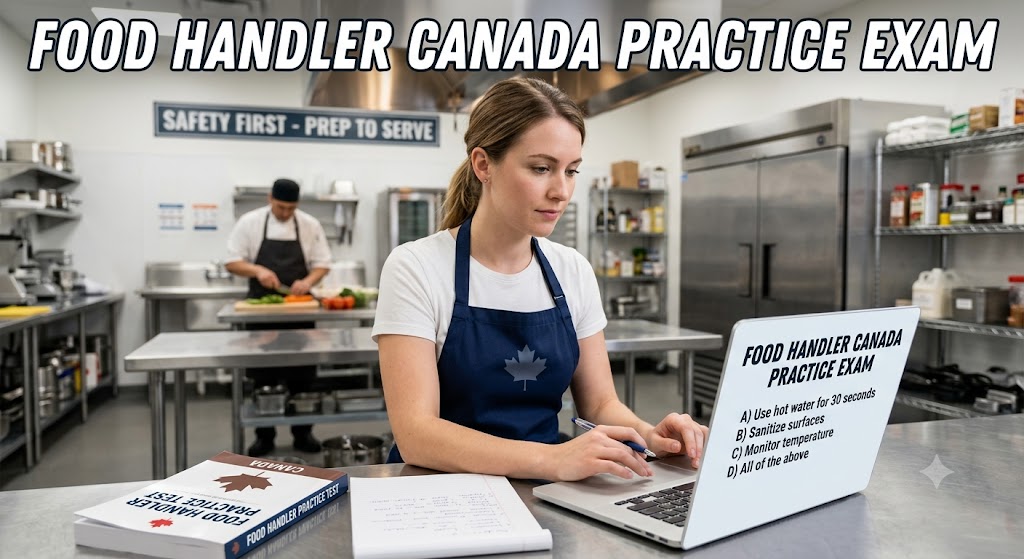
Additional Information
What the Course Entails and Exam Details
The course of study for the Food Handler Certification
covers a critical array of topics vital to food safety management.
Candidates are educated in time and temperature control, understanding
the importance of the temperature danger zone and proper heating and cooling
methods.
Personal hygiene practices, such as rigorous handwashing
techniques and appropriate apparel, are detailed.
Cleaning and sanitization protocols for equipment and
facilities, as well as strategies for effective pest control, are crucial
components.
Furthermore, learners delve into cross-contamination
prevention methods, receiving and storing food procedures, and the legislative
requirements specific to Canadian food safety acts.
The syllabus is structured to provide actionable knowledge
that ensures compliance and safety in a commercial kitchen setting.
What to Expect in
the Final Exam
The final Food Handler exam typically follows a standardized
multiple-choice format, designed to evaluate comprehension of the core learning
objectives.
The number of questions generally ranges from 50 to 75,
testing a broad spectrum of the curriculum.
Candidates often must achieve a passing score of at least
70% to 75%, depending on the specific provincial and provider requirements.
The time limit allocated for completion is usually strictly
enforced, commonly lasting between 60 to 90 minutes.
Depending on the chosen delivery method, the exam might be
administered with specific integrity measures, such as virtual proctoring for
online assessments, to ensure a fair and standardized testing environment.
How to Study and
Exam Centers
Effective preparation for the Food Handler exam involves
leveraging several key study methods.
Utilizing the official study guide or manual provided by
your selected training organization is the most critical step.
These materials are typically based on current provincial
and federal guidelines and contain all the information necessary for success.
Taking advantage of official practice tests, which mirror
the format and difficulty of the actual exam, can reinforce learning and
highlight areas needing improvement.
Candidates can undertake the certification process through
multiple pathways:
Online proctored exams are available through authorized
private training organizations, allowing for flexible testing from home or a
workplace.
Alternatively, physical exam centers, including local public
health units, community colleges, and authorized private training schools,
offer in-person testing sessions.
Organizations like Pearson VUE, while less standard for
local certifications, are sometimes utilized by larger national or
international training providers, though direct authorized training schools are
more frequent in Canada.
Job Opportunities
from the Course
Earning the Food Handler Certification unlocks diverse and
essential roles within the vast Canadian hospitality and food service sector.
Here is a clear list of job opportunities this certification makes possible:
- Line
Cook
- Chef
- Prep
Cook
- Food
Service Supervisor
- Restaurant
Manager
- Catering
Manager
- Server
- Bartender
- Food
and Beverage Manager
- Deli
Clerk
- Bakery
Worker
- Food
Processing Operator
- Hospitality
Instructor
A large percentage of entry-level and management roles in
established restaurants, hotels, hospitals, and long-term care facilities
legally require employees to possess this valid certification.
Frequently Asked Questions
Reviews
5.0
Based on 0 reviews
Leave a Review
No reviews yet. Be the first to review!