
Foa Practice Test & Exam Prep
Unlock the full practice quiz
Get complete access to the questions, explanations and printable quiz resources.
About this Exam
The FOA (Fiber Optic Association) Certified Fiber Optic Technician (CFOT) certification is a highly regarded industry credential for individuals working, or planning to work, in the field of fiber optics. This certification is designed for technicians, installers, designers, and anybody involved in the manufacturing, installation, and maintenance of fiber optic networks. Achieving CFOT status demonstrates a foundational understanding of fiber optic technology, components, installation practices, and testing standards, helping professionals validate their skills and enhance their career prospects in the rapidly growing telecommunications and data communications sectors.
Ready to test your knowledge?
Buy Now to Access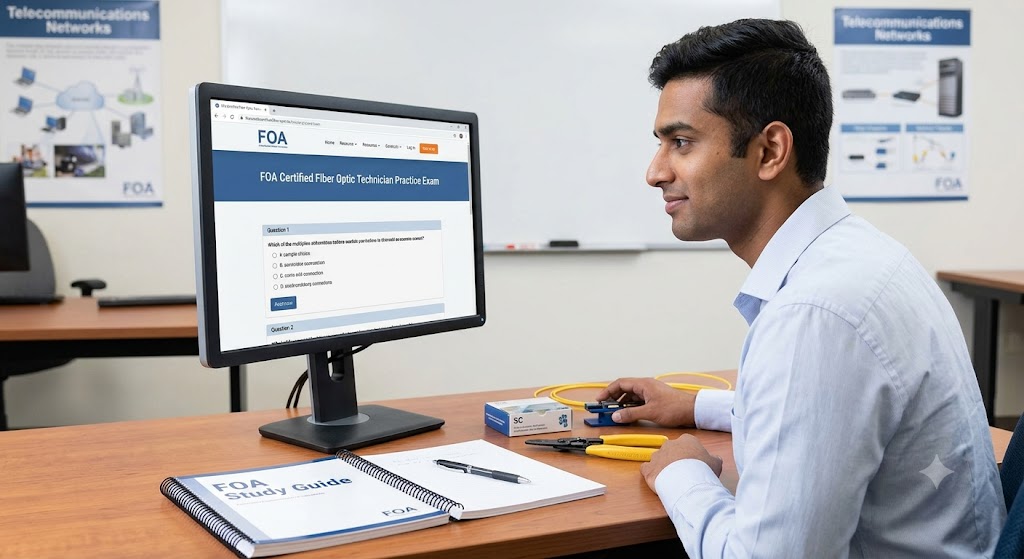
Additional Information
What the Course Entails and Exam Details
The course of study for the FOA CFOT exam covers a broad spectrum of fiber optic knowledge. Students and professionals preparing for this certification must gain proficiency in several core areas, including:
Fiber optic history and applications in telecommunications and data networking.
The basics of light propagation, including reflection and refraction.
Optical fiber construction, types (singlemode and multimode), and classifications.
Fiber optic cables, including different designs for indoor and outdoor use, and proper handling procedures.
Connectors and splices, detailing the various types, installation methods, and loss factors.
Fiber optic installation techniques and best practices, including safety considerations.
Testing fiber optic components and systems, focusing on loss testing and troubleshooting using equipment like optical loss test sets (OLTS) and optical time-domain reflectometers (OTDRs).
The written exam typically consists of multiple-choice questions designed to assess the candidate's understanding of these theoretical and practical concepts.
What to Expect in the Final Exam
The FOA CFOT exam is a comprehensive assessment of your knowledge in fiber optics. While specific details might vary slightly by testing location, you can generally expect the following format for the written portion of the exam:
Format: The written exam is usually composed of 100 multiple-choice questions.
Time Limit: Candidates are typically given 1 to 2 hours to complete the examination.
Passing Score: A passing score is usually around 70%, though candidates should aim for higher comprehension to succeed in the industry.
Content: The questions cover all the topics outlined in the syllabus, requiring candidates to understand everything from basic theory to practical application, testing procedures, and safety standards.
For full certification, candidates may also be required to complete a hands-on skills assessment through an approved training program to demonstrate their ability to install connectors and perform splices according to industry standards.
How to Study and Exam Centers
Preparation is crucial for success in the FOA CFOT exam. Here are actionable study strategies:
Utilize Official FOA Resources: The primary study materials should include the FOA Reference Guide to Fiber Optics and the official FOA online training resources available through their website.
Practice with Mock Exams: Engaging with FOA practice tests and sample questions is one of the most effective ways to identify knowledge gaps and get accustomed to the format and style of the exam.
Review Practical Skills: If possible, gain hands-on experience with fiber optic tools and equipment. Understanding the practical applications of the theory you study is essential.
Take an FOA-Approved Course: Many candidates find that enrolling in an FOA-approved training course at a dedicated fiber optic school is the best way to prepare for both the written and hands-on portions of the exam.
FOA exams are typically administered by authorized FOA schools and training organizations worldwide. Upon completion of an approved training course, the school usually proctors the CFOT exam. You can find a list of approved schools on the official FOA website.
Job Opportunities from the Course
Earning the FOA CFOT certification opens doors to various roles in the telecommunications and data networking industries. Some of the specific job titles and career paths this certification unlocks include:
Fiber Optic Technician
Fiber Optic Cable Installer
Telecommunications Technician
Network Installer
Fiber Optic Splicer
Broadband Technician
Network Engineer (Entry-Level)
Outside Plant (OSP) Technician
This certification is often required or strongly preferred by employers working on large-scale infrastructure projects, data centers, and broadband network deployments.
Related Quizzes
310T Drive Trains Practice Exam599
310T Truck and Coach Technician Exam
2391-52 Inspection and Testing Practice Exam
Aquatic Facility Operator AFO Practice Exam
Aramco Asphalting Practice Test
Frequently Asked Questions
Reviews
5.0
Based on 0 reviews
Leave a Review
No reviews yet. Be the first to review!