
Florida CDL Practice Test 2
$69.00
- Buy to unlock unlimited access to all Quiz questions.
- After purchase you can print a PDF of the whole quiz at any point. The PDF will contain the questions and the correct answers.
About this Exam
The Florida Commercial Driver's License (CDL) is a mandatory certification required to operate large, heavy, or placarded hazardous material vehicles within the state and across the nation. This practice exam is expertly designed for aspiring commercial drivers, including freight haulers, bus operators, and specialized vehicle drivers, who must demonstrate a comprehensive understanding of federal and Florida-specific safe driving regulations. Successfully passing the official state exams is the critical first step toward unlocking a rewarding and vital career in the transportation industry.
Ready to test your knowledge?
Buy Now to Access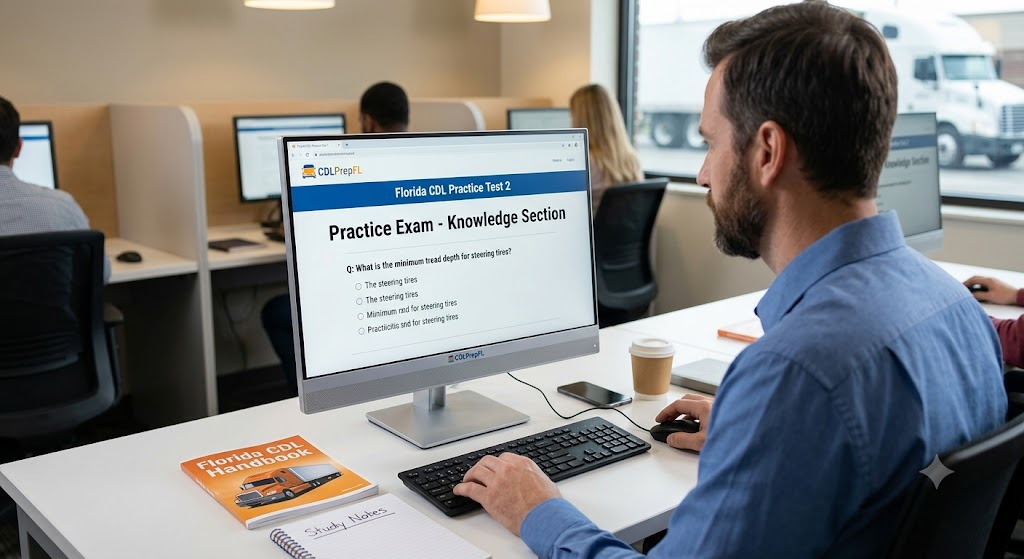
Additional Information
What the Course Entails and Exam Details
This practice test acts as a vital simulation for the multiple written knowledge exams you must pass to obtain your Commercial Learner's Permit (CLP). "Florida CDL Practice Test 2" typically serves as a comprehensive review, covering key material from the Florida CDL Handbook, including:
General Knowledge: Basic control of your vehicle, shifting gears, space management, seeing and communicating effectively, and recognizing hazards.
Safe Driving Practices: Techniques for driving in diverse conditions, such as night, fog, winter, and hot weather, as well as mountain driving and managing speed.
Cargo and Vehicle Systems: Rules for transporting cargo safely, vehicle inspections (pre-trip, en route, and post-trip), and basic hazardous materials regulations.
Air Brakes (if applicable): The components of an air brake system, how they work, and critical safety checks.
Combination Vehicles (for Class A): Driving combinations safely, coupling and uncoupling.
Endorsement-Specific Topics: Depending on your career goals, this may include sections on transporting passengers (Passenger), school kids (School Bus), liquids in bulk (Tanker), and hazardous materials (HazMat).
What to Expect in the Final Exam
The actual Florida CDL knowledge exam is administered as a series of standalone, multiple-choice tests at an official state testing facility. You will take the core General Knowledge test, plus separate tests for any specific endorsements you require.
Format: Computer-based multiple-choice questions.
Question Count: The General Knowledge test typically consists of 50 questions. Endorsement tests vary, often ranging from 20 to 30 questions each.
Passing Score: You must achieve a minimum score of 80% on each individual test to pass.
Time Limit: While there isn't a single, rigid timer for the entire session, individual test sections are generally self-paced, allowing reasonable time to complete the questions, but are often scheduled within a specific appointment block.
Rules: The test is closed-book. No outside materials or electronic devices are permitted during the examination. You must provide official, valid identification and meet all Florida residency and medical requirements before testing.
How to Study and Exam Centers
The key to passing is thorough preparation. We recommend a structured study method:
Step 1: Master the Florida CDL Handbook: Read this manual cover-to-cover. Every question on the official exam is derived directly from its contents.
Step 2: Use Practice Tests Regularly: Engage with reliable practice exams like this one to identify weak areas, understand question formats, and build test-taking stamina. Treat each session as a dress rehearsal.
Step 3: Review Explanations: When you miss a practice question, understand why. Use the detailed explanations provided to learn the concept, not just the correct answer.
Taking the Exam: In Florida, you must schedule and take your CDL written knowledge tests at a Florida Department of Highway Safety and Motor Vehicles (FLHSMV) location or a cooperating County Tax Collector's office that offers driver license services. It is essential to check their specific websites to make an appointment. After successfully passing all required written tests and holding your Commercial Learner's Permit (CLP) for at least 14 days, you must then schedule and pass the specialized CDL Skills Test (pre-trip inspection, basic control, and road driving) through an authorized third-party testing provider or specific state-run sites.
Job Opportunities from the Course
Earning your CDL in Florida opens the door to a diverse and robust range of career opportunities within one of the state's most critical economic sectors. Here are some of the specific job titles you can pursue:
Class A Tractor-Trailer Driver (Over-the-Road or Regional)
Class B Truck Driver (Local Delivery, Construction, or Waste Management)
Owner-Operator Truck Driver
Specialized Cargo Hauler (Flatbed, Reefer, Tanker)
Hazardous Materials (HazMat) Transport Driver
Motorcoach or Charter Bus Driver
School Bus Driver
Local Transit Authority Bus Operator
Municipal Service Vehicle Operator (Dump Truck, Street Sweeper)
Airport Shuttle Driver
Delivery/Route Driver (Class A, B, or C depending on vehicle size)
Frequently Asked Questions
Reviews
5.0
Based on 0 reviews
Leave a Review
No reviews yet. Be the first to review!